Pan Thickness, Explained: Why Cheap Pans Warp
Gauge, cladding and disc bases decide whether a pan stays flat. Here's how pan thickness actually works, and how to spot a warper before you buy in 2026.
Reader-supported: we may earn a commission from links on this page, at no extra cost to you. It never affects our picks. Learn more.
The pop you hear is physics, not bad luck
Almost everyone has heard it: a pan goes on a hot burner, and thirty seconds later there's a metallic tonk as the base domes up and starts spinning on the glass top. Oil slides to the rim. The egg cooks in a ring. The usual reaction is to blame the cook — "you heated it too fast" — and that's partly fair. But the deeper truth is that some pans are built to survive fast, uneven heating and some are not, and you can tell the difference before you ever turn on a burner.
Warping is a stress problem. Metal expands when it's hot. If one part of a pan's base gets hot much faster than the part an inch away, the hot region tries to grow while the cool region holds it back. The metal relieves that stress by bending. If the stress exceeds the metal's yield point, the bend is permanent. Everything about pan construction — gauge, cladding, disc bases, rim treatment — is either helping that stress spread out or letting it concentrate.
What's actually going on when a pan warps
Two mechanisms do most of the damage, and they're worth separating because they call for different pans.
The first is thermal shock: a hot pan hits cold water, or a frozen protein hits a ripping-hot surface. Cooking guidance on warping consistently points to sudden temperature swings as the leading cause, and it's the easiest to avoid — let the pan cool before it meets the sink.
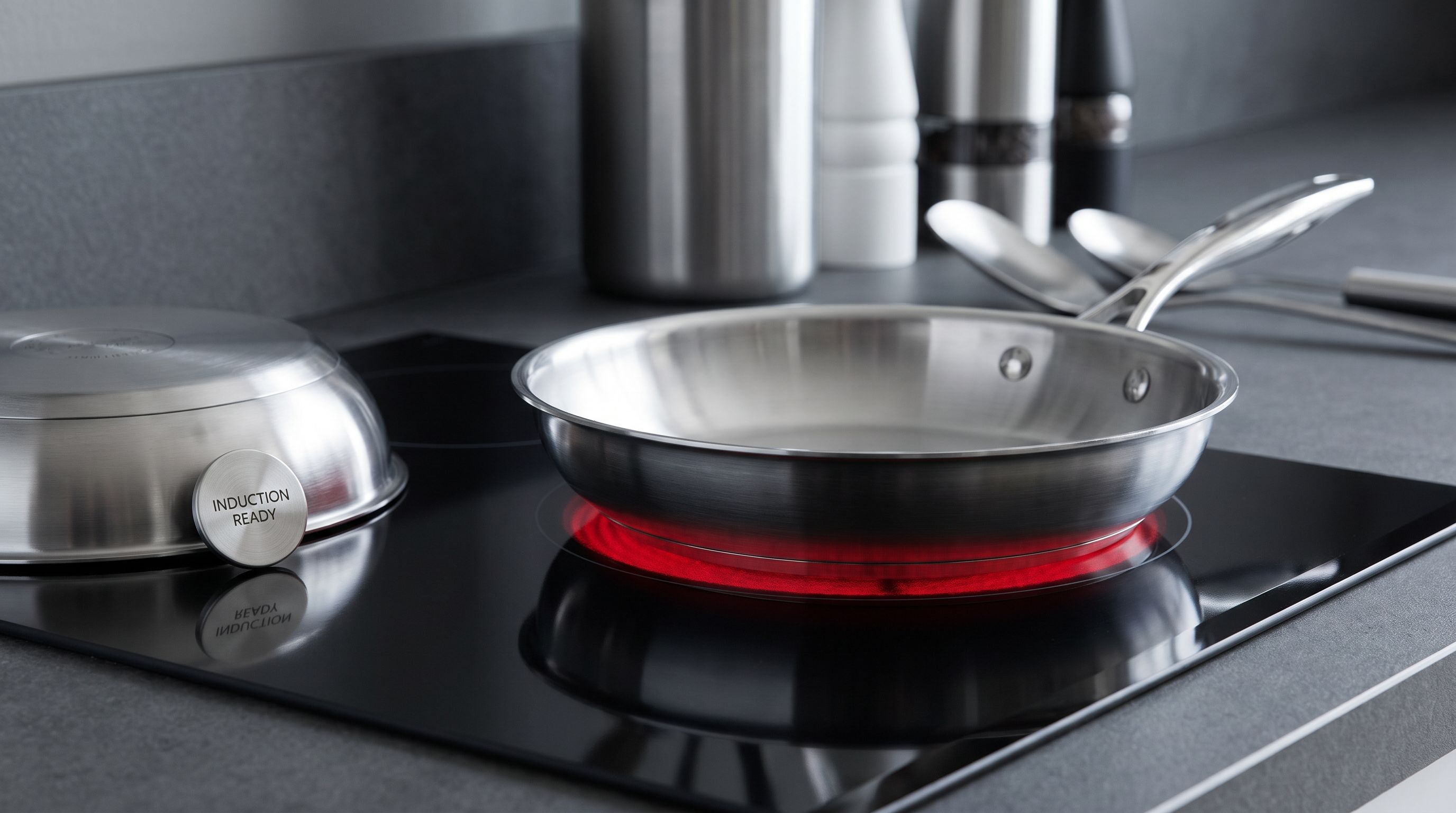
The second is uneven heating, and it's the one thickness fixes. A gas flame touches a ring; an induction hob energizes a coil zone; a smooth-top radiant element heats a disc narrower than the pan. In all three cases the center or a ring of the base gets energy first. Cookware explainers repeatedly flag induction as a common culprit for exactly this reason — the heat arrives fast, directly in the metal, and a thin base has nowhere to put it. Reports from home cooks on glass smooth-tops describe large frying pans going convex almost immediately, which is the same story with a different heat source.
Thickness is the buffer. As Mac Kohler of Blanc Creatives has put it in writing about warped pans, thin pans are far more likely to warp than thickly constructed ones because more material within the thickness gives the thermal energy somewhere to go. More mass means heat spreads sideways before the hot spot can out-expand its neighbors, and it means more section stiffness resisting the bend. Both effects pull in the same direction.
Aluminum matters here beyond weight. It conducts roughly three to four times better than stainless steel, which is why nearly every serious stainless pan is a stainless-aluminum sandwich rather than solid steel. The aluminum is the heat spreader; the steel is the cooking surface and the structure.
The real players, and what their construction actually does
The cookware market splits into three construction families, and each fails — or doesn't — in a characteristic way.
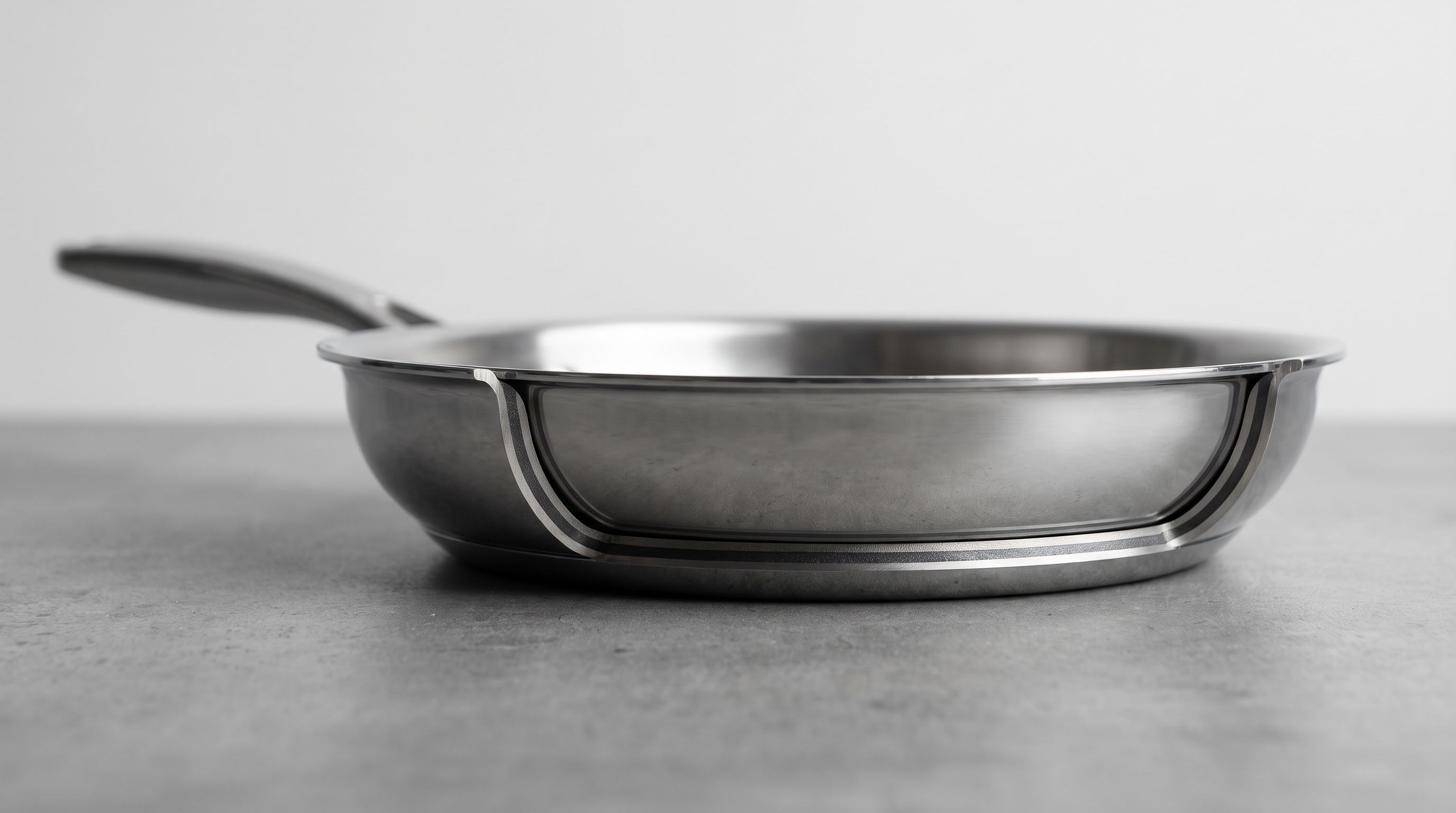
Fully clad means the stainless/aluminum/stainless sandwich runs from the base up the sidewalls as one bonded sheet. All-Clad's D3 line is the reference product for this; Tramontina's Tri-Ply Clad is the mass-market version of the same idea and is why clad construction stopped being a luxury-only feature. Because there's no seam between base and wall, there's no interface for differential expansion to pry apart. These pans can still bow slightly when abused, but they tend to relax back as they heat evenly.
Disc-bottom pans are a thin stainless body with a thick aluminum or aluminum-and-steel puck bonded to the underside. Demeyere and Fissler build excellent versions, and most restaurant-supply stainless is disc-bottom. The engineering tradeoff is honest: a disc base can be thicker than most clad bases for the money, but the disc and the body are different metals meeting at a hard edge. On very cheap examples that joint is where things go wrong over time.
Monolithic heavy pans — cast iron and carbon steel — solve the problem by brute force. A Lodge 10.25-inch cast iron skillet has no bonded layers to fight each other and enough mass that localized heating barely registers as stress. Carbon steel is thinner and does flex, which is why new carbon pans often arrive with a slight dome; it usually settles with seasoning and gentle heat cycling, and it is not the same failure as a permanently buckled stainless base.
Sheet pans deserve their own note because the same physics applies in cheaper metal. The standard commercial answer — heavy-gauge aluminum with a rolled wire rim, the Nordic Ware Naturals half sheet being the familiar consumer version — works because the rolled rim acts as a stiffening flange around the whole perimeter. Thin steel cookie sheets with a flat or minimally turned edge have no such flange, which is why they're the pans that bang in a 450°F oven.
| Construction | Where the thickness is | Typical warp behaviour | Trade-off |
|---|---|---|---|
| Fully clad tri-ply | Base and walls, bonded | Resists; no base-to-wall seam | Costs more per pan |
| Disc-bottom | Thick puck under thin body | Good until the bond is stressed | Heat stops at the disc edge |
| Thin stamped stainless/nonstick | Minimal anywhere | Most likely to dome permanently | Light, cheap, short-lived |
| Cast iron | Everywhere, single piece | Very resistant | Heavy, slow to change temperature |
| Rolled-rim aluminum sheet | Thin sheet, stiff rim | Rim does the structural work | Not for stovetop use |
What this means if you're shopping today
Weight in the hand is still the fastest proxy, but it's a crude one — a heavy handle skews it. Better checks:
Look at the cut edge. On a clad pan you can usually see the layers at the rim: steel, a thicker lighter band, steel. If the rim is a single thin line, the pan is stamped, and the base may carry a bonded disc you can't see from above.
Check the base edge in profile. Set the pan on a counter at eye level. A disc base reads as a visible step. Measure that step against your thumbnail — roughly 2mm or less of total base material is thin for a stovetop pan of any size.
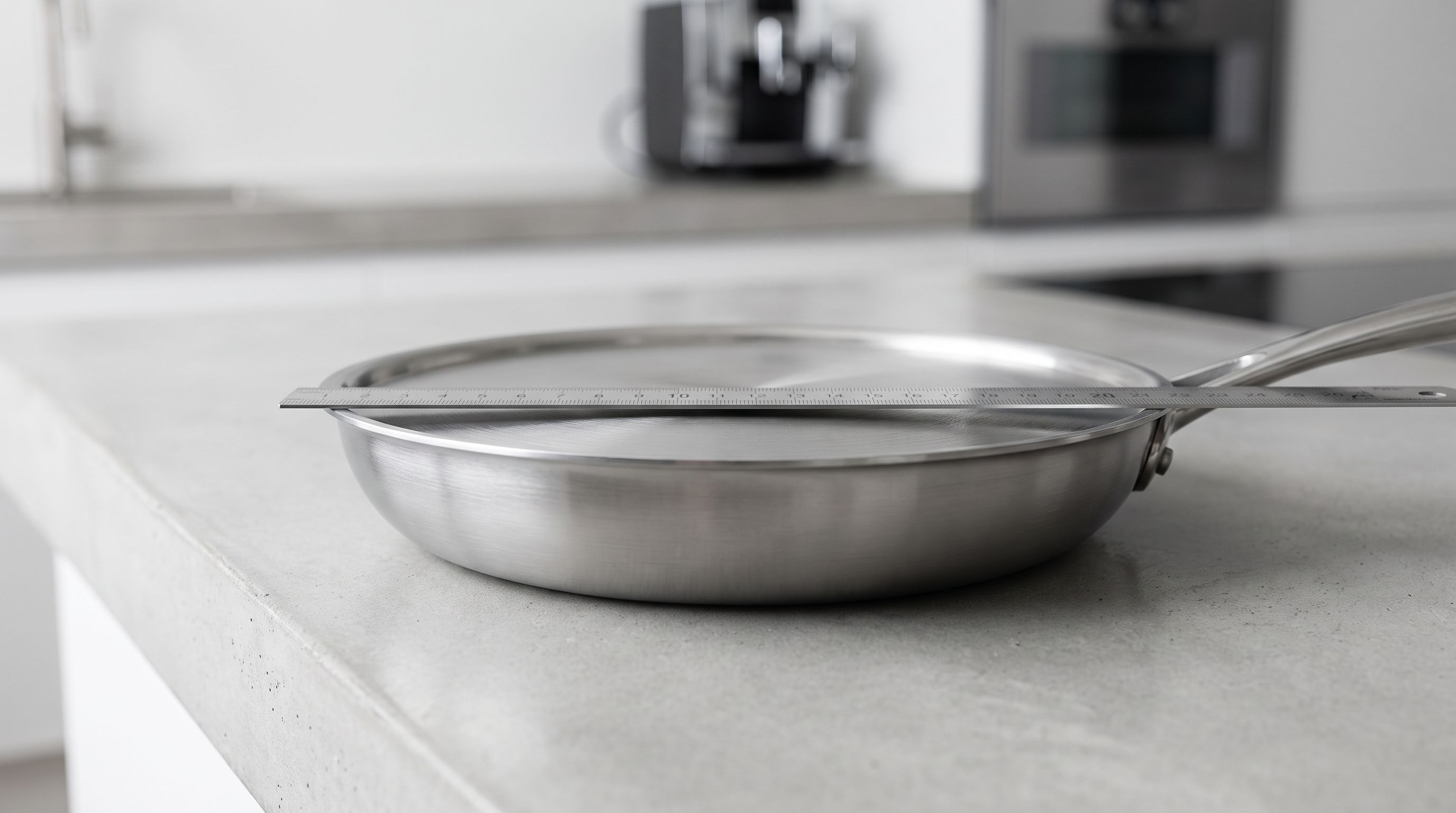
Test flatness before cooking. Put the pan on a flat countertop and press one edge. Rocking means it's already not flat. On a glass top you can also slide a ruler across the base and look for light underneath.
Size the pan to the burner, not the recipe. A 12-inch pan on a 6-inch element is a warp waiting to happen regardless of brand. Induction especially rewards matching pan diameter to coil diameter.
Read the nonstick spec honestly. A nonstick pan's coating will almost always fail before the body does, but a thin-bodied nonstick pan warps first and then the coating fails faster because contact with the heat source becomes uneven. Thickness is a coating-longevity spec, not just a flatness spec.
What to watch next
Three things are shifting the picture in 2026. Induction adoption keeps rising, which pushes manufacturers toward thicker, flatter, magnetically uniform bases — induction punishes the compromises gas forgives. Multi-ply marketing is escalating, with five-ply and seven-ply lines widespread; more layers is not automatically better, because what matters is total base thickness and how much of it is aluminum or copper rather than the layer count on the box. And at the budget end, "warp-resistant" is becoming a marketing claim rather than a measurable one — there's no industry test standard behind it, so treat it as a prompt to go measure the base yourself.
The practical conclusion hasn't changed and probably won't: thickness and continuous construction are what keep a pan flat, and both are visible at the rim and the base edge before you buy.
FAQ
Can a warped pan be fixed? Sometimes, cosmetically. Gentle, even reheating can relax mild bowing in clad pans, and sheet pans occasionally flatten with slow cooling. Once stainless has yielded past its elastic limit, it's permanent.
Is heating a pan empty what causes warping? It contributes. An empty pan on high heat has no food or liquid to absorb energy, so the base reaches extreme temperature fast and unevenly. Preheating on medium, with the burner sized to the pan, is the standard advice.
Does cast iron ever warp? Rarely, but it can crack — the brittle failure mode instead of the bending one. Thermal shock on enameled cast iron, like water into a dry hot pot, is the common way people damage it.
Is a disc base always worse than clad? No. A thick disc base can out-perform a thin clad pan for flatness. The disc's real limitation is that heat largely stops at the disc edge, so sidewalls stay cooler.
How thick should a sheet pan be? There's no single number to trust from marketing copy, but heavy-gauge aluminum with a rolled steel rim is the restaurant standard for a reason, and that rim is the part doing the structural work.
Our picks

All-Clad D3® Stainless Steel 10" Fry Pan with Lid, Made in the USA
Three-ply stainless-aluminum-stainless bonded wall-to-wall — the construction warp advice usually points to.

Tramontina Signature Tri-Ply Clad Stainless Steel 12-Inch Large Frying Pan
Same stainless/aluminum/stainless sandwich idea at a far lower cost, widely available in 10 and 12 inch.

Lodge Pre-Seasoned Cast Iron Skillet with Hot Handle Holder, 10.25 Inches
Heavy single-piece cast iron has no bonded layers to fight each other, which is why it rarely goes convex.

Nordic Ware Naturals Half Sheet - USA Made Aluminum Commercial Quality Sheet Pan for Baking or Roasting, Encapsulated Galvanized Steel Rim Prevents Warping, 2-Pack
Heavy-gauge aluminum with a rolled steel rim — the standard answer to oven pans that buckle and pop.
Get the best kitchen gear deals in your inbox
Join the PrepDeck newsletter for hand-picked kitchen gear deals and new buying guides. No spam, unsubscribe anytime.
Related reads
Induction Compatibility, Explained: What Actually Works
Why some "induction-ready" pans heat slowly, buzz, or trip error codes — plus the magnet test, base construction basics, and which cookware genuinely performs in 2026.
Pan Warping, Explained: Gauge, Cladding, and Flatness
Why cheap pans warp on induction and glass tops in 2026 — how gauge, cladding, and disc bases behave, plus how to spot a pan that won't stay flat.
Cookware Sets Under $500 in 2026: The Piece-Count Math
The best cookware set under 500 in 2026, judged by usable pans — not padded lid counts. Cladding, oven limits, and induction compatibility compared.