Pan Warping, Explained: Gauge, Cladding, and Flatness
Why cheap pans warp on induction and glass tops in 2026 — how gauge, cladding, and disc bases behave, plus how to spot a pan that won't stay flat.
Reader-supported: we may earn a commission from links on this page, at no extra cost to you. It never affects our picks. Learn more.
The pan didn't fail. The physics did.
There's a specific sound that tells you a pan has given up: the tok of a skillet rocking on a glass cooktop, or the startling bang of a sheet pan popping in a 425°F oven. Neither is a defect in the usual sense. Both are metal doing exactly what metal does when one part of it gets hot faster than the part next to it.
Warping is the most common way inexpensive cookware dies, and it's almost entirely predictable from three things you can check before you buy: how thick the metal is, how the heat-conducting layer is attached, and how the pan is being heated. The marketing copy on the box rarely tells you any of them directly. But the clues are there if you know what you're looking at.
What's actually happening now
Warping has always existed. What changed is the heat source. Induction hobs and smooth glass-ceramic tops have become the default in a lot of new kitchens, and both are unforgiving in ways coil burners never were.
Induction doesn't heat the pan from below — it heats the ferromagnetic layer inside the pan, directly and very fast. Cookware guidance and repair writeups consistently point to rapid heating on induction as a leading cause of warped frying pans, including on enameled cast iron, where thermal shock can damage the coating as well as the body. A high-power induction element dumping energy into a thin disc base creates a steep temperature gradient between the center and the rim in seconds. Metal expands when it's hot. If the middle expands while the edge is still cool, something has to give, and the base buckles.
Glass tops compound the problem differently. Home cooks on smooth tops report fry pans "bowing up" in the center — once a pan is convex, it rocks, contact with the flat surface becomes a ring instead of a disc, and the heating gets more uneven, which accelerates the deformation. The same loop happens in ovens: uneven heating makes different regions expand and contract at different rates, which is why a cold-water splash or a tray of frozen food on a hot sheet pan triggers the classic pop.
The mechanical principle underneath is straightforward, and cookware makers describe it the same way: thin pans warp more readily than thick ones because there's simply less material to absorb and spread the thermal energy before a gradient forms. Heavier gauge means more mass, slower gradients, and more stiffness resisting the bending force.
The real players, and what they actually ship
Three construction types dominate what's on shelves, and they fail in different ways.
Fully clad (bonded) cookware bonds an aluminum core between stainless layers across the entire pan — base and walls. All-Clad's D3 line is the long-standing reference for this: three-ply, no separate base plate, conductive metal running up the sides. Tramontina's Tri-Ply Clad line uses the same basic architecture at a much lower position in the market, and Made In and Misen ship comparable bonded stainless. The advantage for flatness is structural: there's no joint between a base and a body, so there's no place for differential expansion to concentrate.
Disc-base (impact-bonded) cookware takes a thin stainless or aluminum body and attaches a thick conductive disc to the bottom. Demeyere's industrial-style pieces and many commercial stockpots do this very well with a substantial disc. Budget sets do it badly with a thin one. The disc and the body expand at different rates, and that bimetallic mismatch is exactly the mechanism that bows a base upward over time. If a pan has a visible seam or ridge where the bottom plate meets the sidewall, you're looking at a disc base.
Single-material heavy cookware — cast iron like the Lodge 10.25-inch skillet, or thick carbon steel such as Matfer Bourgeat and de Buyer pans — sidesteps cladding entirely. Cast iron is far too thick and rigid to bow; its failure mode is cracking under genuine thermal shock, not warping. Carbon steel can warp, because it's thinner, and it's well known to do so when heated hard and fast or quenched — but it's also the material that typically relaxes back with careful, even reheating.
For bakeware, the equivalent of cladding is the rim. Nordic Ware's Natural Aluminum Commercial Baker's Half Sheet uses heavy-gauge aluminum with a steel wire rolled into the edge, which stiffens the perimeter against the bending moment that causes the pop.
| Construction | Typical warp behavior | Tell-tale sign |
|---|---|---|
| Fully clad 3-ply (All-Clad D3, Tramontina Tri-Ply) | Resistant; no base-to-body joint | Uniform edge thickness, visible layers at the rim |
| Thin disc base (budget sets) | Most common warper; bows convex | Seam or lip where base meets sidewall |
| Heavy disc base (commercial-style) | Good, if the disc is genuinely thick | Substantial, dead-flat plate |
| Cast iron (Lodge) | Won't bow; can crack on shock | Obvious mass and weight |
| Carbon steel (de Buyer, Matfer) | Can warp when heated hard | Thin, light, springy feel |
| Rolled-rim aluminum sheet (Nordic Ware) | Strong resistance to oven pop | Steel wire inside the folded edge |
What it means if you're shopping today
Weight remains the single most honest spec in cookware, and nobody prints it on the front of the box. Pick the pan up. Within a size class, the heavier pan has more gauge, and more gauge means slower, gentler temperature gradients.
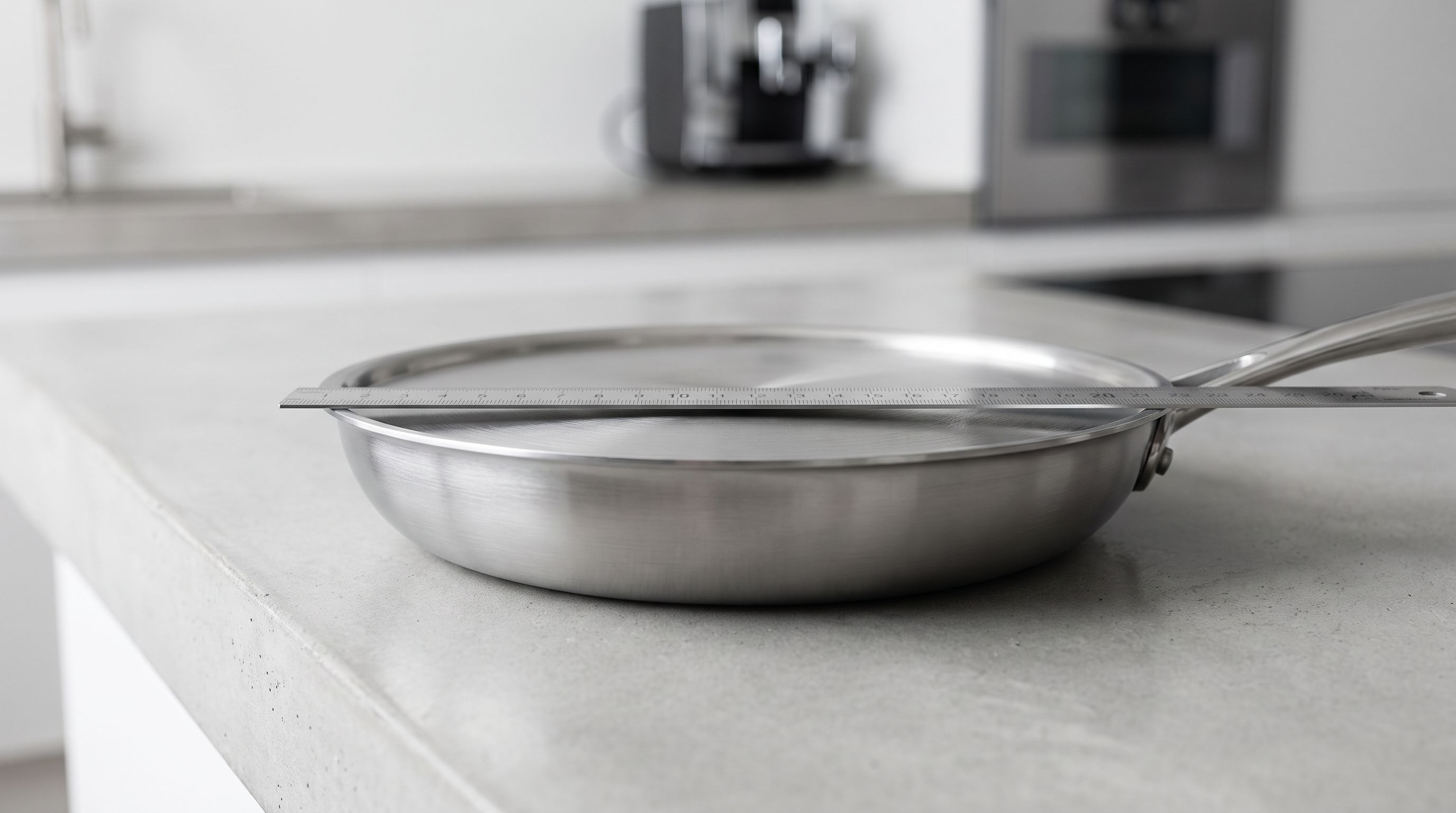
Run a straightedge test where you can. A ruler or the edge of another pan laid across the base will show daylight in the center or at the edges if the pan isn't flat. Plenty of pans are sold slightly concave on purpose, because the center rises as it heats; a pan that's already convex cold will only get worse.
Check the rim for layers. A fully clad pan shows its laminate at the cut edge. A disc-base pan shows a sharp transition near the bottom. Neither is automatically wrong, but the disc base is where thin, cheap construction hides.
Then consider your hob. If you cook on induction, a thin disc-base nonstick pan is a poor match regardless of what the listing claims about "induction ready." Preheating on medium rather than max, and never pouring cold liquid into a ripping-hot pan, does more for longevity than any coating technology. The r/cookware consensus is blunt about the causes: uneven heating, uneven cooling, rapid change in either direction, overheating, or an inconsistent thickness built into the pan itself.
What to watch next
Two things are worth tracking. First, induction manufacturers are leaning harder into power-management features — bridge zones, pan-detection sizing, and lower-power simmer settings — which reduce the gradient problem at the source rather than asking cookware to absorb it. Second, the economics of bonded construction keep improving; lines that would have been premium-only a decade ago now have mid-market equivalents from Tramontina and others, which quietly makes the warp-prone thin disc pan harder to justify at any price.
What won't change is the underlying tradeoff: mass costs money and weight, and it's the only reliable defense. A pan that stays flat is a pan with enough metal in it to refuse to bend.
FAQ
Can a warped pan be fixed? Sometimes, and mostly for carbon steel or aluminum sheet pans — gentle, even reheating and careful flattening is the usual approach described by cooks. Clad stainless and nonstick pans are generally not worth attempting; on nonstick, the coating is the limiting factor anyway.
Is a slightly concave new pan a defect? Not necessarily. Some makers build in a small concavity so the base sits flat once it's hot. A base that's already domed upward when cold is the one to avoid.
Does nonstick warp more than stainless? Nonstick pans are often thinner and lighter at a given price, and thin construction warps more readily. The coating itself doesn't cause warping, but the build quality that typically accompanies budget nonstick does.
Will cast iron warp on induction? Bowing is essentially a non-issue given the thickness. The real risk with cast iron and especially enameled cast iron is thermal shock — rapid heating or cold liquid into a hot pan — which can crack the body or damage enamel.
Our picks

All-Clad D3® Stainless Steel 10" Fry Pan with Lid, Made in the USA
Fully clad three-ply construction with no disc edge — the classic point of comparison for flatness.
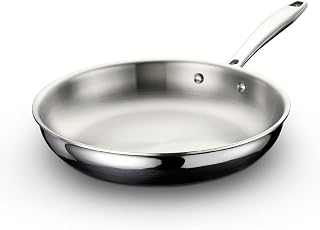
Tramontina Signature Tri-Ply Clad Stainless Steel 10-Inch Frying Pan
Full three-ply body in a widely available line, a sane entry point into bonded cookware.

Lodge Pre-Seasoned Cast Iron Skillet with Hot Handle Holder, 10.25 Inches
Thick single-material casting; it will crack before it bows, but it needs gentle heat changes.

Nordic Ware Naturals Half Sheet - USA Made Aluminum Commercial Quality Sheet Pan for Baking or Roasting, Encapsulated Galvanized Steel Rim Prevents Warping, 2-Pack
Heavy-gauge aluminum with a rolled steel rim — the standard answer to warping bakeware.
Get the best kitchen gear deals in your inbox
Join the PrepDeck newsletter for hand-picked kitchen gear deals and new buying guides. No spam, unsubscribe anytime.
Related reads
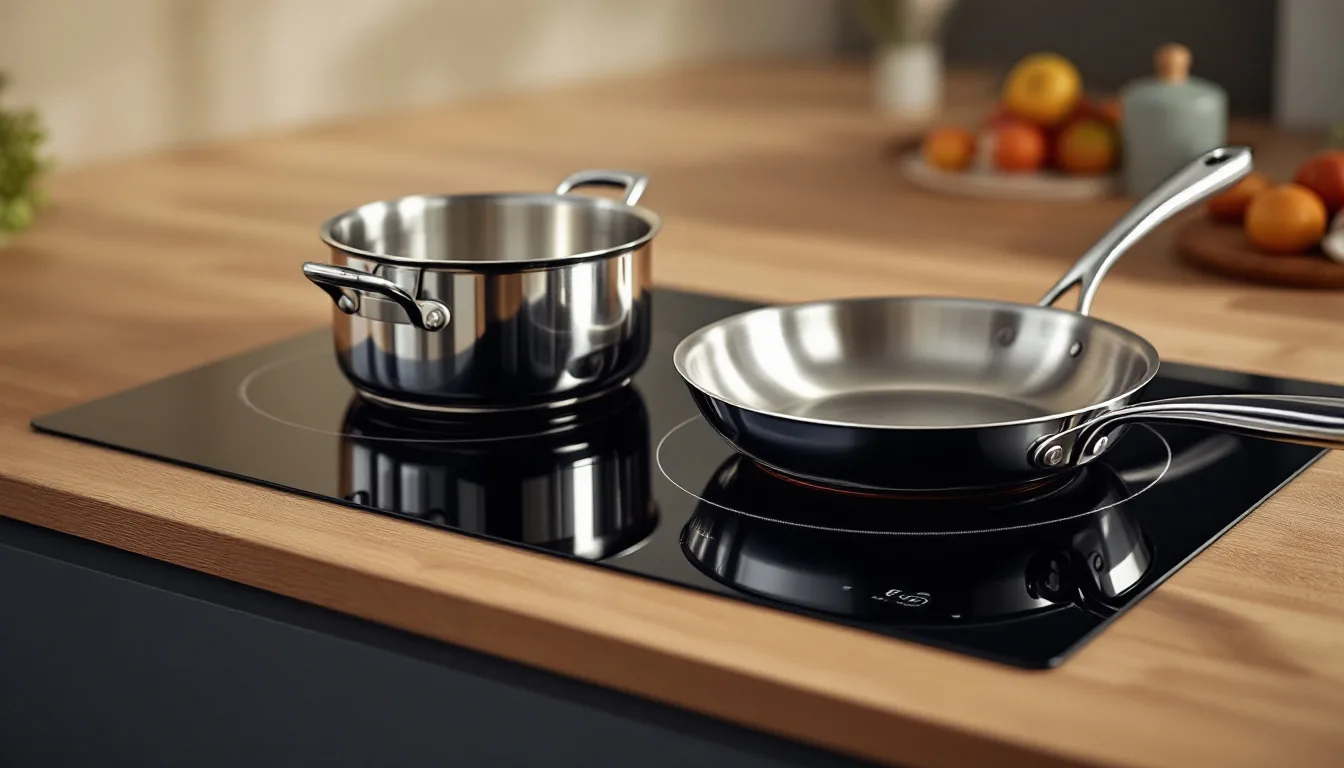
Induction Cookware Sets in 2026: What Passes the Magnet Test
The best induction cookware set for your hob depends on base construction, not marketing. How cladding, disc bases and warping work — plus 4 sets that qualify.
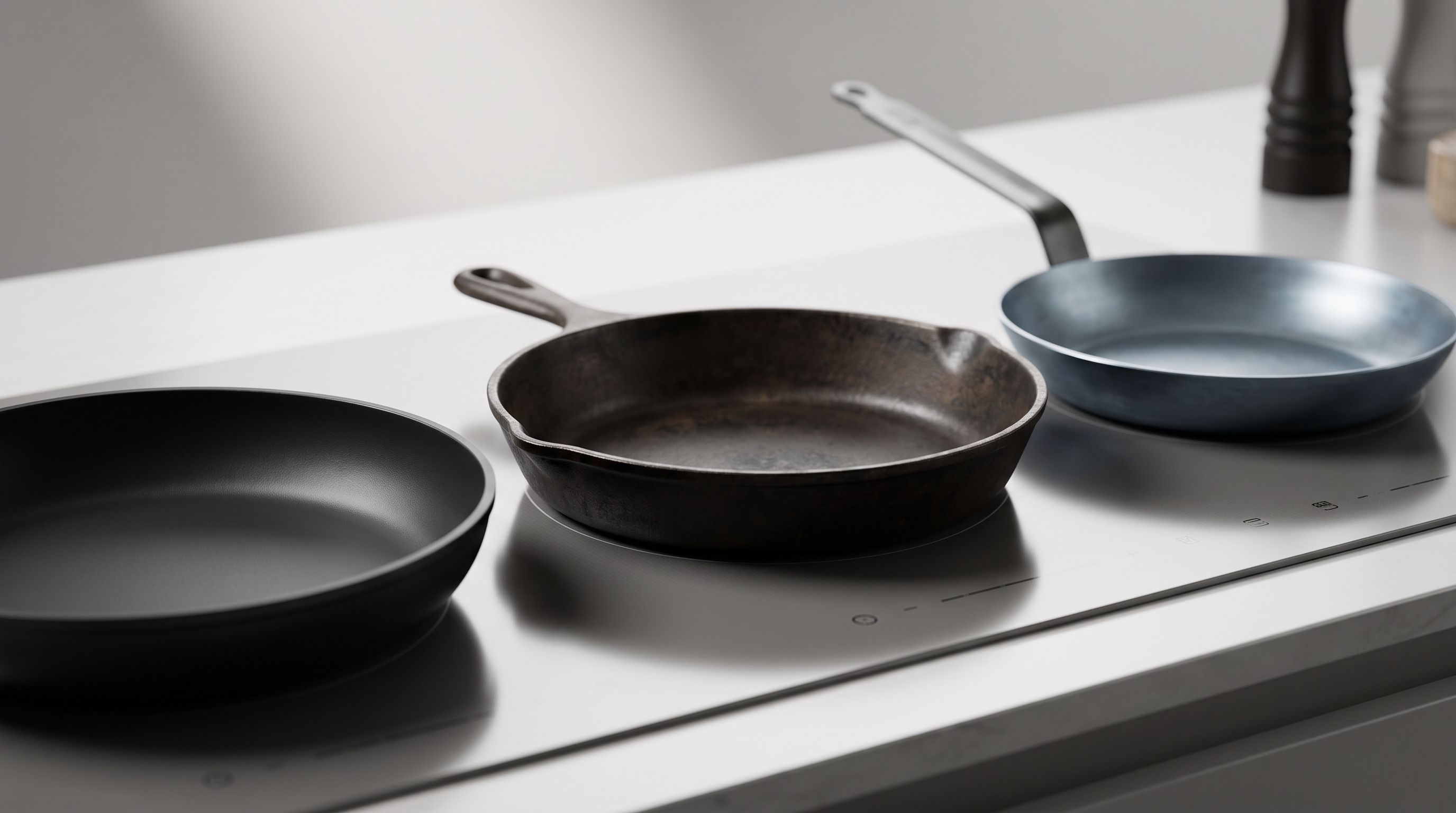
What Actually Lasts: Nonstick vs. Cast Iron vs. Carbon Steel
Nonstick coatings wear out, cast iron outlives you, carbon steel splits the difference. Here's what actually destroys each pan — and the honest trade-offs in 2026.
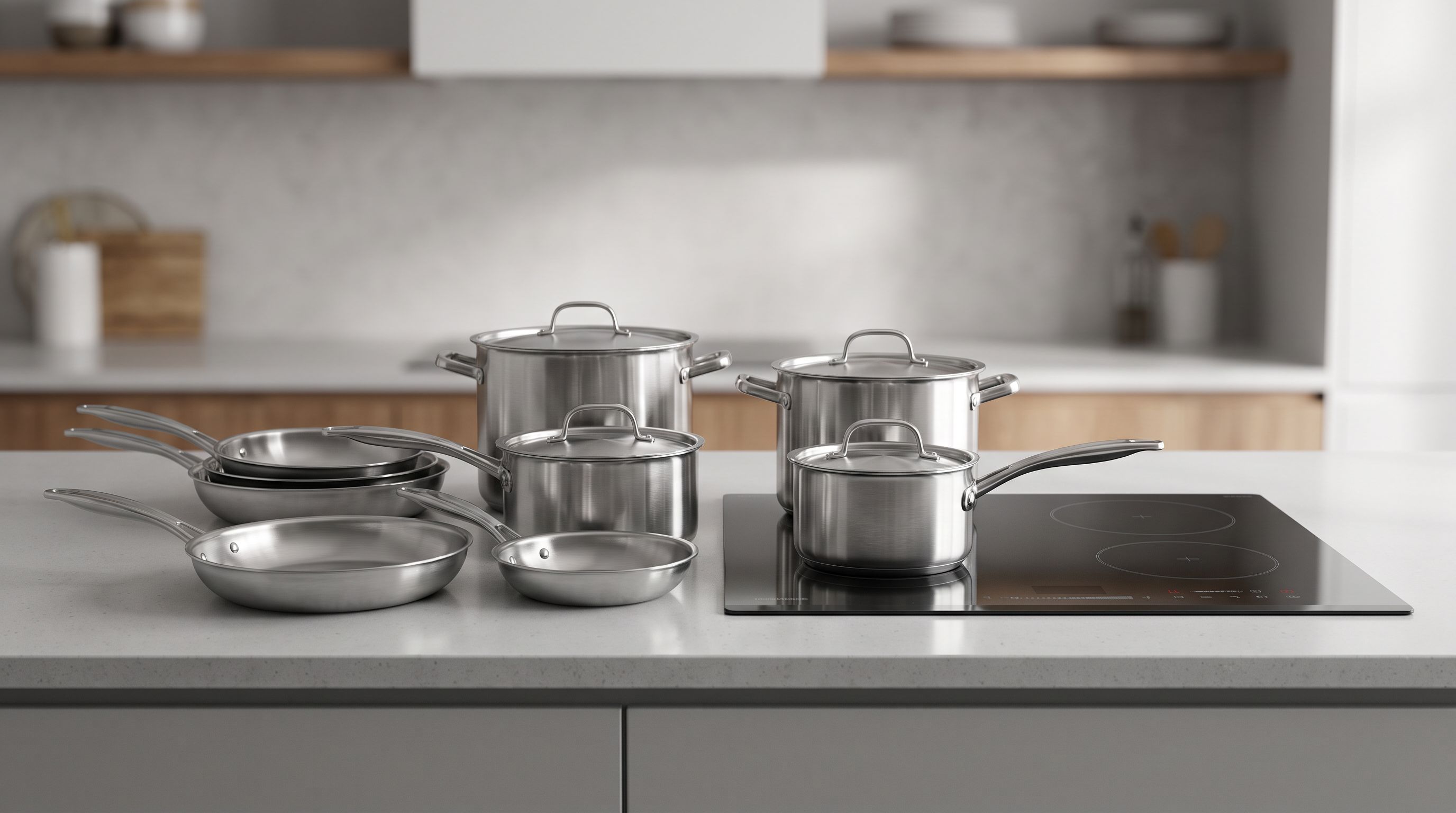
Stainless Cookware Sets 2026: Stop Paying for Lids
The best stainless steel cookware set 2026 picks compared on real usable piece count, handle comfort, oven limits and induction compatibility — not lid math.