Offset Smoker Buying Guide 2026: Steel Gauge Decides
Our 2026 offset smoker buying guide explains why steel thickness, firebox volume and reverse flow decide temperature stability — plus four picks worth buying.
Reader-supported: we may earn a commission from links on this page, at no extra cost to you. It never affects our picks. Learn more.
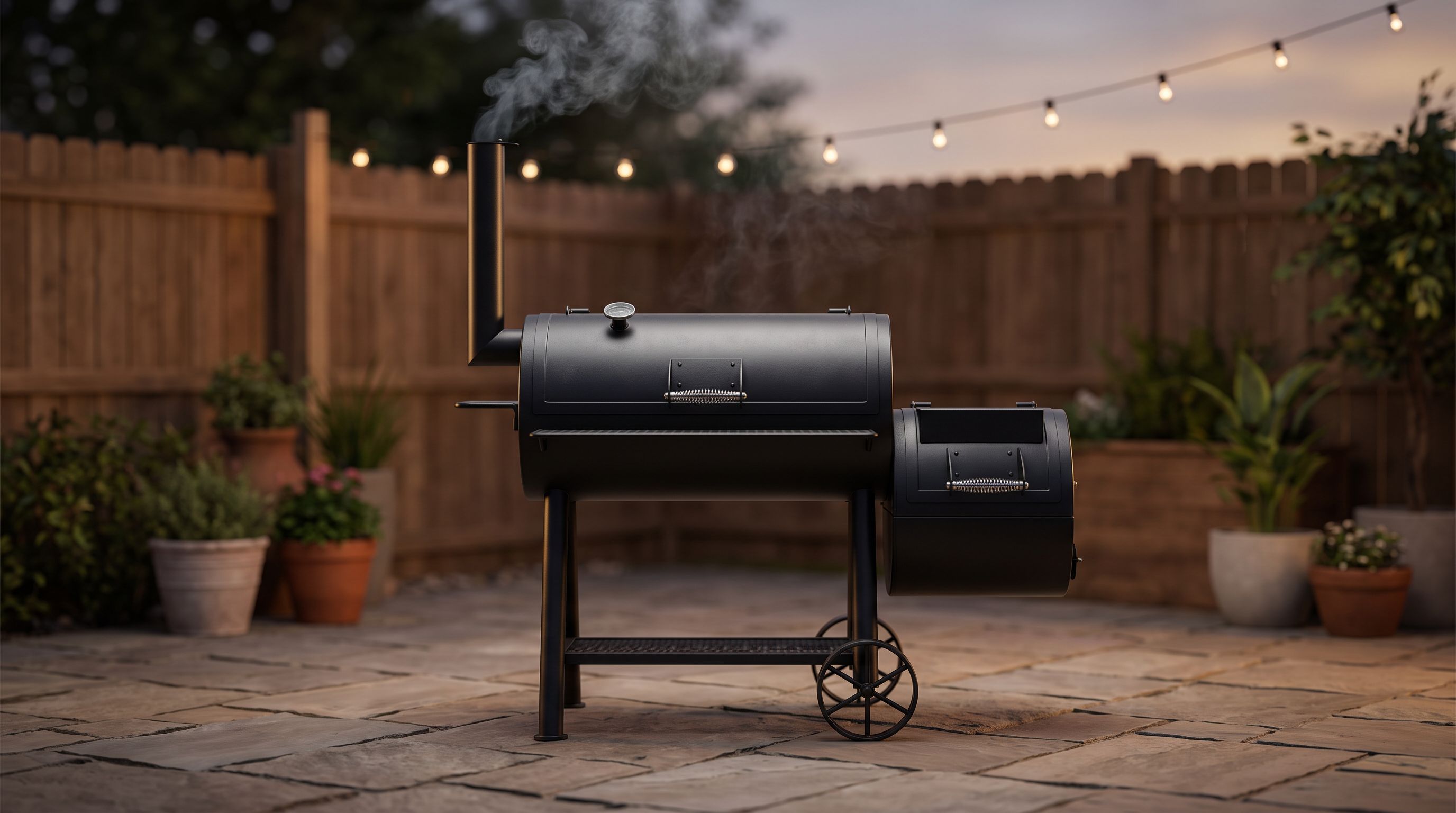
Every argument about offset smokers eventually collapses into one number: how thick is the steel? Not the brand badge, not the number of dampers, not whether it has a warming rack. Thickness, more than anything else, determines whether your cooker coasts through a 12-hour brisket or swings 75°F every time a cloud passes overhead.
That's the lens for this offset smoker buying guide. We compared current models using manufacturer specifications, independent review-site testing, and verified owner feedback, and sorted them by what actually matters in the backyard: steel gauge, firebox-to-cook-chamber ratio, and airflow design.
Why steel gauge is the whole ballgame
An offset smoker is a thermal battery. The fire in the firebox is wildly uneven — it flares when a split catches, it sags when that split burns down. Thick steel absorbs that volatility and re-radiates it slowly, so the cook chamber sees a smoothed-out average instead of the raw spikes.
Here's the practical hierarchy you'll encounter in 2026:
- 16-gauge (about 1/16", ~1.5mm): The big-box baseline. Found on most sub-$500 offsets. It heats fast, cools faster, and is extremely sensitive to wind and ambient temperature. Workable, but you will be feeding it constantly.
- 1/8" (11-gauge, ~3mm): The real step up, and where "backyard-serious" begins. Roughly double the mass of 16-gauge. Noticeably steadier, still light enough that two people can move it.
- 1/4" (~6mm): The benchmark for heavy offsets. A 1/4" cook chamber will hold temperature through a wood split burning down, through a lid opening, and through a cold snap. It also weighs several hundred pounds, which is the trade.
The physics are boring but unforgiving: double the thickness and you roughly double the thermal mass per square foot. That's why a 1/4" pit can run a 250°F cook with fire management every 45 to 60 minutes while a thin-gauge cooker wants attention every 20.
What thin steel costs you beyond temperature swings
Thin steel also warps. Repeated heat cycling on a 16-gauge firebox leads to doors that no longer seal, lids that gap at the hinge, and rust-through at the fire grate line — often within three to five seasons of regular use. Heavy-gauge pits develop surface patina and keep going. If you cook twice a month for a decade, gauge is a durability decision as much as a performance one.
Firebox volume: the spec nobody reads
A firebox should be roughly one-third the volume of the cook chamber. Undersized fireboxes are the most common design flaw in budget offsets, and they create a nasty trap: the box is too small to hold a clean, well-aerated fire, so you choke the airflow to keep the temperature down, and choked fires produce the acrid, bitter smoke that ruins barbecue.
A properly sized firebox lets you run a small, hot, oxygen-rich fire with the intake wide open. That's the entire secret to thin blue smoke. If a manufacturer doesn't publish firebox dimensions, that's informative on its own.
Look for an insulated or double-wall firebox if it's offered — it slows heat loss at the hottest point on the cooker and makes cold-weather cooking dramatically less miserable.
Reverse flow versus traditional offset
In a traditional offset, heat and smoke enter at the firebox end, travel across the grate, and exit the stack at the far end. The firebox end runs hot — a 40 to 60°F gradient is normal, more on a poorly sealed pit.
A reverse-flow design adds a solid baffle plate under the grates. Heat travels the full length under the plate, turns at the far end, and comes back over the meat before exiting a stack mounted on the firebox end. The result is a far more even cook chamber and a baffle that doubles as a heat sink and a grease drain.
Reverse flow wins if you want set-and-forget evenness, cook large racks of ribs, or hate rotating meat. Traditional offset wins if you want a usable temperature gradient (hot end for chicken, cool end for brisket), faster response to damper changes, and slightly cleaner smoke flavor — many competition cooks still prefer it. Neither is objectively better; reverse flow is simply more forgiving.
One more design detail: the stack should start at grate level, not at the top of the dome. A grate-height exhaust pulls smoke across the food rather than letting it pool at the lid.
How the 2026 picks compare
| Model | Steel gauge | Design | Firebox | Best for |
|---|---|---|---|---|
| Oklahoma Joe's Highland | ~16-gauge (2.5–3mm range) | Traditional, offset | Standard side firebox | First offset, learning fire management |
| Oklahoma Joe's Longhorn Reverse Flow | Heavy-gauge steel | Reverse flow with removable baffles | Large side firebox | Even temps + convertibility |
| Dyna-Glo Signature Series Vertical Offset | Heavy-gauge | Vertical cabinet + offset firebox | Side firebox | Small footprints, high capacity |
| Char-Griller Grand Champ XD | Heavy-gauge, insulated | Offset with insulated firebox | Insulated, oversized | Cold-weather cooking, longer burns |
 Best insulated firebox · Char-Griller Grand Champ XD Offset Smoker — Check price on Amazon →
 Best for beginners · Oklahoma Joe's Highland Offset Smoker — Check price on Amazon →
 Best overall · Oklahoma Joe's Longhorn Reverse Flow Offset Smoker — Check price on Amazon →
Oklahoma Joe's Highland — the honest starting point
The Highland is the default first offset for a reason: the fundamentals are right. Decent firebox proportions, a usable cook chamber, grate-height stack, and a body that accepts modifications gracefully. It is not 1/4" steel and it will not pretend to be — expect to tend the fire every 20 to 30 minutes and expect to add a high-temp gasket and a baffle if you want tighter control. As a tool for learning fire management without a four-figure commitment, it's still the best value in 2026.
Oklahoma Joe's Longhorn Reverse Flow — the versatile pick
The Longhorn Reverse Flow is the most broadly recommended backyard offset we found. The removable baffle plates mean you can run it as a true reverse flow for even ribs, then pull the plates and run it as a traditional offset when you want a gradient. Heavier steel than the Highland, more grate area, and a firebox sized to hold a real wood fire. For most people buying one offset for the next decade, this is the sweet spot.
Char-Griller Grand Champ XD — the cold-weather answer
The Grand Champ XD's headline feature is the insulated firebox, and it matters more than it sounds. Insulation keeps combustion temperatures up, which means cleaner smoke and longer intervals between splits — and it's the single most effective fix for cooking offset in winter. Owner feedback consistently cites longer burn times than comparably priced uninsulated pits.
Dyna-Glo Signature Series Vertical Offset — the small-patio pick
If your patio is 10 feet wide, a horizontal offset is a non-starter. The Dyna-Glo Signature Series stacks the cook chamber vertically beside an offset firebox, delivering serious rack capacity in a narrow footprint. The vertical format naturally produces a top-to-bottom gradient, so put your fattier cuts up high. It's the compromise that actually works.
What to budget and what to skip
Skip anything under roughly $300 marketed as an "offset." Those are grills with a side box bolted on: tiny fireboxes, paper-thin steel, lids that gap. You'll fight them and quit.
Spend your upgrade money in this order: steel gauge first, firebox size second, reverse flow third, accessories last. A heavy pit with no thermometer beats a light pit with four of them. And budget for a quality leave-in dual-probe thermometer regardless — factory lid dials are frequently off by 25 to 50°F and read dome temperature, not grate temperature.
FAQ
Is 1/4-inch steel actually necessary for a backyard cook? No — it's necessary for easy backyard cooking. A 1/8" pit with a good gasket seal and a properly sized firebox will produce identical barbecue; you'll just work harder and watch it closer. 1/4" buys you time and forgiveness, not better flavor.
How much does a thin-gauge offset really swing? Owner reports and review-site testing commonly describe 30 to 50°F swings on 16-gauge pits as splits catch and burn down, with wind pushing that wider. Heavy pits typically hold within 10 to 15°F through the same cycle.
Does reverse flow produce less smoke flavor? Slightly, in most accounts — the baffle plate lengthens the smoke path and the airflow is gentler. The difference is small, and it's traded for far better evenness. Many reverse-flow owners never notice it.
Can I fix a cheap offset with mods? To a point. A high-temp gasket on the lid and firebox door, a tuning plate or baffle, a grate-level stack extension, and sealing the sheet-metal seams will meaningfully improve a Highland-class pit. What you cannot mod is thermal mass — the steel is the steel.
Charcoal or wood? Start the fire with a chimney of lump charcoal to build a hot coal bed, then feed preheated wood splits. Running pure wood from a cold start is the fastest route to dirty smoke.
Our picks
Oklahoma Joe's Highland Offset Reverse Flow Offset Charcoal Smoker and Grill With 1093 sq. in. Cooking Area in Black
Removable baffles let it run as a reverse flow or a traditional offset — the most versatile backyard pit.
Oklahoma Joe's Highland Offset Charcoal Smoker and Grill with 900 sq. in. Cooking Area in Black
Right proportions and grate-level stack make it the classic first offset for learning fire management.
Char-Griller Smokin Pro Charcoal Grill and Offset Smoker with Side Fire Box, Dual Damper Control, Chrome Plated Steel Warming Rack, 1,130 Cooking Square Inches in Black, Model CG30044223
Insulated firebox means cleaner combustion, longer burns and far better cold-weather performance.

Dyna-Glo DGO1176BDC-D Vertical Offset Charcoal Smoker
Vertical cabinet plus offset firebox delivers big rack capacity in a narrow footprint.
Get the best kitchen gear deals in your inbox
Join the PrepDeck newsletter for hand-picked kitchen gear deals and new buying guides. No spam, unsubscribe anytime.
Related reads
Charcoal vs Gas Grill in 2026: Which Fits Your Patio?
Charcoal vs gas grill in 2026: compare fuel cost, preheat time, BTUs, burner layout, cleanup and balcony/HOA rules to pick the right grill for your space.
Flat Top Griddle vs Pellet Grill in 2026: Only Room for One
Flat top griddle vs pellet grill in 2026: we compare fuel cost, cook surface, cleanup, winter use and long-term durability to help you pick the one that earns your patio.
Offset vs Pellet vs Kamado Smoker: Which Wins in 2026?
Offset vs pellet vs kamado smoker in 2026: we compare fuel cost, temp stability, capacity and outdoor durability so you can pick the right format the first time.