Charcoal vs Gas Grill in 2026: Which Fits Your Patio?
Charcoal vs gas grill in 2026: compare fuel cost, preheat time, BTUs, burner layout, cleanup and balcony/HOA rules to pick the right grill for your space.
Reader-supported: we may earn a commission from links on this page, at no extra cost to you. It never affects our picks. Learn more.
The charcoal-versus-gas argument usually gets framed as a flavor debate. It isn't, really. Flavor differences are real but smaller than most people claim, and they shrink further once you add a smoker box or cook something that isn't a thin burger patty.
What actually decides this purchase is your schedule, your square footage, and your building's rules. We compared current models using manufacturer specs, independent review testing, and verified owner feedback to sort out which fuel fits which patio.
The short version
Buy gas if you grill on weeknights, you want to be eating 25 minutes after you walk in the door, or you cook for a crowd and need to run different temperatures across the grate at once.
Buy charcoal if you grill mostly on weekends, you want searing heat and real smoke without added equipment, you want the most cooking area for the money, or you want a grill that can still be repaired in ten years.
Buy gas by default if you live in an apartment, condo, or anything with an HOA — because charcoal is the fuel that gets banned.
Preheat time and the weeknight test
This is the single biggest practical difference and it's not close.
A gas grill is at cooking temperature in roughly 10 to 15 minutes from cold, hood closed. You turn a knob, press the igniter, and walk away. Shutdown is equally fast: burn off the grates for five minutes, kill the gas, done.
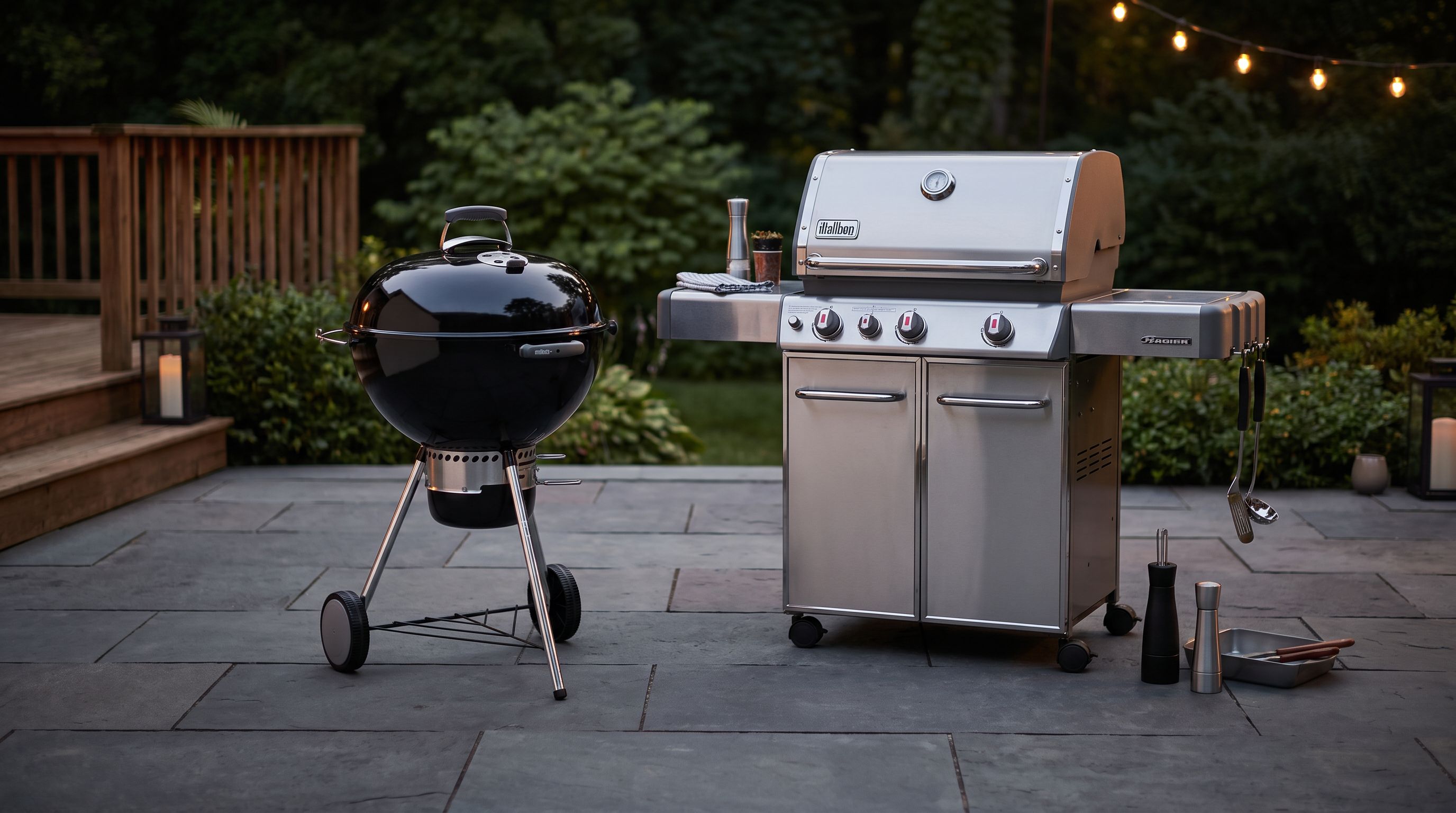
Charcoal realistically needs 20 to 30 minutes. A chimney starter full of briquettes takes about 15 minutes to ash over, then you dump, arrange, and let the grates come up to temp. Afterward, you have to wait for the coals to die or close the vents to snuff them, then deal with ash before your next cook. The Weber Original Kettle Premium's One-Touch ash catcher makes that last part genuinely painless, which is a large part of why it has stayed the default recommendation for so long — but it's still a step gas owners never take.
If you cook three-plus nights a week, that time delta compounds into the reason the grill either gets used or becomes a patio sculpture.
Fuel cost: cheaper per cook than you think, either way
Neither fuel is expensive relative to the food you're putting on it, so don't let running costs drive the decision.
A 20 lb propane tank gives most three-burner grills somewhere in the range of 15 to 20 hours of cooking on medium — call it a month or two of normal use. Charcoal is bought per cook: a standard chimney of briquettes per session, with lump burning hotter and faster than briquettes and costing more per pound.
Where charcoal wins on cost is upfront. Solid gas grills start around the $400 mark and climb fast; a 22-inch kettle delivers a serious amount of grate space and capability for a fraction of that. Where gas wins is hidden cost of ownership: no chimney, no starter cubes, no running out of fuel mid-cook on a Tuesday.
BTUs, burner layout, and why the number on the box lies
Gas grill marketing leans on total BTU, which is close to meaningless on its own. BTUs tell you fuel consumption, not heat delivered to food. A poorly insulated grill with a thin lid can burn more gas and cook worse than a well-built one.
What matters more:
- BTU per square inch of primary cooking area. Roughly 75 to 100 BTU/sq in is a healthy target for a backyard grill.
- Burner count and orientation. Three burners is the practical minimum for two-zone cooking — two on, one off, so you have a safe zone for thicker cuts. The Weber Spirit II E-310 is the classic expression of this layout.
- Heat diffusion. Flavorizer bars, ceramic briquettes, or heavy tent-shaped deflectors vaporize drippings and even out hot spots. Grills without them show scorched stripes.
- Grate material. Porcelain-enameled cast iron holds and transfers heat better than thin chrome-plated rod, which is why compact grills like the Weber Q2200 punch above their size.
Charcoal has no BTU rating because you control output by fuel quantity and vent position. A loaded kettle with the vents wide open hits temperatures most mid-range gas grills can't touch — which is why charcoal still owns the hard-sear conversation. Independent testing has found a handful of high-end gas grills, like the Grilla Primate, reaching comparable searing temps, but you pay premium money for that.
Charcoal vs gas at a glance
| Factor | Charcoal | Gas |
|---|---|---|
| Preheat to cooking temp | 20–30 min (chimney + settle) | 10–15 min |
| Max searing heat | Very high; easy 600°F+ | Moderate to high; premium models excel |
| Temperature control | Vents + coal arrangement; learned skill | Knob-precise, instant |
| Smoke flavor | Built in | Requires wood chips / smoker box |
| Cleanup per cook | Ash removal, grate brush | Burn-off, grease tray occasionally |
| Upfront cost for capability | Lower | Higher (good ones start ~$400) |
| Fuel logistics | Buy bags; store dry | Tank swap or refill; keep a spare |
| Balcony / HOA friendliness | Frequently prohibited | Often permitted; electric sometimes required |
| Best for | Weekend cooks, searing, low-and-slow | Weeknights, crowds, multi-zone cooking |
Balcony rules, HOAs, and the thing people find out too late
Check before you buy. Many municipal fire codes — and the widely adopted NFPA 1 framework most of them borrow from — restrict open-flame and charcoal appliances on balconies and within a set distance of combustible construction in multi-family buildings. Propane is sometimes allowed with tank-size limits; sometimes only electric grills pass.
Practical sequence: read your lease or HOA covenants, then call your local fire marshal's office, then buy. If propane is permitted but space is tight, a compact single-burner like the Weber Q2200 is the sensible answer — cast-iron grates, a real lid, and a footprint that fits a small balcony table or cart. If only charcoal is allowed at a shared community pit, a packable Weber Jumbo Joe travels better than anything with wheels.
 Budget/portable charcoal pick · Weber Jumbo Joe 18 Portable Charcoal Grill — Check price on Amazon →
Cleanup, maintenance, and longevity
Charcoal maintenance is frequent but trivial: dump ash, brush grates, occasionally wipe the bowl. There are almost no components to fail. A kettle's weak points are the bowl's enamel and the ash sweeper — both replaceable.
Gas maintenance is infrequent but more involved: clear burner ports, replace burner tubes and flavorizer bars every few years, check the regulator and hose, and empty the grease tray before it becomes a fire hazard. Budget for consumable parts; the brands worth buying are the ones that still stock them, which is a quiet argument for Weber over house-brand big-box grills.
Do combo grills solve this?
Sort of. A side-by-side unit like the Char-Griller E5050 Duo gives you a propane firebox and a charcoal firebox under one lid line, so you can sear over coals and run a gas side for sides or lower-heat items. The tradeoffs are real: a combo takes up more patio than either grill alone, each side is typically smaller than a dedicated grill at the same price, and build quality tends to be mid-tier. Buy one if your genuine answer is "both, often." Don't buy one to avoid making a decision.
How to choose in 60 seconds
- Apartment, condo, or HOA? Gas (or electric, if that's the rule). Start with the Weber Q2200.
- Grill three or more nights a week? Gas. The Weber Spirit II E-310 is the safe three-burner default.
- Weekend cook who wants sear and smoke for less money? Charcoal. The Weber Original Kettle Premium 22" is the answer and has been for a long time.
- Camping, tailgates, tiny yard, charcoal allowed? Weber Jumbo Joe.
- Genuinely want both and have the space? Char-Griller E5050 Duo.
FAQ
Does charcoal actually taste better? It tastes different. Charcoal adds smoke and the drippings vaporize differently, which is most noticeable on long cooks and fatty cuts. On a quick chicken breast or vegetables, most people can't reliably tell. A smoker box with wood chips closes much of the gap on a gas grill.
Is a gas grill faster than charcoal for weeknight cooking? Yes, dramatically. Roughly 10–15 minutes to cooking temperature versus 20–30 for charcoal, plus no ash cleanup afterward.
How many burners do I actually need? Three. Two burners technically allows two zones but leaves you with very little usable indirect space. Four or more only matters if you regularly cook for eight or more people.
Can I smoke on a gas grill? Yes, with a smoker box and the burner under it lit while the food sits over unlit burners. It works, but a kettle with a charcoal snake or a dedicated smoker does it better and holds low temperatures more easily.
Propane or natural gas? Natural gas is cheaper per cook and never runs out mid-cook, but requires a gas line and permanently tethers the grill. Propane is portable and far more common. Choose propane unless you already have a line stubbed out.
How long should a grill last? A well-maintained kettle can run 15 years or more with occasional replacement parts. A mid-range gas grill kept under a cover realistically lasts 8–12 years, with burner tubes and flavorizer bars replaced along the way.
Our picks

Weber Original Kettle Premium Charcoal Grill, 22-Inch, Black
The benchmark 22-inch kettle: two-zone fires, ash catcher, hinged grate, and decades of parts support.

Weber Spirit E-310 Gas Grill, Outdoor Cooking, Small Propane Grill, Black
Three burners, GS4 ignition and Flavorizer bars make it the most reliable weeknight workhorse.
Weber Q2200 Liquid Propane Grill
Compact single-burner portable with cast-iron grates — the practical pick where charcoal is banned.
Char-Griller E5050 Duo Gas and Charcoal Grill
Side-by-side propane and charcoal fireboxes if you refuse to choose one fuel.
Weber Jumbo Joe Charcoal Grill, 18‑Inch, Black
An 18-inch kettle with a locking lid — cheap, packable, and surprisingly capable for burgers.
Get the best kitchen gear deals in your inbox
Join the PrepDeck newsletter for hand-picked kitchen gear deals and new buying guides. No spam, unsubscribe anytime.
Related reads
Offset Smoker Buying Guide 2026: Steel Gauge Decides
Our 2026 offset smoker buying guide explains why steel thickness, firebox volume and reverse flow decide temperature stability — plus four picks worth buying.
Flat Top Griddle vs Pellet Grill in 2026: Only Room for One
Flat top griddle vs pellet grill in 2026: we compare fuel cost, cook surface, cleanup, winter use and long-term durability to help you pick the one that earns your patio.
Pellet Smokers in 2026: 5 Picks From $500 to $1,800
The best pellet smoker 2026 picks compared on hopper capacity, cook area, temperature swing and WiFi control — from budget Pit Boss to Weber and Recteq.