Knife Edge Angle in 2026: 15° vs 20°, and Which Fits You
Knife edge angle explained: 15 vs 20 degrees, how bevel angle interacts with steel hardness, sharpener presets, and your cutting board habits in 2026.
Reader-supported: we may earn a commission from links on this page, at no extra cost to you. It never affects our picks. Learn more.
Edge angle is the single spec that changes how a knife feels more than steel type, handle shape, or brand name. It's also the spec most often misunderstood — partly because manufacturers measure it differently, and partly because "sharper" and "better" aren't the same thing.
Here's what the 15° vs 20° debate actually means for a home cook, and how to pick the angle your knives, your board, and your habits can live with.
What "edge angle" actually measures
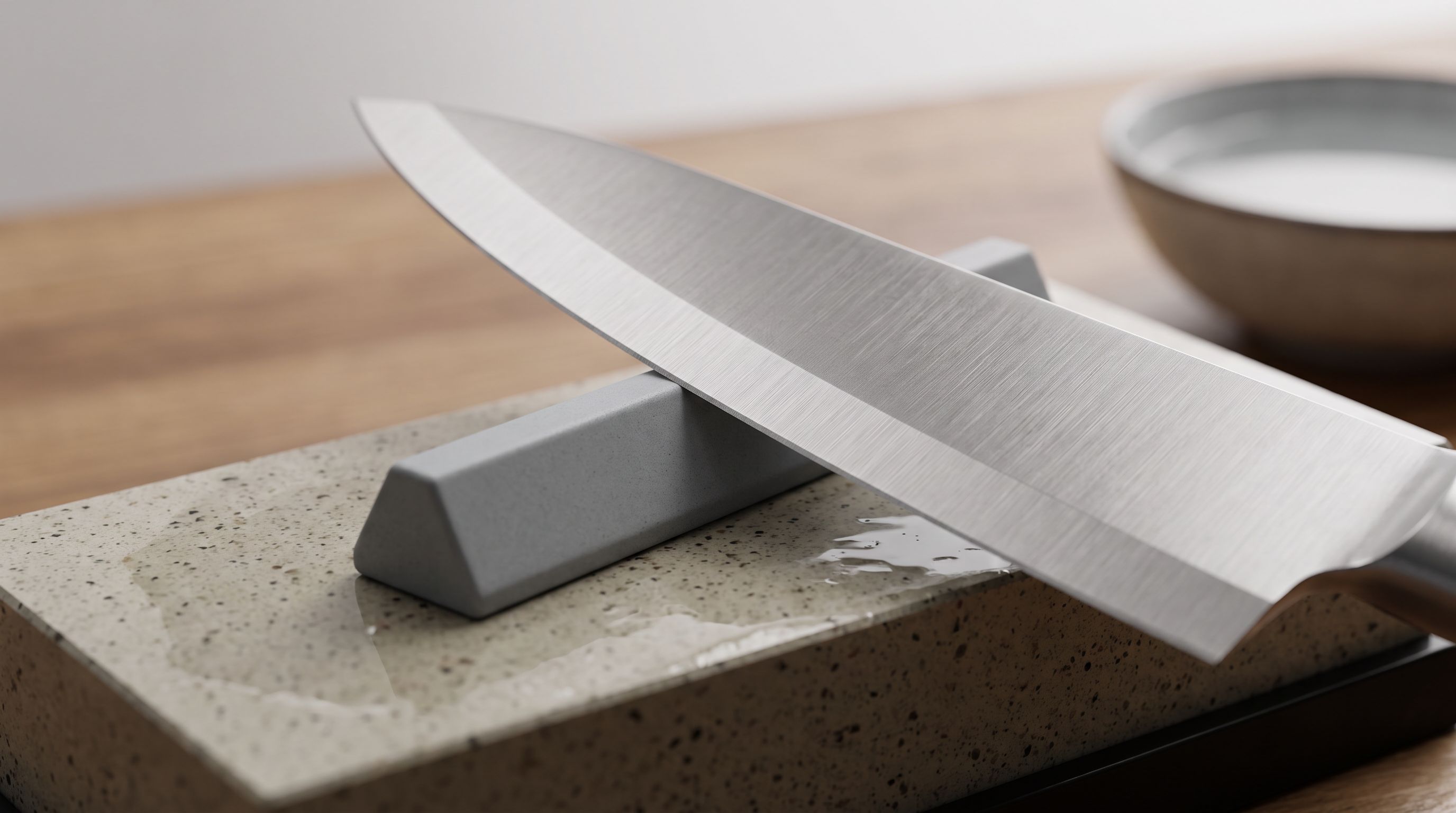
A knife edge is a wedge. The edge angle is the angle of one side of that wedge measured from the blade's centerline — that's the per-side angle. Add both sides together and you get the inclusive angle.
So a knife described as "15 degrees" is almost always 15° per side, or 30° inclusive. A 20° knife is 40° inclusive. European brands historically ground around 20° per side; Japanese makers commonly grind 15°–16°, and some single-bevel traditional knives go far thinner on one face only.
Where confusion creeps in: a few sharpener manufacturers and listings quote inclusive angles. If a sharpener says "30 degrees," check whether that means 15° per side. Getting this wrong means you'll spend twenty minutes grinding a perfectly good edge into the wrong geometry.
Why thinner cuts better
Less steel has to push food apart. A 15° edge enters a tomato skin or a shallot with less resistance, which is why thin edges feel "scary sharp" even at the same polish level. A 20° edge needs more force to start the cut, and that force is what crushes delicate herbs and makes onions weep.
Why thicker lasts longer
That same thinness is fragile. The apex of a 15° edge has less steel behind it to support it, so lateral stress — twisting through a squash, scraping food off the board with the edge, hitting a chicken joint — can roll or chip it. A 20° edge has a fatter wedge of metal right behind the apex, so it deforms rather than breaks.
Note the nuance you'll see argued on sharpening forums: a thinner edge can feel sharper for longer, because even after wear it's still a narrower wedge. But it's more likely to take visible damage from an impact. Edge retention and edge durability are two different things.
How steel hardness changes the math
This is the part most guides skip, and it's the part that matters.
Hardness is measured on the Rockwell C scale (HRC). Harder steel resists deformation — it holds a thin apex instead of rolling over. Softer steel bends instead of chipping, which makes it forgiving but means a very thin edge just folds under load.
- Around 56–58 HRC (typical German-style stainless, most budget knives): 18°–20° per side is the sweet spot. Push to 15° and the edge tends to roll during normal board work.
- Around 58–61 HRC (better Western stainless, many mid-range Japanese knives): 15°–17° per side works well and the improvement in cutting feel is obvious.
- 62 HRC and up (high-carbon Japanese cores, powder steels): 15° or thinner is the point of the knife. These steels hold a fine apex but chip rather than roll, so technique and board choice matter.
The Victorinox Swiss Classic Chef's Knife 8-Inch is a good illustration of the soft-steel end. It's tough, easy to re-sharpen, and genuinely happier at a wider angle where the edge resists rolling. The Shun Classic 8-Inch Chef's Knife sits at the other end: a hard VG-MAX core ground near 16° per side, where the thin geometry is doing real work and a 20° regrind would waste the steel.
 Best showcase for a 15° edge · Shun Classic 8-Inch Chef's Knife — Check price on Amazon →
 Best 20°-friendly workhorse · Victorinox Swiss Classic Chef's Knife 8-Inch — Check price on Amazon →
The comparison, side by side
| 15° per side (30° inclusive) | 20° per side (40° inclusive) | |
|---|---|---|
| Cutting feel | Noticeably cleaner slicing, less wedging | More force needed, more crushing on soft food |
| Best steel range | ~58 HRC and harder | ~54–58 HRC, softer stainless |
| Durability | Prone to rolling/chipping on impact | Resists chips, tolerates bone contact |
| Maintenance cadence | More frequent honing and touch-ups | Longer intervals between touch-ups |
| Sharpening time | Slower to set, removes more steel initially | Faster to restore |
| Board requirement | End-grain wood or soft poly only | Tolerates most boards |
| Best for | Vegetable prep, proteins off the bone, careful cooks | Breaking down poultry, squash, heavy daily use |
| Typical origin | Japanese and Japanese-influenced knives | German/European and workhorse knives |
Which angle fits your actual cooking
Forget the knife for a second and look at your board and your habits.
Go 15° if: you cut on end-grain wood or a soft polyethylene board, you prep a lot of vegetables, you don't hack through bones, and you're willing to hone every few sessions. You want the cut quality and you'll do the upkeep.
Stay at 20° if: your board is bamboo, glass, or a hard composite; you scrape food off the board with the edge rather than the spine; you break down whole chickens; or your knife is a softer stainless workhorse. Also stay at 20° if the knife lives in a drawer with other utensils — thin edges and drawer chaos don't mix.
A quiet third option: 17°–18°. Many adjustable sharpeners support it, and it's a legitimate compromise for a German-steel chef's knife you want to improve without making fragile. If you're unsure, this is the low-risk move.
Sharpener presets, and what they commit you to
The angle you can maintain is limited by the tool you own.
Fixed-angle electric sharpeners make the decision for you. The Chef'sChoice Trizor XV 15 is the well-known example: it reprofiles a 20° factory edge into a 15° arched edge across three stages. That's a genuine conversion, not a touch-up — it removes real metal on the first pass, and once you've done it, that knife is a 15° knife until you reprofile it again. Great if that's what you want; irreversible-feeling if it isn't.
Adjustable guided systems keep your options open. The Work Sharp Precision Adjust Knife Sharpener clamps the blade and runs abrasives on a guided rod at settings you choose, so you can keep a Japanese gyuto at 15° and a German chef's knife at 20° without compromise. For a mixed knife drawer — which is most kitchens — this flexibility is worth more than raw speed.
 Best angle control · Work Sharp Precision Adjust Knife Sharpener — Check price on Amazon →
Whetstones give total control and demand the most skill. The Sharp Pebble Premium Whetstone 1000/6000 Grit is a reasonable entry point: 1000 grit sets the bevel, 6000 refines it, and the included guide helps until your hands learn the angle. A useful rule of thumb while you practise: two stacked quarters under the spine of a typical chef's knife approximates roughly 15°, one stack of pennies closer to 20° — rough, but better than guessing.
 Best freehand starter · Sharp Pebble Premium Whetstone 1000/6000 Grit — Check price on Amazon →
Don't fight your factory grind
Reprofiling from 20° to 15° can take a long session and noticeable steel. There's no urgency. If your knife cuts well and you just want it sharper, sharpen it at the angle it already has. Matching the existing bevel is faster, removes less metal, and usually solves the actual problem — which is dullness, not geometry.
Honing vs sharpening, since angle depends on it
A honing rod doesn't remove meaningful steel; it straightens a rolled apex. It needs to be used at the same angle as the edge, or it does nothing useful. Hone a 15° edge at 20° and you're blunting the very tip. This is the most common reason people conclude thin edges "don't hold up" — they're wrecking them during maintenance.
Hone often, sharpen rarely. A 15° edge might want honing every two or three cooking sessions; a 20° workhorse can go longer.
FAQ
Is 15° always sharper than 20°? At the same polish, yes — it cuts with less resistance. But a freshly sharpened 20° edge beats a neglected 15° edge every time. Sharpening frequency matters more than geometry.
Can I put a 15° edge on a cheap knife? You can, but softer steel around 56 HRC will likely roll at that angle during normal use. 18° is a safer improvement on budget stainless.
Does a 15° edge chip more? It's more vulnerable to impact damage — bones, frozen food, hard boards, and scraping with the edge. On a wood board with careful technique, chipping is uncommon.
My knife says 15° but my sharpener says 30°. Which is right? Both, probably. 15° per side equals 30° inclusive. Always confirm which convention a manufacturer is using before you grind.
Should different knives in my kitchen have different angles? Yes, and that's the sensible setup: a thin 15° edge on your vegetable and slicing knife, a sturdier 20° edge on the knife that meets bones and hard squash.
Our picks
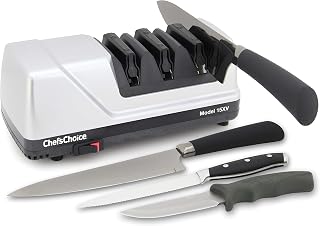
Chef’sChoice 15XV EdgeSelect Professional Electric Knife Sharpener with 100-Percent Diamond Abrasives and Precision Angle Guides for Straight Edge and Serrated Knives, 3-Stage, Gray
Three-stage electric that reprofiles 20° factory edges to a 15° Trizor arch without freehand skill.
WORK SHARP Precision Adjust Elite Knife Sharpener
Clamp-and-rod guided system with adjustable angle settings, so you can match 15°, 17°, or 20° exactly.
Victorinox Swiss Classic 8" Straight Blade Chef's Knife, Black Handle
Softer, tough stainless that takes a 20° edge happily and shrugs off board abuse and bone contact.
Shun Classic 8" Chef's Knife
Hard VG-MAX core ground around 16° per side — the kind of steel a thin edge actually rewards.
Sharp Pebble Whetstone Knife Sharpener – 1000/6000 Grit Sharpening Stone
Dual-grit stone with a base and angle guide for learning to hold a consistent bevel by hand.
Get the best kitchen gear deals in your inbox
Join the PrepDeck newsletter for hand-picked kitchen gear deals and new buying guides. No spam, unsubscribe anytime.
Related reads
Japanese vs German Chef Knife: Which Fits Your Hands in 2026
Japanese vs German chef knife, compared on edge angle, steel hardness, blade geometry and upkeep — plus four knives worth buying as your first serious blade in 2026.
VG-10 vs AUS-10 vs S35VN: The Best Chef Knife Steel in 2026
VG-10, AUS-10, S35VN and X50CrMoV15 decoded. Learn which chef knife steel matches your cooking style, hardness, edge retention and chip risk in 2026.
Espresso Machine Water in 2026: Stop Scale Before It Starts
Espresso machine water filter hardness explained: how to test GH and KH, pick resin filters vs. remineralization packets, and match water to your boiler type in 2026.