Grain Mills in 2026: Stone vs Impact, and Which Mills Faster
Stone vs impact grain mills compared for 2026: throughput, noise and fineness. Find the best grain mill for home flour, from NutriMill Classic to Mockmill 200.
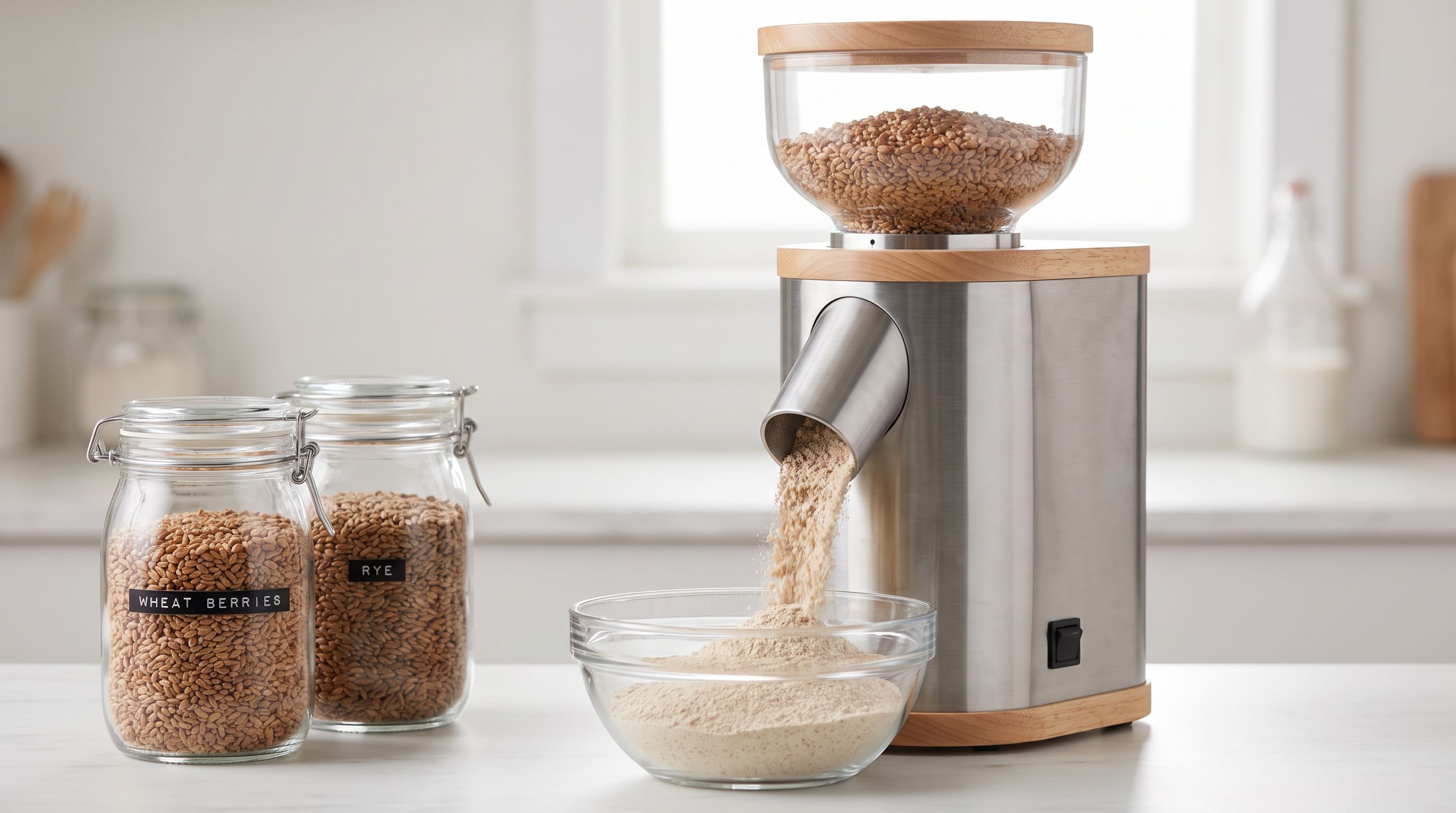
Reader-supported: we may earn a commission from links on this page, at no extra cost to you. It never affects our picks. Learn more.
Fresh-milled flour has a short, glorious shelf life — the oils in the germ start oxidizing within hours, which is exactly why home bakers mill their own. But the moment you start baking two or three loaves a week, the question stops being "which mill is best?" and becomes "how fast can this thing produce flour, and how loud is it while doing it?"
That's the right question. Most home grain mills fall into two camps — impact (burr-free) mills and stone mills — and the camp you choose determines throughput, noise, texture range, and what you're allowed to put in the hopper. Brand loyalty is the least useful way to decide.
Impact vs. stone: the only distinction that really matters
Impact mills fling grain between two counter-rotating stainless steel heads studded with concentric rings of teeth. Nothing grinds; the kernel is shattered repeatedly until it's small enough to exit. They are fast, they produce very fine flour, and because there's no contact surface to wear, they're nearly maintenance-free. They're also genuinely loud — high-RPM air movement plus grain impact lands them in the shop-vac range. And they're dry-grain only: no oily seeds, no flax, no coffee, no nut flour. Oil gums the chambers.
Stone mills pass grain between a stationary and a rotating burr of corundum-ceramic or natural stone. They run at lower RPM, produce noticeably less noise, let you dial texture from cracked cereal to fine pastry flour on a continuous adjustment, and handle a wider range of grains (though oily seeds are still a bad idea in most of them — check the manual). Throughput is lower, and the stones do eventually need dressing or replacement after years of heavy use.
A useful rule of thumb: if you bake sandwich loaves and want the finest possible whole-wheat flour in the least time, impact wins. If you want control over granulation — coarse for polenta, medium for porridge, fine for bread — and you'd like to hold a conversation while it runs, stone wins.
Throughput, decoded
Manufacturers quote output in grams or cups per minute, and the numbers aren't directly comparable because they're measured on different grains at different settings. Hard red wheat on the finest setting is the slowest, most demanding case; rye and spelt run faster. When you see a figure, assume it's close to best case.
What matters practically: a standard 2-loaf batch of whole wheat bread needs roughly 1,000–1,200 g of flour. A mill doing ~100 g/min handles that in about 10 minutes. A high-output impact mill does it in two or three. Over a year of weekly baking, that difference is real but not life-changing — noise and texture control usually matter more day to day.
The picks
NutriMill Classic is the default recommendation for high-volume bread bakers, and deservedly so. It's a 1200-watt impact mill with stainless steel milling heads, a large hopper, and a flour canister in the 12-cup range — enough to mill a multi-loaf batch in one go without stopping to empty. It has a texture dial, but understand what that means on an impact mill: you're adjusting from fine to very fine, not producing true cracked grain. It is loud. Owners consistently describe it as the thing you run before the household wakes up, or in the garage. If you bake in bulk and want bread flour fine enough that the bran disappears into the crumb, it's hard to beat.
Mockmill 200 is the stone mill most often set against it, and the comparison is instructive. It uses corundum-ceramic stones, mills on a continuous adjustment from coarse meal to fine flour, and the whole machine is compact enough to leave on a counter without resenting it. The 200 is the higher-output model in the home line (the 100 is the smaller sibling); real-world rates land well below a big impact mill, but the flour comes out cooler, the noise is markedly lower, and you can actually make cracked wheat cereal and coarse rye meal — not just flour. For most households baking a few times a week, this is the better machine to live with.
NutriMill Harvest splits the difference: a stone mill in a hardwood-accented housing, continuous texture adjustment, and a quieter profile than the Classic, aimed at bakers who want stone flour without the Mockmill's industrial-lab aesthetic. It's a sensible pick if the mill is going to sit out permanently in an open kitchen.
WonderMill Grain Mill is the other serious impact option. Like the NutriMill Classic it's a high-wattage, stainless-head machine built for speed and fine flour, with a sealed flour canister that does a decent job containing the dust cloud impact mills are notorious for. It's dry grain only. Choose it over the Classic largely on capacity preference and which hopper layout you like.
 Best dust control · WonderMill Grain Mill — Check price on Amazon →
KitchenAid Grain Mill Attachment belongs in a different conversation. It's a metal burr mill powered by a stand mixer's PTO hub, and its output is slow — this is a 15-minute-per-loaf proposition, with the mixer motor working hard. But if you already own a stand mixer, mill occasionally, and mostly want cracked grain and medium flour for the odd loaf, it costs you no counter space and no second appliance. For anyone milling weekly, it's underpowered.
 Budget pick · KitchenAid Grain Mill Attachment — Check price on Amazon →
Comparison
| Model | Type | Texture range | Relative throughput | Noise | Oily seeds? |
|---|---|---|---|---|---|
| NutriMill Classic | Impact, stainless heads, 1200W | Fine to very fine only | Highest | Loud | No |
| WonderMill Grain Mill | Impact, stainless heads | Fine to very fine only | Highest | Loud | No |
| Mockmill 200 | Stone (corundum-ceramic) | Cracked grain to fine flour | Moderate | Low–moderate | No |
| NutriMill Harvest | Stone | Cracked grain to fine flour | Moderate | Low–moderate | No |
| KitchenAid Grain Mill Attachment | Metal burr, mixer-driven | Cracked to medium-fine | Lowest | Moderate | No |
How to choose, in three questions
How much do you bake? Under two loaves a week, a stone mill or even the KitchenAid attachment is plenty. Four-plus loaves, or you bake for others, and the time an impact mill saves starts compounding.
Where will it live? Impact mills are not quiet and not small. If it has to go in a cabinet between uses, factor in the weight. Mockmill 200 and NutriMill Harvest are the easier counter companions.
Do you want anything other than flour? Cracked wheat, steel-cut-style oats, coarse rye for porridge, corn for polenta — all require a stone or burr mill. Impact mills make one thing, extremely well.
Practical notes nobody mentions
Mill into a container with a lid and let it settle a minute before opening — impact mills in particular aerosolize fine flour, and you'll breathe it otherwise. Fresh flour is warm and slightly damp with released moisture; let it cool before weighing for precise recipes, and expect your hydration to run a touch higher than with store-bought whole wheat. Store what you don't use immediately in the freezer, and use it within a couple of weeks — otherwise you've bought a mill to make rancid flour.
Finally: buy grain in bulk from a mill or co-op, not the grocery baking aisle. The machine is the small part of the equation; a steady supply of hard red, hard white, spelt and rye is what actually changes your baking.
FAQ
Is stone-milled flour better than impact-milled flour? Not better — different. Impact mills produce a finer, more uniform particle size that behaves well in sandwich bread and pastry. Stone mills produce slightly more variable granulation with a bit more texture, which many bakers prefer in rustic loaves. Both keep the bran and germ.
Do grain mills overheat the flour and destroy nutrients? Home mills of both types run well below the temperatures that degrade nutrients in a single pass. Flour comes out warm, not hot. Stone mills typically run cooler simply because they spin slower.
Can I grind oily seeds, nuts or coffee? Not in an impact mill, and generally not in a stone mill either — oil clogs the milling chamber and is difficult to clean out. Use a dedicated nut grinder or food processor.
How loud are impact mills, really? Loud enough that most owners wear hearing protection or leave the room. It's a short burst — a few minutes — but plan around sleeping household members.
Does the KitchenAid attachment work for serious bread baking? It works, slowly, and it puts sustained load on the mixer's motor. Fine for occasional use or cracked grain; frustrating as a weekly workhorse.
Our picks

Nutrimill Harvest Electric Stone Grain Mill, 450 Watt - White
1200W impact mill with stainless heads and a large flour canister — fastest route to very fine flour.
Mockmill 200 Stone Grain Mill
Corundum-ceramic stones, continuous coarse-to-fine adjustment, and far quieter than any impact mill.

Nutrimill Harvest Electric Stone Grain Mill, 450 Watt - Bronze
Compact stone mill with full texture range and a hardwood-accented body you won't mind leaving out.
WONDERMILL Junior Deluxe Grain Mill for Flour, Hand Crank Wheat Mill for Grains, Nuts, Seeds, Oily Foods & Spices, Grain Grinder with Stone and Stainless Steel Burrs (Red)
High-speed impact mill with a sealed flour canister that contains the fine-flour cloud better than most.
KGM All Metal Grain Mill Attachment for KitchenAid Stand Mixers
Metal burr attachment for stand mixer owners who mill occasionally and have no counter space to spare.
Get the best kitchen gear deals in your inbox
Join the PrepDeck newsletter for hand-picked kitchen gear deals and new buying guides. No spam, unsubscribe anytime.
Related reads
Pizza Steel vs Stone in 2026: Pick One That Fits Your Oven
Pizza steel vs stone in 2026: how thickness, mass and rack clearance change your crust — plus picks sized for standard 30-inch home ovens.
Cast Iron Bakeware in 2026: Preheat Mass Is the Real Spec
Cast iron bakeware in 2026, ranked by preheat mass and oven rack clearance — loaf, cornbread and pizza pans compared against steel and ceramic for crust.
Countertop Oven vs Wall Oven in 2026: A Baker's Call
Countertop oven vs wall oven for baking in 2026: cavity size, rack spacing, heat recovery, and real installed cost compared, plus four ovens worth buying.