Espresso Ratios, Explained: Dose, Yield, Grind in 2026
Why espresso tastes different every morning: how dose, yield and grind interact, which numbers actually matter, and what scales and grinders fix the drift.
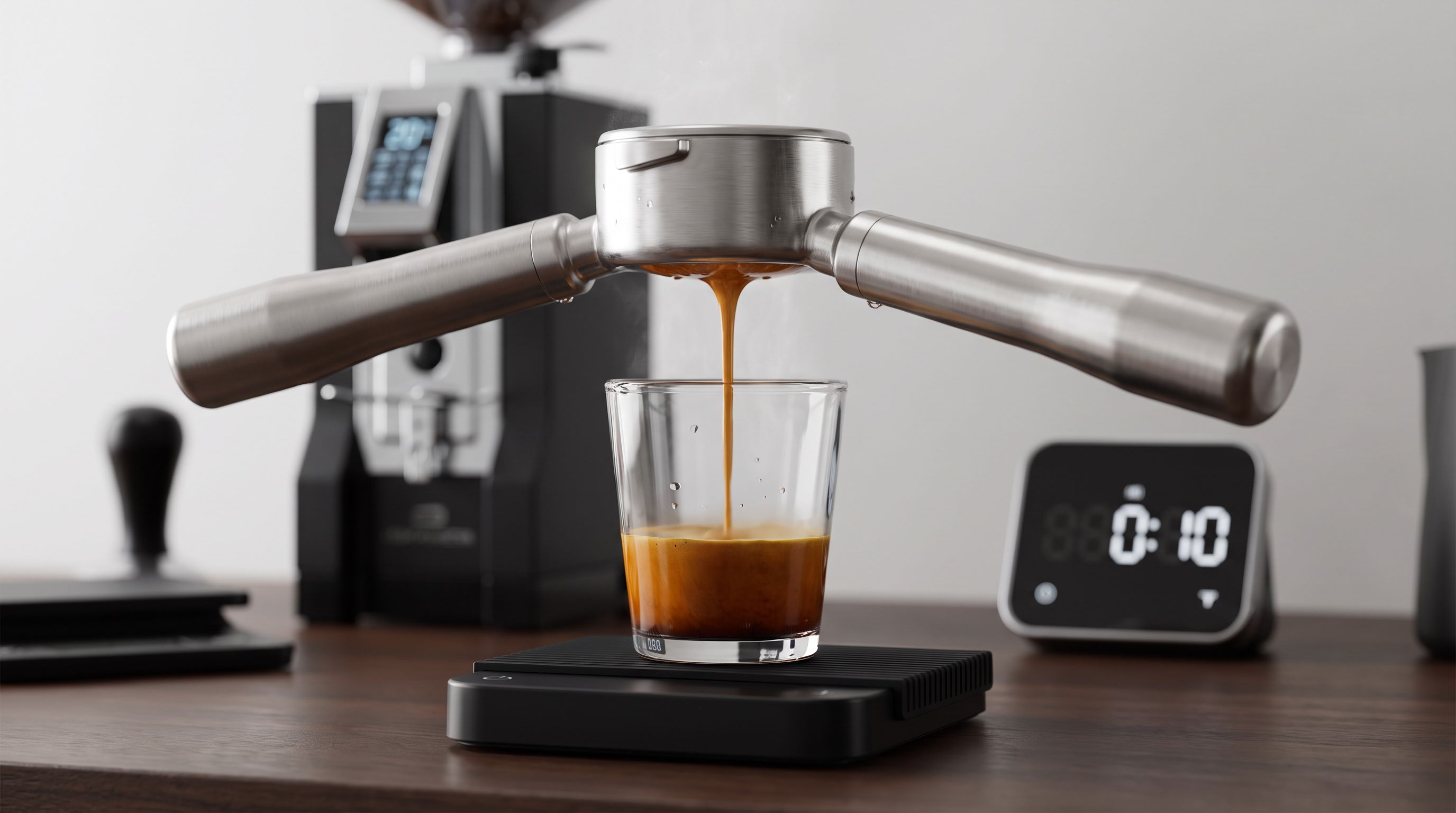
Reader-supported: we may earn a commission from links on this page, at no extra cost to you. It never affects our picks. Learn more.
The shot that was perfect on Tuesday and sour on Thursday
You didn't change anything. Same beans, same machine, same button. Yet Thursday's shot ran fast and tasted thin and sharp, while Tuesday's was syrupy and sweet. This is the single most common complaint in home espresso, and forum threads about it — "same settings, airtight beans, clean machine, different shot" — turn up constantly because the frustration is real.
The reason is structural, not mystical. Espresso is a brew method where roughly 9 bars of pressure forces water through a compressed bed of very fine coffee in about 25 to 30 seconds. That setup magnifies small variations. A drip brewer gives water four minutes to average out imperfections; espresso gives it half a minute and a pressurized shortcut around any weak spot in the puck. Everything that is merely a rounding error in a pour-over becomes a taste-defining event in a shot.
The good news is that the variable list is shorter than it looks. Dose, yield, and grind do most of the work. Water temperature, puck prep, bean age, and machine stability matter — but they mostly express themselves through those three numbers. If you control dose and yield precisely and use grind as your one adjustment dial, the morning lottery mostly ends.
What's actually happening in the cup
A brew ratio is just dose in, liquid out. Pull 18 g of dry coffee and stop at 36 g in the cup and you've brewed a 1:2 — the standard modern "normale." Tighten to 18 g in, 18 g out and you have a 1:1 ristretto: thicker, more intense, less total extraction, and more likely to read as sour or salty if the grind isn't fine enough. Open to 1:3 (18 g to 54 g) and you get a lungo-style shot: higher extraction, more clarity and acidity on the nose, and real risk of bitterness and astringency if you go too far. Those three ratios are the common reference points, and they describe genuinely different drinks, not minor tweaks.
Here is the part people miss: the ratio is a target, not a result. The only thing you actually control directly is dose and the moment you stop the pump. Grind size controls how long it takes to get there — and therefore how much of the coffee's soluble material comes along. Two shots at an identical 1:2 ratio can taste entirely different because one took 22 seconds and the other 34. That's the scenario that fuels the "same dose and yield, different espresso" question: the ratio matched, the flow rate didn't.
Then layer in the stuff that shifts underneath you overnight:
- Bean age. Coffee degasses continuously. Fresh-off-roast beans release CO2 that resists water flow, so shots run slow; two weeks later the same grind setting runs faster. Your grinder didn't change; the coffee did.
- Humidity and static. Finer grinds clump and cling differently day to day, changing how evenly the bed packs.
- Roast level and origin. Light, dense, high-altitude coffees generally want finer grinds, hotter water, and often longer ratios than dark roasts. A new bag is a new recipe, full stop.
- Puck prep. Uneven distribution creates channels. Water takes the path of least resistance, overextracts that channel, underextracts everything else, and the cup tastes simultaneously sour and bitter.
- Temperature. Small differences in brew temperature measurably move perceived acidity and sweetness, which is why thermally stable machines and consistent warm-up routines matter.
The real players, and what's actually shipping
Nothing in espresso gear is magic, but a few categories genuinely remove variance.
Scales. This is the unglamorous fix that outperforms almost any machine upgrade. A 0.1 g scale with a fast refresh rate under the cup lets you stop the shot at a real number instead of eyeballing a line on a double shot glass. The Acaia Lunar 2021 is the reference product here — fast response, 0.1 g resolution, built-in timer, sized for a drip tray. The Timemore Black Mirror Basic Plus covers the same job for far less money with 0.1 g readout and auto-start timing. Either turns "yield" from a guess into a measurement.
Grinders. Grind is your adjustment variable, so adjustment resolution is the spec that matters — not burr diameter, which marketing loves to quote. A 64 mm flat burr set with coarse, clunky steps in the espresso range is less useful than a smaller burr with fine, repeatable increments. The Baratza Encore ESP is the clearest illustration: it's a conical grinder whose adjustment range was retuned so that the fine end has usable, closely spaced steps for espresso rather than a single setting that's either too fast or choked. Stepless grinders go further, which is why dedicated espresso grinders from Eureka, Niche, and DF all compete on micro-adjustment and retention rather than headline burr size.
Puck prep tools. A dosing funnel and a distributor are cheap and address the part of the chain nobody measures. Sets like the IKAPE espresso dosing funnel and distributor combination exist because uneven beds, not bad beans, cause a lot of channeling. On paper and in widespread user reports, the biggest gain is from consistent technique, whatever tool enables it.
| Variable | What it does | How precisely to control it | Your daily dial? |
|---|---|---|---|
| Dose (in) | Sets the size and strength base of the shot | ±0.1–0.2 g, same every time | No — fix it |
| Yield (out) | Sets ratio and total extraction | ±0.5 g, stop on the scale | No — fix it |
| Grind | Sets flow rate and extraction speed | Fine steps, one change at a time | Yes |
| Time | A readout, not an input | 25–32 s typical for 1:2 | Diagnostic only |
| Temp | Shifts acidity vs sweetness | Consistent warm-up routine | Rarely |
What it means if you're shopping today
If your shots are inconsistent, the ranked spend is almost always: scale first, grinder second, machine third. A scale costs the least and removes two of the three variables immediately. A grinder with genuine fine adjustment gives you a working dial. A new machine with better temperature stability helps, but it cannot rescue a dose you aren't measuring.
The spec sheet trap is burr diameter. Bigger burrs can grind faster and cooler, but they don't make a grinder more adjustable, and adjustability is the thing that fixes your Thursday shot. Likewise, pressure gauges reading 9 bars tell you about the pump, not about whether water is channeling through a crack in your puck. A bottomless portafilter is a far better diagnostic for that, and costs a fraction of a gauge-equipped machine.
What to watch next
The clear direction in 2026 is machines and grinders that log and repeat recipes rather than just execute them: grind-by-weight dosing, programmable yield-by-weight stops via Bluetooth scales, and flow or pressure profiling that's increasingly appearing below the prosumer tier. The practical promise is that the machine remembers the recipe so you don't have to re-derive it every morning. Also worth watching: more roasters printing suggested dose, yield, and time on the bag, which quietly acknowledges that a ratio is coffee-specific rather than universal.
None of that removes the underlying physics. Beans will still degas, humidity will still shift, and grind will still be the dial you turn. The upgrade is simply that you'll spend less time guessing which variable moved.
FAQ
What ratio should I start with? 1:2 — for example 18 g in, 36 g out — is the standard modern starting point and the most forgiving. Move toward 1:1 for thicker, more intense shots, toward 1:3 for lighter roasts and more clarity.
My shot hit 36 g but in 18 seconds. What do I change? Grind finer and leave dose and yield alone. Time is a readout telling you flow is too fast; grind is the lever that fixes it.
Do I need to change grind when I open a new bag? Yes, essentially always. Different roast levels, origins and roast dates all change how the coffee resists water. Treat each bag as a new recipe.
Why do fresh beans run slow? Freshly roasted coffee is still releasing CO2, which disrupts flow through the puck. Many people find shots stabilize after a week or so of rest, then gradually speed up as the coffee ages.
Is an expensive scale worth it over a cheap one? The useful specs are 0.1 g resolution, a fast refresh rate, and water resistance under a drip tray. A budget scale with those traits gets you most of the consistency; premium models mainly add speed and connectivity.
Our picks
Acaia Lunar 2021 Espresso Scale
0.1 g resolution with fast refresh and a built-in timer — the clearest way to lock dose and yield.

Baratza Encore ESP Coffee Grinder ZCG495BLK, Black
Espresso-tuned burrs and fine steps in the espresso range, so grind changes are actually usable.

TIMEMORE Black Mirror Basic 3.0 Coffee Scale, Espresso Scale with Timer, Flow Rate & Brew Ratio, 3 Brewing Modes, 0.1g High Precision Rechargeable Digital Scale for Pour Over, Espresso - Black
0.1 g readout and auto-timer at a fraction of boutique scale cost — enough to make ratios repeatable.

IKAPE 58MM Espresso Accessories Kit 9 in 1, WDT Tool, Impact Espresso Tamper, Coffee Distributor, Magnetic Dosing Funnel, Puck Screen, Tamper Mat, 200 Paper Filters, Towel & Brush, Barista Tools
Funnel plus leveler reduces spills and uneven beds, the hidden source of shot-to-shot variance.
Get the best kitchen gear deals in your inbox
Join the PrepDeck newsletter for hand-picked kitchen gear deals and new buying guides. No spam, unsubscribe anytime.
Related reads
Single Dose Coffee Grinder 2026: Ranked by Retention
We compared single dose coffee grinders for 2026 on grounds retention, burr size and bellows design — picks from $250 to $900 for home espresso.
Skip the Coffee Subscription: Buy a Grinder in 2026
A coffee subscription won't fix stale, uneven grounds. Here are the burr grinders worth buying in 2026, from a $100 workhorse to single-dose espresso machines.
Espresso Boilers in 2026: Single, HX, or Dual, Explained
Single boiler, heat exchanger, or dual boiler? How each design actually handles back-to-back shots and milk steaming — and what that means for buyers in 2026.