Baking Steel for Bread in 2026: Fit It to Your Rack First
A baking steel for bread lives or dies on fit. Measure your rack, pick a thickness your oven can preheat, and see which 2026 steels suit sourdough and pizza.
Reader-supported: we may earn a commission from links on this page, at no extra cost to you. It never affects our picks. Learn more.
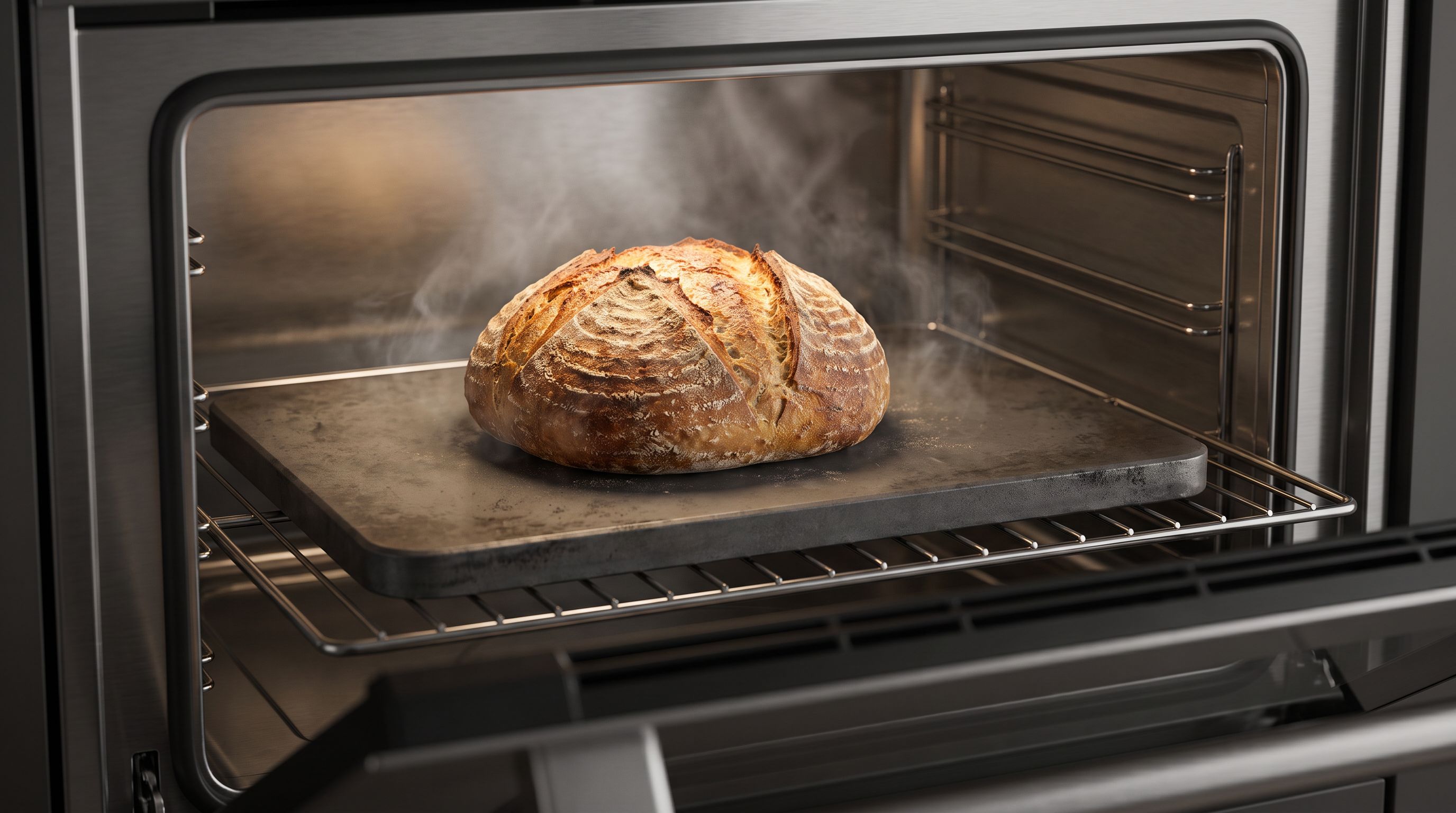
Most baking-steel disappointment traces back to one mistake: buying by thickness and price, then discovering the slab chokes your oven. A steel that spans the full rack blocks convection, starves the heating element, and turns a 500°F oven into a slow, uneven one. A steel that's too thin gives up its heat the moment a 2-pound boule lands on it.
So the order of operations for bread bakers is: measure the rack, then choose thickness, then choose brand. Here's how to do all three.
Step 1: Measure your oven rack — and subtract
Pull out the rack you actually bake on and measure its interior width and depth. Then subtract for airflow.
- Leave at least 1 inch of clearance on each side between the steel and the oven walls, and ideally 1–2 inches at the back. Hot air has to circulate up and around the slab; block it and you get a scorching bottom with a pale top.
- Standard 30-inch US ranges typically have usable rack widths around 22–24 inches, but the practical limit is narrower once you account for side rails and wall clearance. A 14" x 16" steel is the safe universal size.
- 24-inch and apartment ranges, plus most wall ovens under 27 inches, often can't take anything wider than about 14 inches. Measure twice.
- Countertop and compact ovens usually need a small format — check both width and the rack-to-element height, since a thick slab eats vertical space your loaf needs for oven spring.
This is the whole reason the Baking Steel Original 14" x 16" remains the default recommendation: it's big enough for a boule plus room to steam, and it fits the majority of home ovens without strangling them. The Baking Steel Plus 15" x 20" is genuinely better if you bake two loaves at a time or long batards — but in a typical 30-inch range it's close to wall-to-wall, and you need to confirm your rack depth before ordering.
 Best for multiple loaves · Baking Steel Plus 15 x 20 — Check price on Amazon →
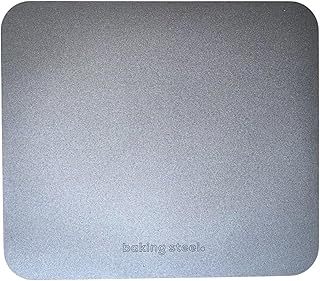 Best overall · Baking Steel Original 14 x 16 — Check price on Amazon →
Step 2: Choose thickness by what your oven can actually preheat
Thickness buys thermal mass. Thermal mass buys oven spring — the burst of expansion in the first 10 minutes that separates an open crumb from a dense one. But mass also costs preheat time, and home ovens have limits.
| Thickness | Rough weight (14x16) | Realistic preheat | Best for |
|---|---|---|---|
| 1/4" (6 mm) | ~15–16 lb | 45–60 min at max temp | All-around: sourdough, pizza, focaccia, baguettes |
| 5/16" (8 mm) | ~19–20 lb | 60 min | Bakers who want more recovery between loaves |
| 3/8" (9.5 mm) | ~23–25 lb | 60–75 min | Back-to-back bakes, high-hydration doughs, Neapolitan-style pizza |
| 1/2" (12 mm) | 30 lb+ | 75–90 min+ | Rarely worth it at home; hard to handle, risks burnt bottoms |
A few hard truths:
Most home ovens top out at 500–550°F. A thicker steel doesn't get hotter than the oven — it just holds more energy at that temperature. The benefit is recovery, not peak heat.
Preheat time is non-negotiable. Your oven's "preheat complete" beep measures air temperature, not slab temperature. A 1/4" steel needs roughly 45 minutes to an hour at full temperature; 3/8" needs longer. Short-change it and you've bought a very heavy cookie sheet. An infrared thermometer is the cheapest upgrade you can pair with a steel.
Thicker is not automatically better for bread. Pizza wants an aggressive, fast bottom bake. Bread wants 35–50 minutes on the slab, and an over-energetic 1/2" steel at 500°F can carbonize the base of a sourdough boule before the crumb sets. This is why many bread-focused bakers land on 1/4" to 3/8", not thicker.
For most people the sweet spot is 1/4". Step up to 3/8" — the NerdChef Steel Stone Pro territory — only if you bake several loaves or pizzas in sequence and want the surface back up to temperature fast. Be honest about whether you want to lift 25 pounds in and out of a hot oven.
 Premium pick · NerdChef Steel Stone Pro (0.375) — Check price on Amazon →
Step 3: Steel vs. stone vs. "bread steel"
Steel conducts heat roughly 15–20 times faster than cordierite stone. That's the entire argument: steel dumps energy into dough quickly, which is what you want for oven spring and blistered pizza crust.
The counterargument for bread is that fast conduction can over-brown bottoms on long bakes. Two ways around it: lower your bake temperature by about 25°F after the first 15 minutes, or slide a sheet pan under the loaf partway through.
Or choose gear designed for the problem. The Brod & Taylor Baking Steel Plate is pitched explicitly at bread bakers — the thickness and mass are tuned to heat quickly and retain heat without burning loaf bottoms, and it arrives pre-seasoned so you can bake on it the day it lands. If you mostly bake hearth loaves and only occasionally make pizza, it's the more sensible default than a maximal slab.
 Best balance of heat and weight · Brod & Taylor Baking Steel Plate — Check price on Amazon →
And if you've decided the fast-conduction thing isn't for you, the FibraMent-D Home Oven Baking Stone is the long-standing non-steel answer: a thick composite slab that bakes gentler, more even bottoms, works beautifully for multi-loaf hearth baking, and weighs less than a steel of comparable footprint. It won't blister a pizza in five minutes. It will bake excellent bread.
 Best non-steel alternative · FibraMent-D Home Oven Baking Stone — Check price on Amazon →
How to actually use a steel for bread
- Position it on the middle or lower-middle rack for bread. Lower-middle gives better bottom heat for boules; middle is safer for enriched doughs.
- Leave it in the oven permanently if your rack space allows. It evens out temperature swings for everything you roast and bake, and you stop dreading the lifting.
- Steam matters more than the steel. A steel gives you spring from below; steam gives you an extensible crust that can expand. Use a covered vessel for the first 20 minutes, or a pan of lava rocks on the bottom rack.
- Preheat at your oven's max, then drop. Many bakers preheat at 550°F, load the loaf, and reduce to 450–475°F for the remainder.
- Don't shock it. No cold water, no dishwasher. Scrape when cool, wipe with a thin film of oil. A carbon steel slab will darken and season like a cast iron pan — that's the goal, not a defect.
- Account for the extra oven load. A 20-pound steel slows recovery every time you open the door. Work quickly when loading.
Which one for which baker
| Baker | Pick | Why |
|---|---|---|
| One loaf at a time, standard 30" range | Baking Steel Original 14" x 16" | Universal fit, 1/4" thickness, proven performer |
| Two loaves or long batards, confirmed wide rack | Baking Steel Plus 15" x 20" | Full surface for batch bakes; measure first |
| Bread-first, pizza occasionally | Brod & Taylor Baking Steel Plate | Tuned to avoid scorched bottoms, pre-seasoned |
| Back-to-back bakes, pizza nights | NerdChef Steel Stone Pro 3/8" | Maximum recovery between launches |
| Wants gentler bottoms, less weight | FibraMent-D Home Oven Baking Stone | Even hearth bake, easier to handle |
FAQ
What size baking steel fits a standard oven? 14" x 16" fits the large majority of 30-inch US ranges with clearance for airflow. Before buying anything larger, measure your rack's interior width and depth and leave at least an inch on each side.
How thick should a baking steel for bread be? 1/4" (6 mm) handles sourdough, baguettes and focaccia well and preheats in under an hour. Go to 3/8" only if you bake multiple items back-to-back. Half-inch slabs are heavy, slow to preheat, and prone to over-browning bread bottoms.
How long do I preheat a baking steel? Plan on 45–60 minutes at your oven's maximum for a 1/4" steel, and up to 75 minutes for 3/8". Ignore the preheat chime — it reads air temperature. An infrared thermometer confirms the surface.
Can I leave a baking steel in the oven all the time? Yes, and most owners do. It stabilizes oven temperature for roasting and baking generally. Just add a few minutes to any preheat, and be aware it may slightly slow broiling from below.
Will a steel burn the bottom of my bread? It can, on long bakes at high heat. Drop the temperature about 25°F after the first 15 minutes, or slide a sheet pan beneath the loaf for the final stretch. A bread-oriented plate like the Brod & Taylor also reduces the risk.
Steel or stone for sourdough? Steel for maximum oven spring and crust blistering; a thick stone like the FibraMent-D for gentler, more even bottoms across longer bakes. Both work — steel is less forgiving but more dramatic.
Our picks
Baking Steel Original 14x16 | Pre-Seasoned Pizza, Bread & Sourdough Steel
The 1/4" original that started the category: fits most 30-inch ovens with airflow to spare.
Nordic Ware Extra Large High-Sided Baking Pan, 21.1 x 15 x 2 inches, XL Big baking pan Natural Uncoated Aluminum, Reinforced Steel Rim Prevents Warping, Big Batch
A full-width slab for batch sourdough and long batards — measure your rack before you buy.
Brod & Taylor Bread Steel Duo, Bake Two Loaves at Once and Pizzas, Fast Preheating, Extra Durable Solid Steel, Pre-Seasoned & Ready For Baking
Pre-seasoned and sensibly thick, so it drives oven spring without scorching loaf bottoms.
NerdChef Steel Stone - High Performance Pizza Baking | Made in USA (14.5" x 16") - (.375" Thick - Pro)
Thicker 3/8" plate holds heat through back-to-back bakes; needs a long preheat.
FibraMent® Premium 20" x 15" x 3/4" Rectangle Pizza Stone, Perfect for Home Ovens - Commercial Grade Delivering Superior Heat Retention and Even Cooking - Ranked 'BEST OVERALL PIZZA STONE'
Thick cordierite-composite slab bakes gentler bottoms on long hearth loaves and stays lighter to handle.
Get the best kitchen gear deals in your inbox
Join the PrepDeck newsletter for hand-picked kitchen gear deals and new buying guides. No spam, unsubscribe anytime.
Related reads
Why 1g Kitchen Scales Fall Short for Bread, Explained
Resolution isn't accuracy. Here's why 1g kitchen scales struggle with salt, yeast and starter in bread baking — and what specs actually matter in 2026.
Pizza Steel vs Stone in 2026: Pick One That Fits Your Oven
Pizza steel vs stone in 2026: how thickness, mass and rack clearance change your crust — plus picks sized for standard 30-inch home ovens.
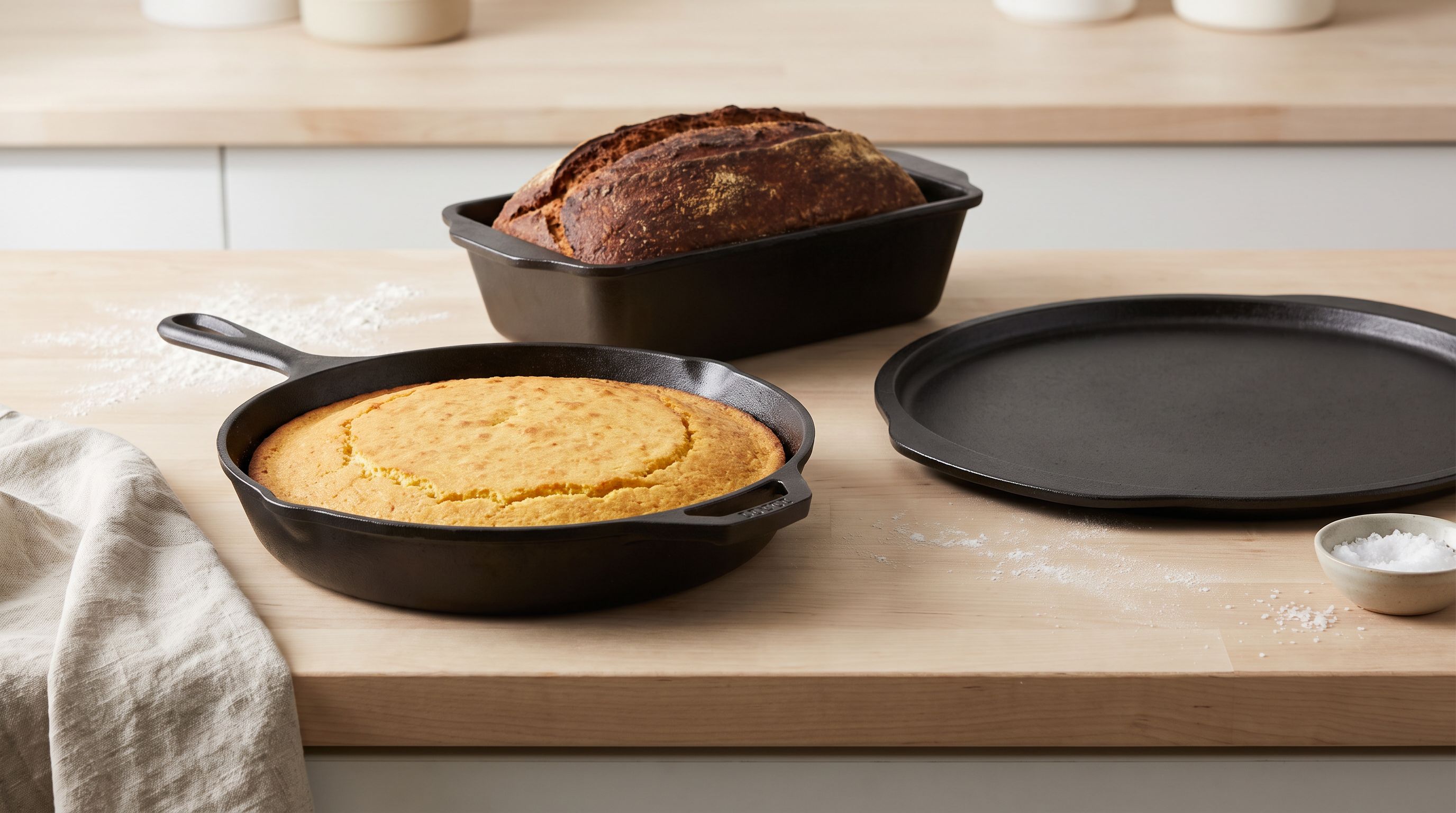
Cast Iron Bakeware in 2026: Preheat Mass Is the Real Spec
Cast iron bakeware in 2026, ranked by preheat mass and oven rack clearance — loaf, cornbread and pizza pans compared against steel and ceramic for crust.