Why 1g Kitchen Scales Fall Short for Bread, Explained
Resolution isn't accuracy. Here's why 1g kitchen scales struggle with salt, yeast and starter in bread baking — and what specs actually matter in 2026.
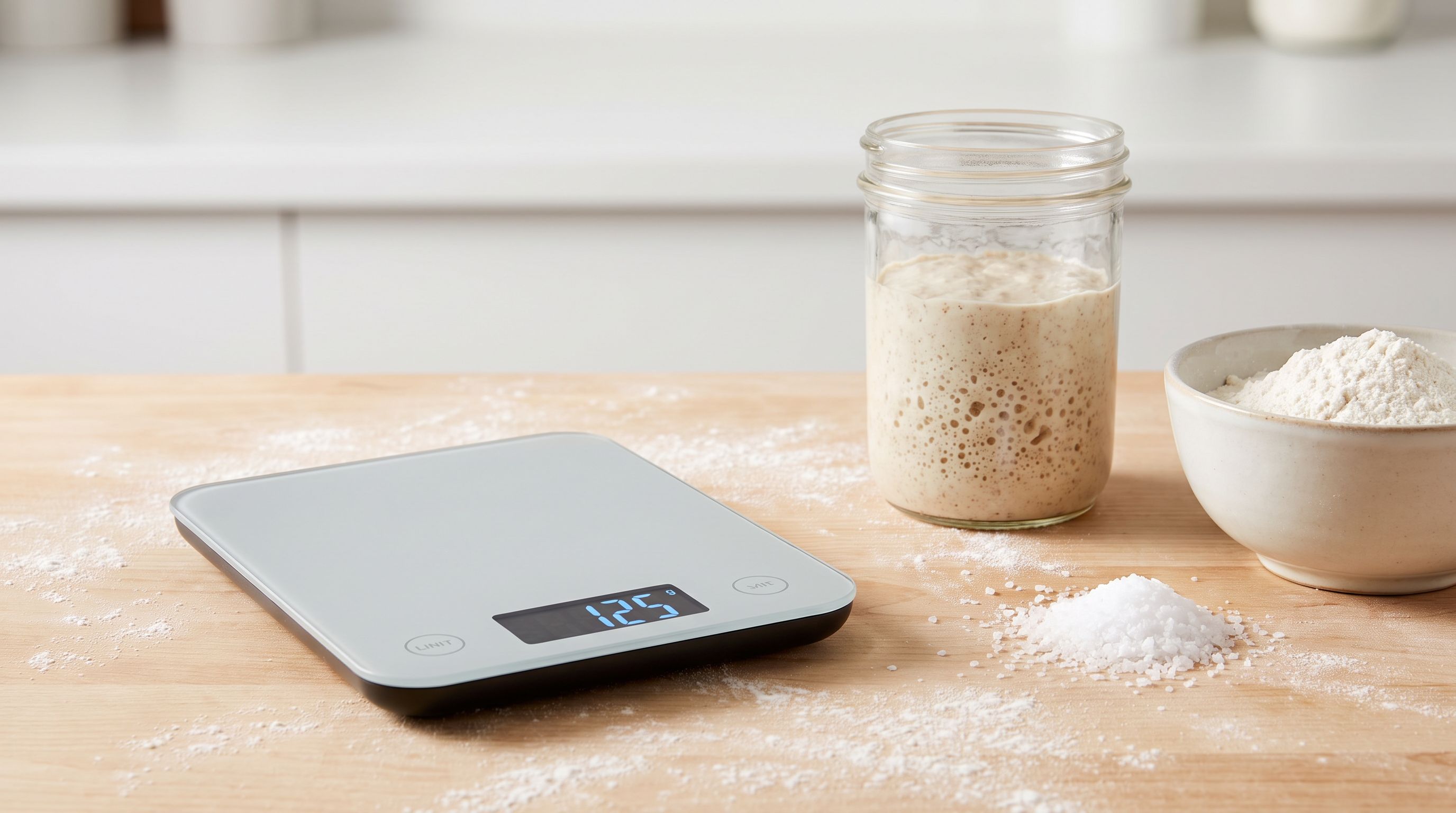
Reader-supported: we may earn a commission from links on this page, at no extra cost to you. It never affects our picks. Learn more.
The 2g of salt that ruins a loaf
Weigh 1,000g of flour on a typical kitchen scale and a gram of error is statistically invisible — one tenth of one percent. Weigh 8g of instant yeast on the same scale and that same gram is a 12.5% error. Weigh 3g of salt for a small test batch and you can be off by a third.
This is the quiet problem with the "1g is fine for baking" advice that dominates roundups. It is true for the big numbers. Bread, unfortunately, is a recipe format built out of one enormous number and several tiny ones, and the tiny ones control fermentation rate, gluten tightness and flavour. Wirecutter's 2026 kitchen scale coverage puts it plainly: most digital food scales weigh in whole grams, and that is fine for most recipes — while separately noting that these scales "struggle to track minuscule changes," which makes them poor at capturing a gram or two of salt. Both statements are correct. Bread lives in the gap between them.
The deeper issue is that "1g" is not even a claim about accuracy. It is a claim about resolution — the smallest increment the display will show. Those are different specifications, and conflating them is how shoppers end up with a scale that reads confidently and weighs badly.
What's actually happening now
Three things converged to make this a live 2026 discussion.
First, baker's percentages went mainstream. Sourdough recipe culture normalised expressing every ingredient as a percentage of flour weight — 2% salt, 75% hydration, 20% levain. Percentages are unforgiving at small scale: a 300g-flour test loaf needs 6g of salt, and a ±1g scale error is a ±17% salt swing.
Second, home bakers started scaling down. Single-loaf and half-batch baking, plus the enduring interest in stiff starters and small preferments, pushed more weights below 10g, exactly where 1g resolution loses meaning.
Third, the market responded with milligram scales — and reviewers started pushing back. Serious Eats' long-running kitchen scale testing found that a small scale marketed as precise to the hundredth of a gram struggled to detect a 0.02g calibration weight. That is the central lesson of this whole category: a display with more decimal places does not guarantee the sensor beneath it can resolve, or repeat, those numbers.
Resolution, accuracy, repeatability — three different specs
Understanding these three terms is most of the battle.
Resolution (readability) is the display increment: 1g, 0.1g, 0.01g. It is a rounding behaviour, nothing more. A scale can show 0.01g and still be wrong by half a gram.
Accuracy is how close the reading is to true mass. On inexpensive kitchen scales this is often stated as a percentage of the load plus some number of display increments — meaning the stated tolerance can be several times larger than the resolution.
Repeatability (linearity and drift) is whether the same object reads the same way twice, at different spots on the platform, after the scale has been on for ten minutes, and after you tare a heavy bowl. This is where cheap strain-gauge load cells show their limits — and where tare stacking quietly compounds error, because each tare carries forward whatever drift already existed.
There's one more practical trap: minimum weighable amount. A scale rated to 5kg may simply not respond until a few grams sit on it. Placing 3g of yeast on a 5kg platform can read 0, 2 or 4 — not because the scale is broken, but because it is being used far outside its useful range. Resolution tells you nothing about this; range does.
| Spec | What it means | Why bread bakers care |
|---|---|---|
| Resolution | Smallest displayed increment (1g, 0.1g, 0.01g) | Sets the floor for reading salt, yeast, diastatic malt |
| Accuracy | Deviation from true mass, often ±% of load + increments | Can be larger than resolution; rarely published clearly |
| Repeatability | Same reading, twice, after tares | Multi-tare bread workflows stack small errors |
| Capacity | Max load (often 5kg / 11lb) | Must hold bowl + 1kg flour + water without maxing out |
| Minimum weight | Lowest load the sensor reliably registers | The real reason tiny amounts read erratically |
The real players and what actually ships
The bulk-weighing tier is mature and largely settled. The OXO Good Grips 11 lb Stainless Steel Food Scale with Pull-Out Display is the archetype: 1g resolution, an 11lb (5kg) capacity that comfortably handles a Dutch-oven-sized dough batch, and a display that slides out from under wide bowls — a genuinely functional design answer to the most common kitchen-scale complaint. The Escali Primo P115 Digital Kitchen Scale occupies the other end of the same tier: flat, cheap, minimal, and a perennial fixture in professional-kitchen recommendations precisely because there is little to go wrong. The Greater Goods Nutrition Food Scale covers the same 1g brief at a lower price point for bakers who mostly need flour and water.
 Budget bulk option · Greater Goods Nutrition Food Scale — Check price on Amazon →
None of these is the problem. They do the 1,000g job well.
The gap gets filled from an unexpected direction: pocket scales built for the jewellery and reloading markets. The American Weigh Scales AWS-100 Digital Pocket Scale reads to 0.01g within a 100g range — small capacity, fine resolution, calibration weight typically supported. That range restriction is the feature, not a limitation. A sensor designed for 100g maximum can meaningfully resolve 3g of salt in a way a 5kg platform cannot.
This is why the honest answer for serious bread baking in 2026 is usually two scales, not one. It is also why the "does everything" milligram kitchen scale remains a sceptical purchase — Serious Eats' calibration-weight findings suggest marketing decimals outrun sensor capability more often than not.
What it means if you're shopping today
If you bake 1kg-flour loaves with 20g of salt, a good 1g scale is genuinely sufficient — your salt error stays around 5%, and dough is more forgiving than recipe pedantry suggests.
If you bake small batches, do percentage-driven sourdough, work with stiff levains, or use potent additions like diastatic malt powder or ascorbic acid, 1g resolution is doing real damage to your consistency, and no amount of careful pouring fixes it.
Practical priorities, in order: capacity that fits your actual mixing bowl plus ingredients; a display you can still see with a bowl on the platform; reliable tare behaviour; and only then decimals. Add a small-range 0.01g scale for anything under about 20g rather than chasing a single unit that claims to span 3g to 5kg.
And buy a calibration weight. It is the cheapest way to convert a spec sheet claim into something you can actually verify — and the only way to find out whether your scale's fourth decimal place means anything.
What to watch next
Watch for clearer spec disclosure. Kitchen scale listings still advertise resolution while burying or omitting accuracy tolerance and minimum weighable amount; legal-for-trade scales publish all three. Consumer pressure and more rigorous review methodology — testing against known calibration masses rather than kitchen impressions — are pushing that direction.
Watch, too, for app-connected and "smart" scales. Connectivity adds recipe-scaling and baker's-percentage math, which is genuinely useful for bread. It does not improve the load cell. Treat software features as convenience, and judge the hardware on capacity, repeatability and range.
FAQ
Is 1g resolution enough for bread? For standard loaves using 500–1,000g of flour, yes. For small batches, or for weighing salt, yeast and other sub-10g ingredients, it is coarse enough to cause meaningful percentage errors.
Should I buy one 0.01g scale instead of two scales? Generally no. Fine-resolution scales usually have small capacities, and reviewers have found that scales claiming hundredth-of-a-gram precision don't always deliver it. A 1g bulk scale plus a small-range pocket scale is the more dependable pairing.
Why does my scale show 0 when I add a pinch of yeast? You're likely below the scale's minimum weighable amount. High-capacity platforms need a certain load before the sensor responds reliably.
Does the 2g-increment scale in my cupboard work for baking? For flour and water, yes. For salt and yeast it compounds the same problem as 1g, doubled — worth relegating to bulk duty.
How do I know my scale is accurate? Check it against a known calibration weight in the range you actually use, and re-check after several tares. Repeatability matters as much as the initial reading.
Our picks
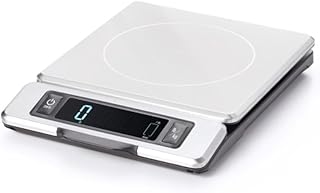
OXO Good Grips 11 Pound Stainless Steel Food Scale with Pull-Out Display
1g resolution, generous capacity and a pull-out display that clears wide mixing bowls.
Escali Primo P115 Digital Kitchen Scale
A long-running, no-frills 1g scale that reviewers repeatedly cite for consistent everyday weighing.

Series Digital Pocket Weight Scale, Stainless-Steel Backlit LCD 100g x 0.01g, (Black), AWS-100-Black - AMERICAN WEIGH SCALES
0.01g readability in a 100g range — the classic second scale for tiny bread ingredients.
Greater Goods Food Scale with Nutrition Calculator, 2,000 Codes (Silver)
Inexpensive 1g kitchen scale with tare and a flat platform for bowls and bannetons.
Get the best kitchen gear deals in your inbox
Join the PrepDeck newsletter for hand-picked kitchen gear deals and new buying guides. No spam, unsubscribe anytime.
Related reads
Stand Mixer Wattage vs. Gearing, Explained
Why a 325-watt KitchenAid can out-knead an 800-watt rival: how gearing, drive type and torque decide dough performance — and what the wattage number really tells you.
Bread Proofing Boxes in 2026: 4 Picks by Counter Space
The best bread proofing box for home bakers in 2026, plus bannetons, bench scrapers and couches — sorted by batch size, counter footprint and real baking use.

The Median Kitchen Scale Costs $24.99 in 2026
The median kitchen scale lists at $24.99 on Amazon, with 94% of 104 analyzed listings priced under $51 — and a 38x gap between cheapest and priciest.