Sous Vide Circulators in 2026: Watts, Pot Size, Noise
How wattage, pump flow, and clamp design decide the biggest pot your circulator can hold. Our 2026 picks for small batches, big briskets, and quiet kitchens.
Reader-supported: we may earn a commission from links on this page, at no extra cost to you. It never affects our picks. Learn more.
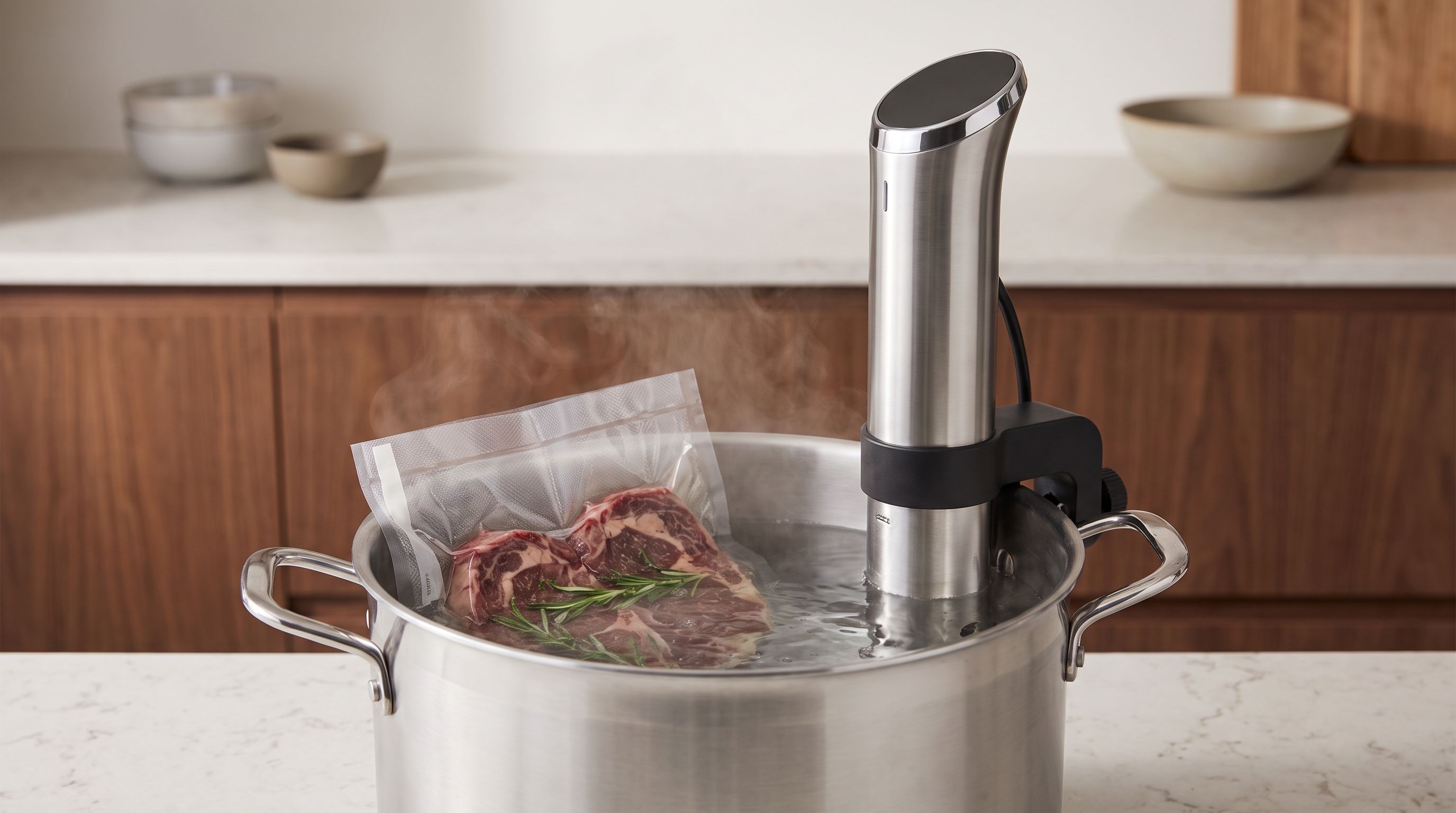
Sous vide gear has quietly stopped being a novelty. The circulators still on sale in 2026 are a small, refined group, and the differences between them come down to three things that actually change what you can cook: how many watts the heater puts out, how much water the pump moves, and how the thing attaches to your container.
Almost every buying guide leads with app features. That's backwards. A circulator's app matters for about ten seconds per cook. Its wattage matters every minute it's running.
Wattage is really a "how big a pot" spec
A circulator has two jobs: get the water up to temperature, and hold it there against heat loss. Wattage governs both.
- 800W brings a typical 12-quart stockpot of hot tap water to 135°F in a reasonable time and holds it easily. It struggles once you get past roughly 5 gallons, or when you're cooking uncovered in a cold kitchen.
- 1000–1100W is the sweet spot for home use. It handles anything from a 6-quart pot to a 20-quart Cambro, and it recovers quickly when you drop in four pounds of refrigerated pork shoulder.
- 1200W (the Anova Precision Cooker Pro's rating) is what you want if you're filling a cooler or running 12-hour cooks on short ribs for a crowd. Anova rates it for up to 100 liters — a figure that assumes an insulated, covered container, not an open pot on a granite counter.
One important caveat: standard North American 15A circuits. A 1200W circulator plus anything else meaningful on the same circuit will trip a breaker. If your kitchen outlets are shared with a microwave or toaster oven, plan accordingly.
Heat-up time is where wattage is most visible. The Joule Turbo's "Turbo" mode is essentially an aggressive heating strategy that overshoots and settles, shaving real time off short cooks like steak or chicken breast. It doesn't make the steak better; it makes dinner happen sooner.
Pump flow: the spec nobody prints
Manufacturers rarely publish liters-per-minute anymore, which is frustrating, because flow rate is what keeps a big container within a fraction of a degree top to bottom. A high-wattage heater with a weak pump produces a hot zone near the device and a cool corner where your bag is floating.
You can't shop by a number here, so shop by proxy:
- Circulators with a directional or adjustable outflow (the Anova Pro's skirt, the Joule's bottom-out design) push water further.
- Container shape matters more than pump specs. A tall, narrow pot circulates better than a wide, shallow one at the same volume.
- Overcrowding kills flow. Four bags stacked flat against the wall will do more damage to temperature uniformity than any pump difference between two good units.
The practical test: clip a second thermometer at the far corner of your container. If it reads within 0.5°F of the circulator after 20 minutes, your setup is fine.
Clamp design decides your container
This is the spec that most often causes buyer's remorse.
- Screw clamps (Anova Precision Cooker Pro, Monoprice Strata Home) open wide, grip thick-walled coolers and polycarbonate Cambros, and stay put. They're bulkier.
- Spring clips / fixed C-clamps are quick but limited. Some won't open far enough for a 1-inch cooler wall.
- Magnetic bases — the Joule Turbo's signature — let it stand upright in any steel pot with no clamp at all. Brilliant in a stainless stockpot, useless in a polycarbonate container, where you'll want the included clip.
Check the minimum water line too. Most circulators need 2.5–3 inches of water depth to run, which rules out a 6-quart saucepan for some models. The Joule has the lowest minimum of the group, which is why it's the one people use for small, weeknight-scale cooks in a Dutch oven.
Noise: quieter than you think, but not silent
Circulators are not loud appliances — expect a low hum somewhere in the range of a refrigerator compressor, plus water movement. What people actually complain about is overnight noise, and the usual culprit isn't the pump. It's:
- Vibration transfer from the clamp into a thin metal pot. Clamp to a heavier vessel or add a silicone pad and the hum largely disappears.
- Low water level, which makes the pump gurgle and slurp. Top it off.
- Evaporation over 12+ hour cooks, which causes both noise and eventual shutoff. Cover the surface with a lid, plastic wrap, or sous vide balls.
If your circulator will run next to a bedroom, the Joule Turbo and the Anova 3.0 are generally reported as the calmer options; older, larger-bodied units with big impellers tend to be the noisiest.
Comparison
| Model | Rated power | Controls | Clamp / mount | Best container size |
|---|---|---|---|---|
| Breville Joule Turbo Sous Vide | 1100W | App only (Wi-Fi + Bluetooth) | Magnetic base + clip | 2 gal to ~12 gal |
| Anova Precision Cooker 3.0 | 1100W | Onboard screen + dial, app optional | Adjustable clamp | 3 gal to ~15 gal |
| Anova Precision Cooker Pro | 1200W | Onboard display, app | Heavy screw clamp | 4 gal to ~26 gal (100L) |
| Monoprice Strata Home 800W | 800W | Onboard buttons, no app | Wide adjustable clamp | 2 gal to ~5 gal |
| Instant Accu Slim | 800W | Onboard buttons, no app | Fixed clamp | 2 gal to ~4 gal |
 Best with onboard controls · Anova Precision Cooker 3.0 — Check price on Amazon →
 Best overall · Breville Joule Turbo Sous Vide — Check price on Amazon →
Which one for your kitchen
Most people: Breville Joule Turbo Sous Vide. It's the smallest body here, stores in a drawer, needs the least water depth, and heats fast. The trade-off is real and worth stating plainly: there is no screen and no dial. If your phone dies or Wi-Fi drops mid-cook, the unit keeps running at its last setting but you can't change anything. If that bothers you, skip it.
If you want physical controls: Anova Precision Cooker 3.0. Same practical wattage class as the Joule, with a screen and a scroll wheel, plus IPX7 water resistance — meaning a full dunk in the sink won't kill it. This is the least stressful circulator to own.
If you cook in volume: Anova Precision Cooker Pro. The 1200W heater and industrial screw clamp exist for coolers, 20-quart Cambros, and all-day cooks. It's physically larger and heavier than everything else here, which is the price of that clamp. Overkill for one steak; correct for 20.
On a budget: Monoprice Strata Home Sous Vide Immersion Cooker 800W is the value play, long a Wirecutter favorite, with a genuinely good clamp for the money. The Instant Accu Slim is the simplest option in the category — buttons, a display, no connectivity — and for someone who cooks two steaks in a 12-quart pot on Saturdays, that's all that's required. Neither is the one to buy if you think you'll graduate to cooler-sized batches.
 Best value · Monoprice Strata Home Sous Vide Immersion Cooker 800W — Check price on Amazon →
What actually improves results (and it isn't the circulator)
Once you're above 800W with a decent clamp, the biggest gains come from the container, not the cooker:
- A lid. Cuts evaporation, noise, and energy draw dramatically on long cooks.
- An insulated or polycarbonate container rather than thin steel. A 12-quart Cambro with a cut lid holds temperature with far less heater duty cycle.
- A rack. Keeping bags separated and vertical does more for even cooking than any pump upgrade.
- Hot tap water to start. You can cut heat-up time roughly in half for free.
FAQ
Do I need Wi-Fi on a sous vide circulator? No. It's genuinely useful for long cooks — a phone alert when a 12-hour brisket finishes is nice — but a unit with onboard controls and a timer does the same job. Don't pay a premium for connectivity alone.
Is 800W enough? For pots up to about 5 gallons, yes. It will just take longer to come up to temperature, and it will recover more slowly after you add cold food. For anything cooler-sized, go to 1100W or above.
Can I leave a circulator running overnight? Yes, that's the normal use case for tough cuts. Use a covered container, start with enough water above the minimum line, and put it on a stable surface. Most units shut off safely on low water.
Will it work in a plastic container? Yes, with a food-safe polycarbonate container rated for the temperature — it insulates better than metal. Note that a magnetic base won't grip it, so you'll need the clamp.
What temperature does the water actually hold? Good modern circulators hold within roughly ±0.1–0.2°F at the device. Variation across a large container is far more likely than drift at the sensor.
Our picks
Breville BSV600PSS Joule Turbo Sous Vide Machine, Polished Stainless Steel
1100W in the slimmest body on the market, fast heat-up, and the best app — but it's app-only.
Anova Culinary Sous Vide Precision Cooker 3.0 (WiFi), 1100 Watts, Stainless Steel
1100W, IPX7 water resistance, and a real screen plus dial so you never need your phone.
Anova Culinary Sous Vide Precision Cooker 3.0 (WiFi), 1100 Watts, Stainless Steel
1200W, 100L rating and a heavy-duty screw clamp built for coolers and 20-quart Cambros.
Monoprice Sous Vide Immersion Cooker 800W - With Adjustable Clamp And Digital LED Touch Screen, Easy To Clean, Black and Silver - Strata Home Collection
800W with a wide adjustable clamp and physical controls; plenty for pots up to about 5 gallons.
Instant Pot Accu Slim Sous Vide Immersion Circulator
800W, simple button interface, no app or Wi-Fi to fight with — good for pots under 4 gallons.
Get the best kitchen gear deals in your inbox
Join the PrepDeck newsletter for hand-picked kitchen gear deals and new buying guides. No spam, unsubscribe anytime.
Related reads
Air Fryer Toaster Ovens in 2026: 5 Picks by Interior Size
The best air fryer toaster oven 2026 picks ranked by usable interior: what actually fits a 12-inch pizza, a half sheet pan, or a 4-lb chicken.
Electric Pressure Cookers in 2026: Pick by Quart Size First
The best electric pressure cooker 2026 guide that sorts multi-cookers by 3, 6, 8 and 10-quart capacity, inner pot material and pressure rating — match your household.
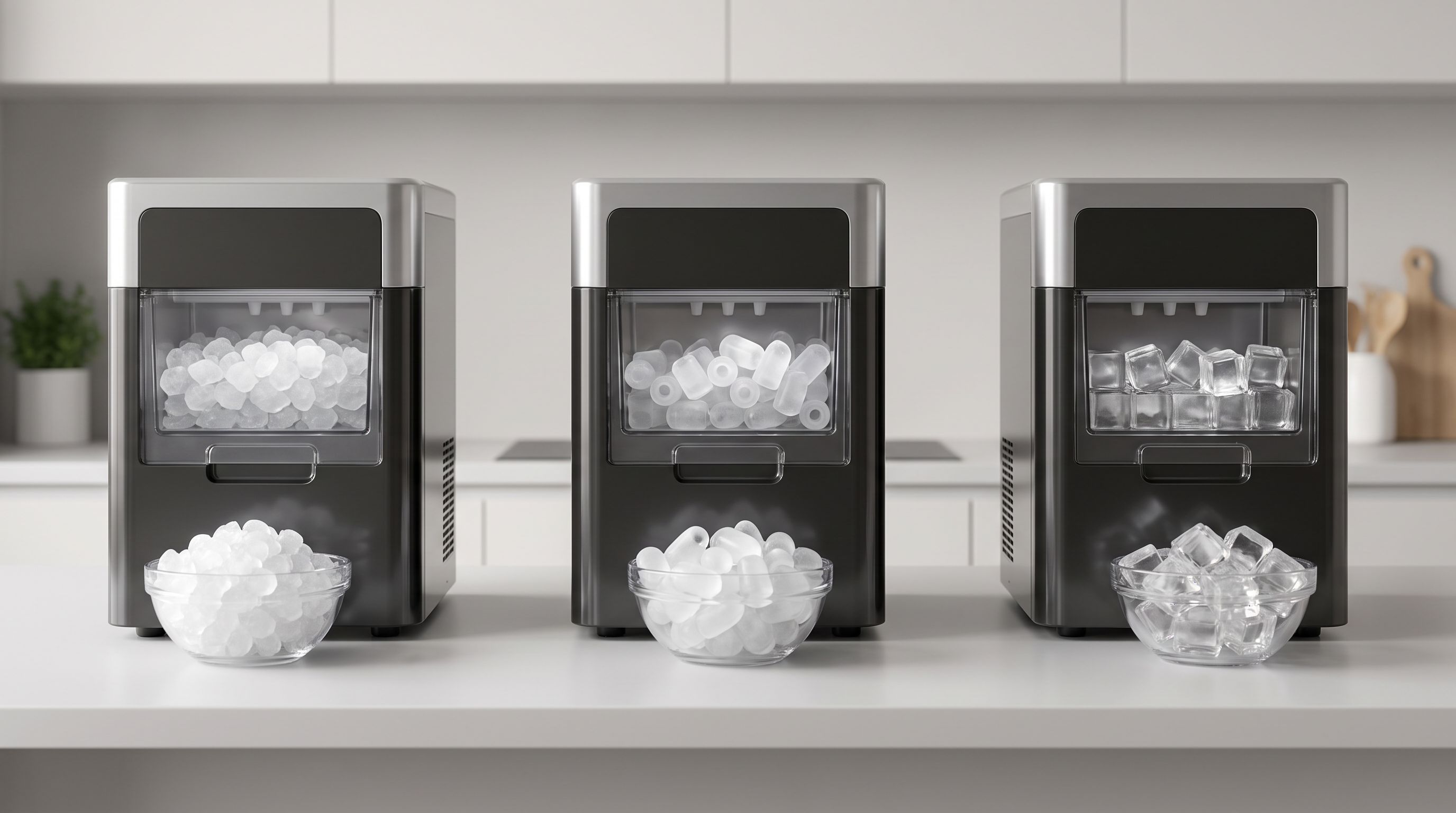
Nugget vs Bullet vs Clear Ice Makers: What to Buy in 2026
Countertop nugget ice maker or a cheap bullet machine? We compare nugget, bullet and clear-cube ice makers on output, noise, drains and counter space for 2026.