Offset vs Pellet vs Kamado Smoker: Which Wins in 2026?
Offset vs pellet vs kamado smoker in 2026: we compare fuel cost, temp stability, capacity and outdoor durability so you can pick the right format the first time.
Reader-supported: we may earn a commission from links on this page, at no extra cost to you. It never affects our picks. Learn more.
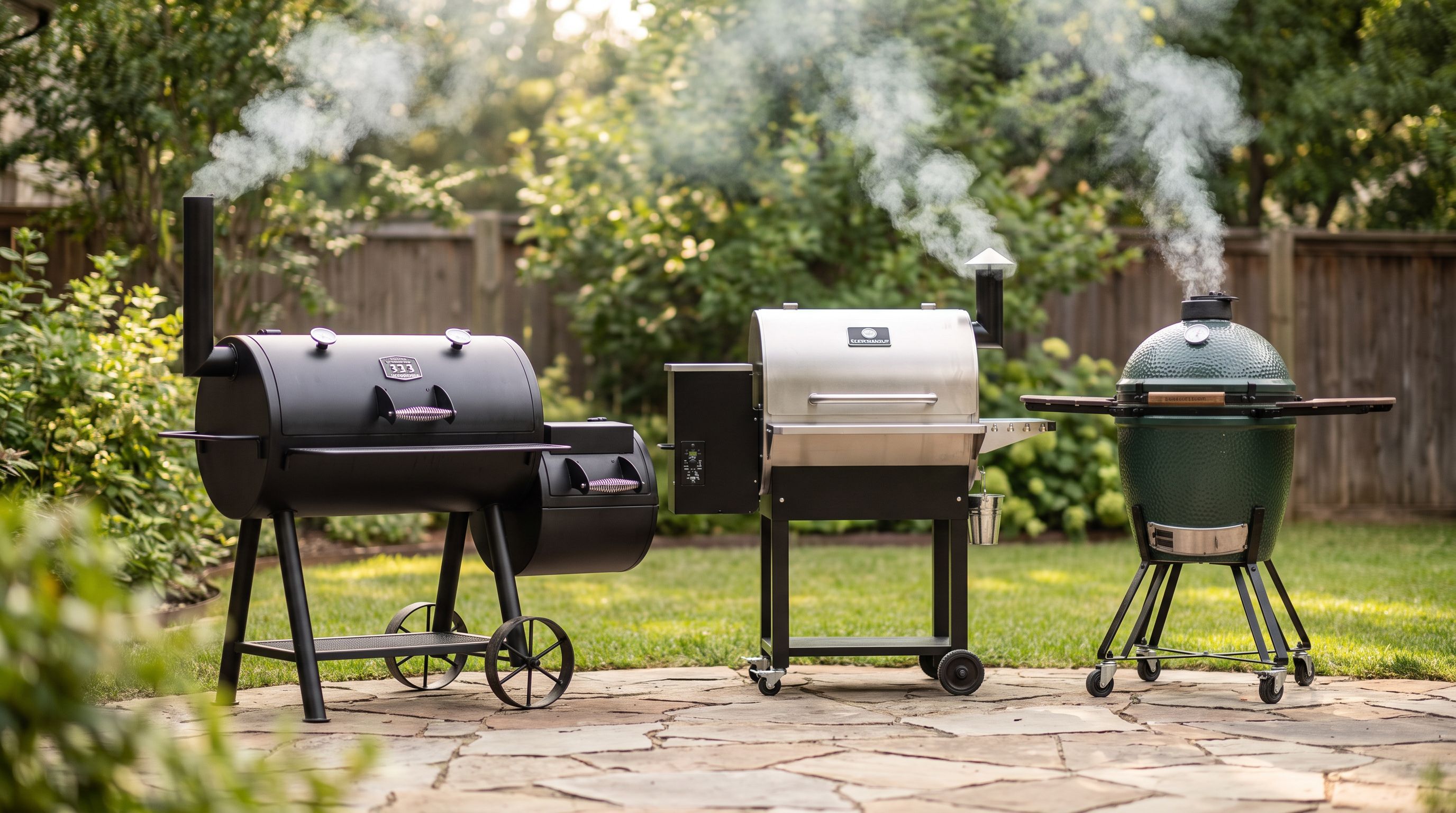
Three smoker formats dominate backyards in 2026, and they solve the same problem in completely different ways. An offset burns split wood in a side firebox and drags smoke across the meat. A pellet grill augers compressed hardwood into a fire pot and runs it like a convection oven. A kamado is a thick ceramic (or insulated steel) egg that turns a small pile of lump charcoal into 12+ hours of stable heat.
Choosing between them is less about which makes the best brisket and more about how you actually spend a Saturday. We compared the three formats on fuel cost, temperature stability, cook capacity and long-term outdoor durability, drawing on manufacturer specs, independent review-site testing and the consistent themes in owner feedback.
The short answer
- Buy a pellet grill if you want reliable barbecue with minimal babysitting, and you're willing to accept a lighter smoke profile and a dependency on electricity.
- Buy a kamado if you have a small patio, want one cooker that smokes low and sears at steakhouse temperatures, and you value fuel efficiency and a 20-year lifespan.
- Buy an offset if the fire is the hobby. Nothing else gives you the same clean wood smoke, but nothing else asks for as much of your day.
Fuel cost and efficiency
Kamados are far and away the cheapest to run per cook. The ceramic shell is essentially a heat battery, so a single basket of lump charcoal commonly carries an overnight brisket at 250°F without a refill. Owners routinely report finishing a long cook with usable charcoal left in the firebox.
Pellet grills land in the middle. Hardwood pellet consumption rises sharply with ambient temperature and set point — roughly 1 to 3 lbs per hour depending on conditions, with winter cooks at the high end. Pellets also need dry storage; a bag that absorbs humidity swells, jams the auger and causes the temperature swings people blame on the controller.
Offsets are the most expensive to feed. You're burning seasoned splits continuously, and a 10-hour brisket cook on a backyard-size offset can go through a meaningful chunk of a wood rack. If you can source local post oak, hickory or pecan cheaply, the math improves a lot; buying bundled wood at a hardware store does not.
Temperature stability
This is where the formats separate most clearly.
A pellet grill with a modern PID controller holds a set point within a tight band and recovers quickly after lid openings. The Traeger Ironwood 885 and Weber Searwood XL 600 both illustrate the current state of the art: set the dial, monitor probes from a phone, and go do something else. For overnight cooks and for anyone new to barbecue, that reliability is the whole selling point.
 Best pellet for searing · Weber Searwood XL 600 — Check price on Amazon →
 Best overall · Traeger Ironwood 885 — Check price on Amazon →
A kamado is stable in a different way — not electronically controlled, but thermally massive. Once it settles at 225–275°F it tends to stay there for hours with only vent tweaks. The catch is overshoot: ceramic is slow to come down, so if you blow past your target on the way up you can spend 45 minutes nursing it back. New owners learn to sneak up on the temperature.
An offset is a live fire you manage. Expect to add a split every 30–60 minutes and to chase a 25–50°F drift all day. Thin-steel offsets are worse, swinging hard with wind and ambient temperature. Reverse-flow designs like the Oklahoma Joe's Highland Reverse Flow Smoker help significantly by routing heat under a baffle plate before it reaches the food, evening out the classic firebox-end hot spot.
 Best entry offset · Oklahoma Joe's Highland Reverse Flow Smoker — Check price on Amazon →
Cook capacity
If you're cooking for a crowd, offsets win on raw real estate. A backyard offset's main chamber typically swallows two to four packer briskets or several racks of ribs laid flat, and many reviewers note an offset holds two to three times what a comparable kamado does.
Pellet grills scale well too — large models like the Ironwood 885 and Searwood XL 600 offer multiple racks and enough square inches for a party, though the upper rack runs cooler and is better for ribs or sausage than for thick cuts.
Kamados are the most space-constrained per dollar, because the circular grate shrinks as you move away from the widest point. Multi-tier rack systems change the picture: the Kamado Joe Classic III's adjustable divide-and-conquer setup roughly doubles usable area and lets you run two zones at once. Still, a full packer brisket on a Classic-size kamado is a tight, often diagonal fit.
 Best kamado · Kamado Joe Classic III — Check price on Amazon →
Durability outdoors
Owner feedback is consistent here. Ceramic kamados are the longest-lived of the three — the shell doesn't rust, and most manufacturers back it with a long or lifetime warranty. The wear items are gaskets, hinge springs and cast-iron vent tops. Ceramic will crack if you thermal-shock it or drop it, so keep it covered and don't pour cold water on a hot grill.
Offsets live or die by steel thickness. Heavy-gauge offsets outlast everything but ceramic if you keep the cook chamber oiled and the firebox dry; thin big-box offsets rust through at the firebox seams within a few seasons. Either way, a cover is mandatory.
Pellet grills have the shortest practical lifespan because they're the only format with electronics and moving parts. Controllers, induction fans, igniters and augers are the common failure points, and rain getting into the hopper is the number one owner-reported killer. Budget for replacement parts around the five-to-seven-year mark.
Head-to-head comparison
| Offset | Pellet | Kamado | |
|---|---|---|---|
| Smoke flavor | Strongest, cleanest wood smoke | Mildest; smoke tube often added | Strong, clean charcoal + wood chunk |
| Fuel | Seasoned splits | Hardwood pellets + electricity | Lump charcoal |
| Fuel cost per cook | Highest | Moderate, rises in cold | Lowest |
| Temp stability | Hands-on, drifts | Set-and-forget (PID) | Very stable once settled |
| Attention needed | Fire every 30–60 min | Check pellets, probe meat | Vent tweaks only |
| Max capacity | Largest | Large on XL models | Smallest per footprint |
| Max temp / searing | Good | Limited on many models | Excellent (600°F+) |
| Needs power? | No | Yes | No |
| Expected lifespan | Decades if heavy steel | Shortest (electronics) | Longest |
| Best for | Weekend BBQ hobbyists | Busy cooks, overnights | Small patios, grill + smoke |
Who should buy what
Most people should buy a pellet grill. If you want barbecue on a weeknight and reliable results without a learning curve, the Traeger Ironwood 885 is the sensible default: large capacity, decent insulation for cold-weather cooking and a hopper cleanout that makes swapping pellet flavors painless. If you'd rather own one cooker that smokes and sears properly, the Weber Searwood XL 600 runs hotter than most pellet grills and is the better choice for someone replacing a gas grill.
Choose a kamado if your patio is small or your charcoal budget matters. The Kamado Joe Classic III is the most versatile single cooker on this list — low-and-slow, pizza, high-heat searing, all from one basket of lump. If the ceramic price or 200+ lb weight is a blocker, the Char-Griller Akorn Kamado Charcoal Grill delivers most of the insulated-kamado behavior in light steel and is a genuinely good first smoker.
 Budget pick · Char-Griller Akorn Kamado Charcoal Grill — Check price on Amazon →
Choose an offset only if tending fire sounds like fun, not work. The Oklahoma Joe's Highland Reverse Flow Smoker is the realistic entry point: thick enough steel to hold heat, reverse-flow plates that tame the hot spot, and a well-documented path of simple mods (gasket sealing, a better thermometer, a charcoal basket) that bring it close to custom-builder performance. Go in expecting to spend a full day beside it.
FAQ
Does a pellet grill really make less smoke flavor? Yes, and it's the most common complaint in owner feedback. Pellet fires burn efficiently and clean, which produces less of the flavorful combustion byproducts. Running at 180–225°F for the first few hours, using a smoke tube, and choosing stronger pellets (hickory, mesquite, competition blends) all narrow the gap — but an offset will still taste more assertive.
Can a kamado handle a full packer brisket? On a Classic-size kamado it's tight. You can fit one by bending the flat into the dome or trimming the point, and the multi-level rack system helps. For regularly cooking two packers, step up to a Big Joe-size kamado or a large pellet grill.
Do pellet grills work in winter? They run, but consumption climbs and recovery slows. Insulated models and a dedicated insulation blanket help a lot. Kamados are the best cold-weather performers — the ceramic mass barely notices the outside temperature.
Is a cheap offset smoker worth buying? Thin-steel offsets under a certain build quality leak everywhere and swing wildly, which frustrates beginners into quitting. If offset is the goal, buy the heaviest steel you can afford, or buy a kamado instead and add wood chunks for smoke.
Which is easiest to clean? Kamado, by a wide margin — ash falls through to a small pan and the ceramic self-cleans at high heat. Pellet grills need periodic fire-pot vacuuming and grease-tray management. Offsets need regular ash removal and chamber maintenance to prevent rust.
Our picks
Traeger Grills BAC513 Full-Length Grill Cover Grill Accessory - Ironwood 885
Big-capacity pellet smoker with solid temperature control, a hopper cleanout and genuinely useful app monitoring.
Kamado Joe Classic Joe™ Series III 18-inch Charcoal Grill & Smoker, Red, with Cart, Side Shelves, Grill Gripper, and Ash Tool, 3 Tier Cooking System, Stainless Steel Cooking Grates, Model KJ15040921
Thick ceramic holds low temps for 12+ hours on one load and sears hot; the 3-tier rack system doubles usable space.
Oklahoma Joe's Highland Offset Reverse Flow Offset Charcoal Smoker and Grill With 1093 sq. in. Cooking Area in Black
Reverse-flow baffles even out the hot spot, and the steel is thick enough to be worth the mods it will need.
Weber Searwood™ XL 600 Wood Pellet Smoker Grill, 36 inches – Wi‑Fi & Bluetooth‑Enabled Outdoor Grill for Smoking, Searing, Rapid React PID & Cooking up to 600°F, Black
Runs hotter than most pellet grills and holds set temps well, so it grills steaks as well as it smokes.
Char-Griller AKORN 20-Inch Kamado Charcoal Grill and Smoker, Triple-Wall Insulated Steel with Cast Iron Grates, Warming Rack and EasyDump Ash Pan, 445 Sq. In. Cooking Area, Graphite
Insulated steel kamado that sips charcoal and weighs a fraction of ceramic — great first low-and-slow cooker.
Get the best kitchen gear deals in your inbox
Join the PrepDeck newsletter for hand-picked kitchen gear deals and new buying guides. No spam, unsubscribe anytime.
Related reads
Flat Top Griddle vs Pellet Grill in 2026: Only Room for One
Flat top griddle vs pellet grill in 2026: we compare fuel cost, cook surface, cleanup, winter use and long-term durability to help you pick the one that earns your patio.
Pellet Smokers in 2026: 5 Picks From $500 to $1,800
The best pellet smoker 2026 picks compared on hopper capacity, cook area, temperature swing and WiFi control — from budget Pit Boss to Weber and Recteq.
Prime Big Deal Days 2026: What Grill Deals Are Real
Prime Big Deal Days runs October 6-7, 2026. Here's what pizza ovens, grills and smokers typically discount, and the price thresholds worth acting on.