Japanese vs German Chef Knife: Which Fits Your Hands in 2026
Japanese vs German chef knife, compared on edge angle, steel hardness, blade geometry and upkeep — plus four knives worth buying as your first serious blade in 2026.
Reader-supported: we may earn a commission from links on this page, at no extra cost to you. It never affects our picks. Learn more.
Buying your first serious chef's knife usually stalls at the same fork in the road: the heavy, confident German blade your parents owned, or the thin, scary-sharp Japanese knife every chef on YouTube is using. Both camps are right about their own gear and wrong about the other's. The honest answer is that the choice comes down to three measurable things — edge angle, steel hardness, and blade geometry — plus one unmeasurable one: how much sharpening you're actually willing to do.
We compared manufacturer specs, independent review results from outlets like Wirecutter and Serious Eats, and long-run owner feedback to lay out the trade-offs clearly, then picked four knives that cover both styles.
The three specs that actually differ
Edge angle
German knives are traditionally ground to roughly 20 degrees per side; most modern makers, Wüsthof included, now sharpen closer to 14 degrees per side on their forged lines. Japanese knives typically land between 10 and 15 degrees per side, and some single-bevel traditional blades go far lower.
A narrower angle means less steel pushing the food apart, so the knife glides rather than wedges. It also means less steel supporting the apex, which is why thin edges chip when they meet a chicken bone or a frozen edge of butter.
Hardness (HRC)
German cutlery steel — usually X50CrMoV15 — is heat-treated to roughly 56–58 HRC. Japanese knives using VG10, VG-MAX, AUS-10, SG2/R2 or white/blue carbon steels usually run 60–63 HRC, sometimes higher.
Harder steel holds a fine edge far longer. Softer steel is more ductile: it rolls instead of chipping, and a few passes on a honing steel stand the edge back up. That's the entire durability argument in one sentence. Owner reports are consistent here — chipped tips and microchips along the edge are overwhelmingly a Japanese-knife complaint, and they almost always trace back to bones, squash skin, scraping the board with the edge, or the dishwasher.
Geometry and weight
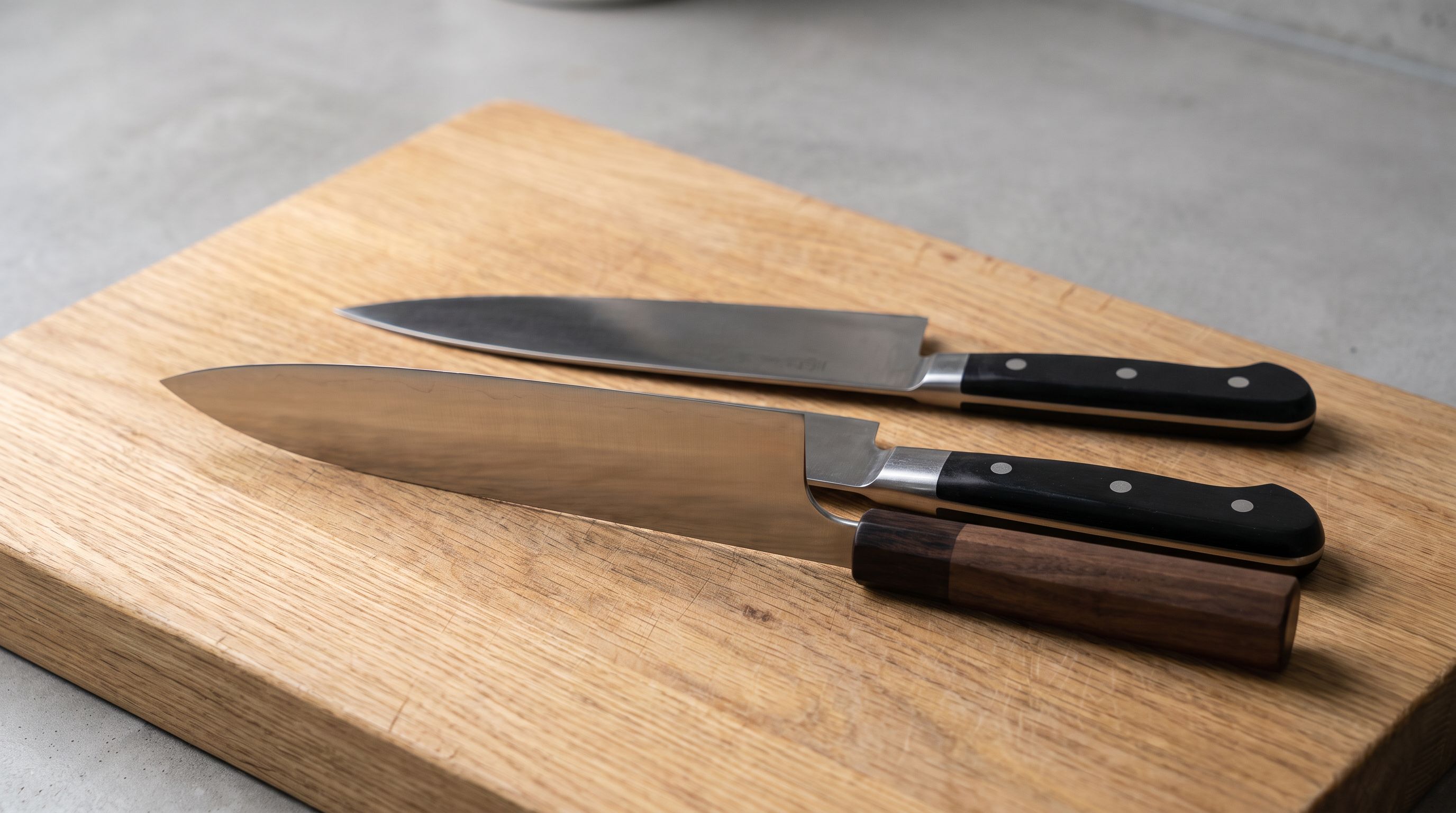
German blades are thicker behind the edge, have a pronounced belly for rock-chopping, often carry a full bolster, and sit heavier in the hand. Japanese gyutos are flatter through the middle, thinner behind the edge, and lighter — they reward a push-cut or glide stroke and a pinch grip.
That bolster matters more than people expect. A full bolster protects your fingers and adds balance, but it also blocks the last centimetre of heel from the sharpening stone, and over years of sharpening it creates a lip you eventually have to grind back.
Side-by-side comparison
| German chef's knife | Japanese gyuto / chef's knife | |
|---|---|---|
| Typical edge angle | ~14–20° per side | ~10–15° per side |
| Typical hardness | ~56–58 HRC | ~60–63 HRC |
| Common steels | X50CrMoV15, 1.4116 | VG10, VG-MAX, AUS-10, SG2, carbon |
| Blade profile | Curved belly, rock-chop friendly | Flatter, push-cut friendly |
| Thickness behind edge | Thicker, more wedging | Thinner, cleaner release |
| Weight (8-inch) | Heavier, blade-forward | Lighter, more nimble |
| Edge retention | Moderate | Longer between sharpenings |
| Chip resistance | High | Lower — avoid bones and frozen food |
| Honing steel | Works well, use often | Use ceramic rod sparingly or skip |
| Sharpening | Easy, forgiving | Needs whetstones for best results |
| Best for | Squash, hard roots, heavy prep, rough handling | Produce, proteins, fine slicing, precision |
Who should buy which
Buy German if you cook fast and messy, break down whole chickens, hack through butternut squash, share the kitchen with people who don't respect knives, or you know you'll never own a whetstone. A Wüsthof Classic 8-Inch Chef's Knife is the archetype: forged, full-tang, full bolster, and essentially impossible to kill with normal home use. Its heft does part of the work on dense vegetables, and when it dulls, a few strokes on a honing rod or a cheap pull-through recovers most of the performance.
 Best overall German · Wüsthof Classic 8-Inch Chef's Knife — Check price on Amazon →
Buy Japanese if you prep a lot of vegetables, care about clean slices through tomatoes and fish, have decent board discipline, and are willing to learn a 1000/3000-grit stone. The Mac Professional Series 8-Inch Hollow Edge Chef's Knife (MTH-80) is the standard recommendation for a reason: it's thin and sharp like a Japanese knife but is ground at a slightly more forgiving angle and uses a tougher steel than most VG10 blades, so it tolerates ordinary home-kitchen clumsiness better than its peers. The hollow-edge dimples genuinely help potatoes and cucumbers release.
If you want Japanese performance with a Western feel, the Miyabi Kaizen II 8-Inch Chef's Knife splits the difference — a hard VG10 core, Damascus cladding, a thin profile, but a full Western handle and bolster that feels familiar to anyone coming off a German knife. The Shun Classic 8-Inch Chef's Knife goes further in the Japanese direction with its D-shaped pakkawood handle and VG-MAX core; it's lighter and finer in the hand, and the handle shape suits right-handed pinch grips especially well.
 Best Japanese design · Shun Classic 8-Inch Chef's Knife — Check price on Amazon →
 Premium pick · Miyabi Kaizen II 8-Inch Chef's Knife — Check price on Amazon →
If you're not sure yet, buy the Victorinox Fibrox Pro 8-Inch Chef's Knife first. It's a stamped, lightweight European knife with a grippy handle, it sharpens in minutes, and professional kitchens have used it for decades. Spend six months learning to cut and sharpen, then you'll know exactly which direction your hands want to go — and you'll still have a knife you're happy to lend out or throw in a bag.
 Budget pick · Victorinox Fibrox Pro 8-Inch Chef's Knife — Check price on Amazon →
The maintenance reality nobody mentions
A Japanese knife is only better than a German knife while it's sharp. A dull 61-HRC blade is more frustrating than a freshly honed 57-HRC one, because the thin geometry no longer has the mass to force its way through anything.
Plan accordingly:
- German knife upkeep: hone on a steel every few uses, full sharpen a couple of times a year. A pull-through or an electric sharpener is acceptable.
- Japanese knife upkeep: skip the steel rod or use a fine ceramic rod very lightly. Sharpen on whetstones — a combination 1000/3000 grit covers nearly everything. Budget 15–20 minutes every month or two depending on use.
- Both: hand wash and dry immediately. Dishwashers wreck edges and handles. Use end-grain or edge-grain wood, or soft polypropylene boards — never glass, stone, or bamboo-with-hard-fillers.
- Both: store in a block, on a magnetic strip, or in blade guards. Loose in a drawer is how tips snap.
Size, handle, and the part you can't read off a spec sheet
Eight inches is the right default for most home kitchens. Ten inches is faster for big-batch prep but intimidating on a small board; seven inches or a 165–180mm santoku suits smaller hands and tight counters.
Handle shape matters more than steel for day-to-day comfort. German handles are contoured and filling; Japanese Western handles are slimmer; traditional wa handles are light octagonal or D-shaped wood that shift the balance toward the blade. If you can get to a shop and hold a few, do it — a knife that's technically superior but uncomfortable gets left in the block.
The short version
Neither tradition wins outright. German knives trade some sharpness and finesse for toughness and low maintenance. Japanese knives trade robustness for a finer, longer-lasting edge and a lighter feel. If your prep is tough, varied, and occasionally careless, go German. If it's precise, produce-heavy, and you enjoy sharpening, go Japanese. And if the honest answer is "I don't know yet," buy a Victorinox Fibrox Pro, learn on it, and upgrade with real information instead of guesswork.
FAQ
Is a Japanese knife too delicate for home use? No, as long as you keep it off bones, frozen food, and hard board materials. The chipping stories are real, but they're almost always a technique or storage problem rather than a defect.
Can I sharpen a Japanese knife with a pull-through sharpener? You can, but you shouldn't. Pull-throughs grind to a fixed, wider angle and will remove the thin geometry you paid for. Whetstones are the right tool, and a basic 1000/3000 combination stone is inexpensive.
Do German knives really need honing that often? Yes — softer steel rolls at the apex, and a honing rod straightens it. Several passes before a big prep session genuinely restores cutting performance between real sharpenings.
Is a santoku a substitute for a chef's knife? Mostly. A santoku is shorter and flatter, so it excels at push-cutting vegetables but is less useful for rocking through herbs or working around a bone. If you only own one knife, an 8-inch chef's knife is the more versatile choice.
Does a more expensive knife cut better? Up to a point. Spending more buys better steel, better heat treatment, thinner grinds, and nicer fit and finish. Past the mid-range, you're mostly buying aesthetics and marginal edge retention — a well-sharpened mid-priced knife beats a neglected expensive one every time.
Our picks
Wüsthof Classic 8" Chef's Knife, Black
The reference-standard German chef's knife: full bolster, forged X50CrMoV15, and nearly indestructible in normal use.
Mac Professional Series 8-Inch Hollow Edge Chef's Knife (MTH-80)
Thin, laser-sharp and forgiving at the same time — the most-recommended Japanese-style chef's knife for home cooks.
Victorinox Fibrox Pro 8 Inch Chef’s Knife, Dishwasher Safe, Black
Stamped, light and cheap to re-sharpen — the no-regrets knife to learn knife skills on before you commit.
MIYABI Kaizen II 8-inch Chef's Knife, Stainless Steel
VG10 core with Damascus cladding and a German-friendly handle — a Japanese edge without a full re-learn.
Shun Classic 8" Chef's Knife
VG-MAX core, D-shaped pakkawood handle and a thin profile that glides through produce.
Get the best kitchen gear deals in your inbox
Join the PrepDeck newsletter for hand-picked kitchen gear deals and new buying guides. No spam, unsubscribe anytime.
Related reads
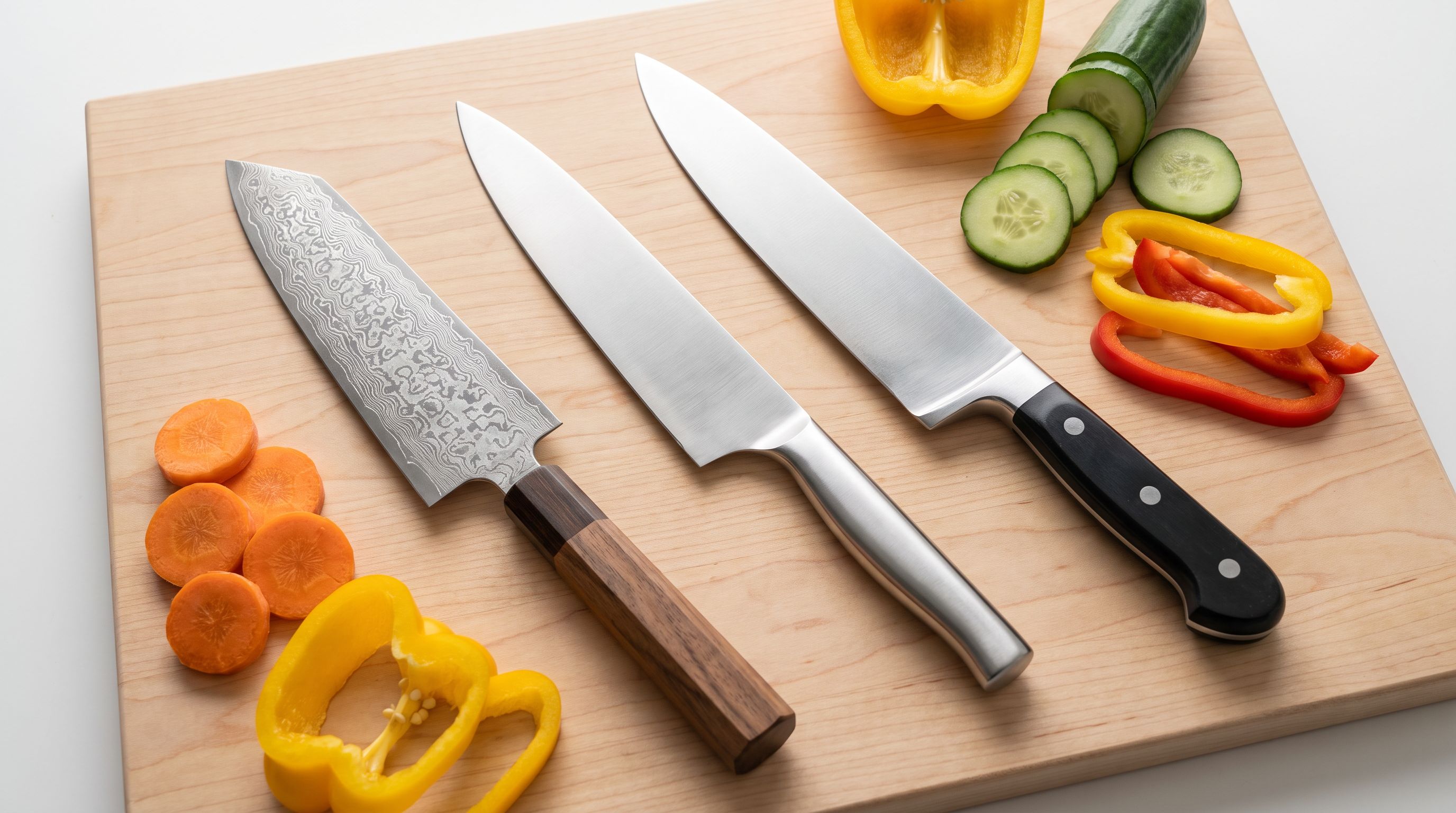
VG-10 vs AUS-10 vs S35VN: The Best Chef Knife Steel in 2026
VG-10, AUS-10, S35VN and X50CrMoV15 decoded. Learn which chef knife steel matches your cooking style, hardness, edge retention and chip risk in 2026.
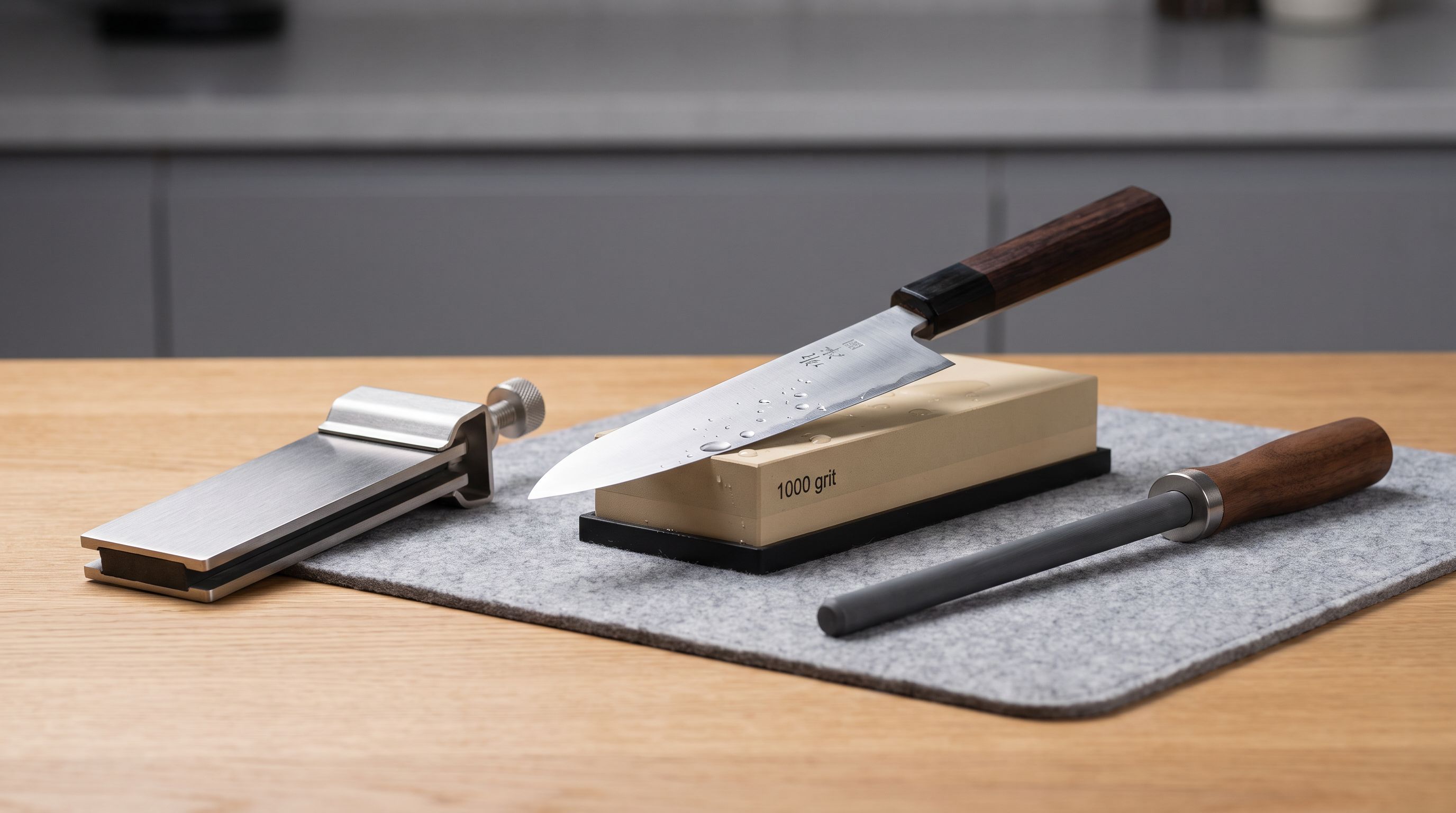
Knife Sharpening Systems in 2026: Stones vs Guided Rigs
Whetstones, guided-angle rigs, or electric? We compare grits, edge angles for Japanese vs German knives, and how much steel each method costs you long term.