Flat Top Griddle vs Pellet Grill in 2026: Only Room for One
Flat top griddle vs pellet grill in 2026: we compare fuel cost, cook surface, cleanup, winter use and long-term durability to help you pick the one that earns your patio.
Reader-supported: we may earn a commission from links on this page, at no extra cost to you. It never affects our picks. Learn more.
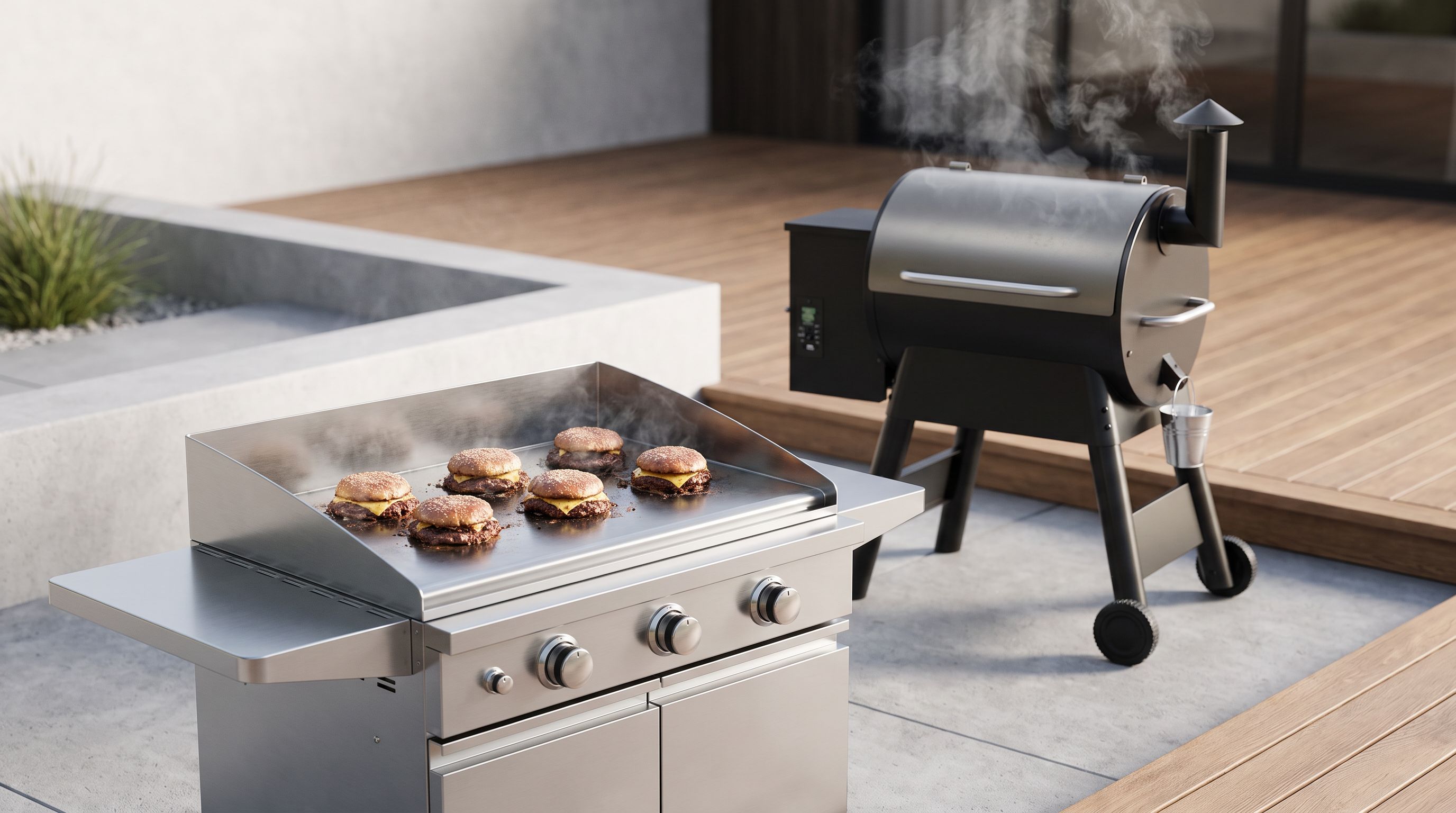
If your patio has one open slot and you're choosing between a flat top griddle and a pellet grill, you're really choosing between two different cooking philosophies. One is a fast, hot steel plate that turns raw ingredients into dinner in 12 minutes. The other is a wood-fired convection oven that turns a tough cut into something remarkable over eight hours — while you do something else.
Neither one replaces the other. But one of them probably fits your actual life better. Here's how they compare on the things that matter after the novelty wears off.
The short version
Buy a griddle if you cook for your family on weeknights, you have kids, breakfast is a thing, and you want dinner on the table faster than the oven preheats. Smash burgers, fried rice, fajitas, hibachi, pancakes, bacon, cheesesteaks, smashed quesadillas — a griddle does these better than any other backyard tool.
Buy a pellet grill if you want barbecue flavor, you cook on weekends more than weeknights, and you'd rather set a temperature and walk away. Pellet grills are also genuine outdoor convection ovens: pizza, wings, spatchcocked chicken, meatloaf, even bread.
The honest tiebreaker: griddles get used more often; pellet grills get used more impressively.
Head-to-head comparison
| Flat top griddle | Pellet grill | |
|---|---|---|
| Fuel | 20 lb propane tank (or natural gas conversion) | Hardwood pellets, by the 20 lb bag; needs an outlet |
| Typical fuel burn | Low — burners rarely run full open for long | Roughly 1–3 lb of pellets per hour depending on temp and weather |
| Heat range | Very high direct heat, zone control per burner | Roughly 180°F to 500°F; some models sear hotter |
| Best at | Burgers, breakfast, stir-fry, fajitas, volume cooking | Brisket, ribs, pork butt, whole chickens, wings, pizza |
| Weak at | Anything needing low-and-slow smoke; no lid on basic models | Fast weeknight dinners; no true flat-top searing surface |
| Time to cooking | 5–10 minutes | 10–15 minutes to come up to temp and settle |
| Cleanup | Scrape, water, wipe, oil — every cook, no exceptions | Minimal per cook; periodic ash vacuum and grease trap |
| Weather tolerance | Excellent — works in wind and cold | Struggles in deep cold and wind; burns more pellets |
| Moving parts | Burners, igniter — that's about it | Auger, fan, hot rod, controller, temp probes |
| Capacity | Whole surface is usable at once | Grate space plus upper rack; indirect only |
| Resale | Steady but modest; tops rust if neglected | Strong for known brands with working electronics |
Fuel cost and running cost
Propane wins on paper. A griddle running two of four burners at medium will stretch a 20 lb tank across many cooks, and propane is cheap and available everywhere.
Pellets are the consumable that surprises people. Expect roughly 1 to 3 pounds per hour depending on set temperature, ambient cold, and wind. A 12-hour brisket can empty a sizable chunk of a bag, and premium hardwood pellets cost meaningfully more than the generic ones. Buy a bag of something decent, store it sealed and dry, and never leave pellets in the hopper over a damp week — swollen pellets jam augers, which is the single most common pellet grill failure.
Then there's the hidden running cost of each: a griddle needs oil and paper towels forever; a pellet grill needs a shop vac and the occasional replacement temp probe or hot rod.
Cook surface: usable space, not advertised space
Griddle surface numbers are honest. A 36-inch flat top, like the Blackstone 36" Griddle with Hood, gives you roughly 700+ square inches of usable steel, and you can use every square inch simultaneously — bacon left, eggs center, hash browns right. That's the real argument for a griddle: throughput. Feeding six people happens in one pass.
 Best overall griddle · Blackstone 36 Griddle with Hood — Check price on Amazon →
Pellet grill numbers are less honest, because the upper rack is usually counted and it runs hotter and drier than the main grate. A mid-size pellet grill like the Traeger Pro 575 or the Weber Searwood XL 600 fits two pork butts or three racks of ribs comfortably, which is plenty for most households. But you can't cook six eggs on it.
 Best overall pellet grill · Weber Searwood XL 600 — Check price on Amazon →
If you have a small balcony or a camping setup, the Blackstone 22" Tabletop Griddle with Hood covers breakfast for four and stores on a shelf — a far better small-space buy than a tiny pellet unit, which still needs power and ash management regardless of size.
 Budget / small-space pick · Blackstone 22 Tabletop Griddle with Hood — Check price on Amazon →
Cleanup: the thing that decides whether you actually use it
Griddle cleanup is mandatory and immediate. Scrape while hot, hit it with water, wipe, re-oil. Takes three minutes if you do it, and turns into a weekend restoration project if you don't. A cold-rolled steel top left wet and bare will show rust within days. The hood matters here more than people expect — it keeps rain and pollen off and holds seasoning longer.
Pellet grill cleanup is deferred. Most cooks need nothing beyond emptying the grease bucket occasionally. But every 15–20 cooks you'll want to vacuum the firepot and barrel ash, and grease management is a genuine fire-safety item — a grease fire in a pellet grill with a loaded hopper is not a small event.
Net: griddles ask for a little effort every time. Pellet grills ask for a bigger effort occasionally. Be honest about which pattern you'll actually follow.
Year-round usability
This is where griddles quietly win in cold climates. A propane burner doesn't care that it's 20°F and windy. A pellet grill in those conditions burns far more fuel, takes longer to recover after you open the lid, and may struggle to hold a clean 225°F without an insulated blanket. If you live somewhere with real winter and plan to cook outside in January, the griddle is the more dependable machine — or budget for a thermal blanket made for your specific pellet model.
Conversely, in summer the pellet grill is the one that keeps your kitchen cool while you ignore it for six hours.
Durability and resale in 2026
Griddles are mechanically simple: steel, burners, an igniter. Failures are usually surface rust or a cheap igniter, both fixable. The risk is cosmetic cart rust and a warped top from extreme thermal shock (don't pour cold water on a screaming-hot plate). Resale is steady but unspectacular — these are common items.
Pellet grills have electronics, and electronics age. Controllers, induction fans, augers, and hot rods are all wear items. The upside is that the big brands sell every one of those parts, and a Traeger or Weber with a working controller holds value well on the used market. Lesser-known brands with proprietary controllers are the risky buy — when the board dies in year five, there may be nothing to replace it with.
If smoke flavor is the whole reason you want a pellet grill, the Camp Chef Woodwind Pro 24 is the one worth stretching for: its smoke box burns actual wood chunks alongside pellets, which produces noticeably more pronounced smoke than standard pellet combustion at low temps.
 Premium pick for smoke flavor · Camp Chef Woodwind Pro 24 — Check price on Amazon →
So which earns the patio?
Count your cooks. If 80% of your outdoor cooking happens on a Tuesday at 6 p.m. with hungry people nearby, buy the griddle — the Blackstone 36" Griddle with Hood is the default for a reason, and you can add a cheap charcoal kettle later for smoke duty.
If your cooking is a weekend project and you genuinely want barbecue, buy the pellet grill. The Weber Searwood XL 600 is the better all-rounder thanks to its sear capability and responsive controller; the Traeger Pro 575 is the safer long-term bet on parts, apps, and accessories.
And if you truly can fit two eventually: griddle plus pellet grill is the strongest two-device backyard combo there is. They overlap almost not at all.
FAQ
Can a pellet grill sear like a griddle? No. Some models hit 500°F or higher and newer units like the Searwood have a dedicated sear mode, but a flat top's full steel contact is a different mechanism entirely. For smash burgers, the griddle is not close to beatable.
Can you smoke on a griddle? Not meaningfully. Hooded griddles let you do a loose "smoke" with a pellet tube at low heat, but it's a workaround, not a feature. If barbecue matters, buy the pellet grill.
Do pellet grills need electricity? Yes — every one of them. The auger, fan, and controller all require an outlet, so you need a weather-rated extension cord or a nearby receptacle. Griddles only need propane and a spark.
How long does a griddle top last? Indefinitely if you season it and keep it covered. Rust is almost always a storage problem, not a steel-quality problem. A hood plus a fitted cover is the cheapest durability upgrade you can make.
Which is better for a busy family with kids? The griddle, by a wide margin. Breakfast, quesadillas, chicken for salads, and burgers all come off faster than you could preheat an oven, and everything cooks at once.
Our picks
BLACKSTONE 36 Inch Gas Griddle with Hood Cooking Station 4 Burner Flat Top Gas Grill Propane Fuelled Restaurant Grade Professional 36” Outdoor Griddle Station with Side Shelf
Four-burner, 36-inch cold-rolled steel top with a hood — the default pick for weeknight volume cooking.
Weber Searwood™ XL 600 Wood Pellet Smoker Grill, 36 inches – Wi‑Fi & Bluetooth‑Enabled Outdoor Grill for Smoking, Searing, Rapid React PID & Cooking up to 600°F, Black
Fast-heating pellet cooker with a genuine sear mode and a controller that holds temps without drama.
Traeger Pro 575
The long-running benchmark: huge parts and accessory ecosystem, strong app control, easy resale.
BLACKSTONE 1813 Original 22" Tabletop Griddle with Hood
Two-burner portable flat top that handles breakfast for four and stores on a shelf.
Kipiea 600D Pellet Grill Cover for Camp Chef Woodwind 24, Woodwind Pro 24, Waterproof BBQ Smoker Cover, UV Resistant, No Tear, No Fading
Smoke box burns real wood chunks alongside pellets, closing the flavor gap with a stick burner.
Get the best kitchen gear deals in your inbox
Join the PrepDeck newsletter for hand-picked kitchen gear deals and new buying guides. No spam, unsubscribe anytime.
Related reads
Pellet Smokers in 2026: 5 Picks From $500 to $1,800
The best pellet smoker 2026 picks compared on hopper capacity, cook area, temperature swing and WiFi control — from budget Pit Boss to Weber and Recteq.
Flat Top Griddles in 2026: 5 Picks Ranked by Cook Surface
The best flat top griddle for 2026, sorted by cooking surface, burner zones and plate thickness — plus seasoning, rust protection and cover advice for year-round patio use.
Portable Pizza Ovens 2026: Pick Your Stone Size First
The best portable pizza oven 2026 picks compared by stone diameter, fuel type, preheat time and packed weight — so your oven matches the pie you actually bake.