Fermentation Chamber Fridge 2026: Picks by Shelf Height
How to choose a fermentation chamber fridge in 2026: usable shelf height, low-temp floor, and controller compatibility for dough retarding, charcuterie, and brewing.
Reader-supported: we may earn a commission from links on this page, at no extra cost to you. It never affects our picks. Learn more.
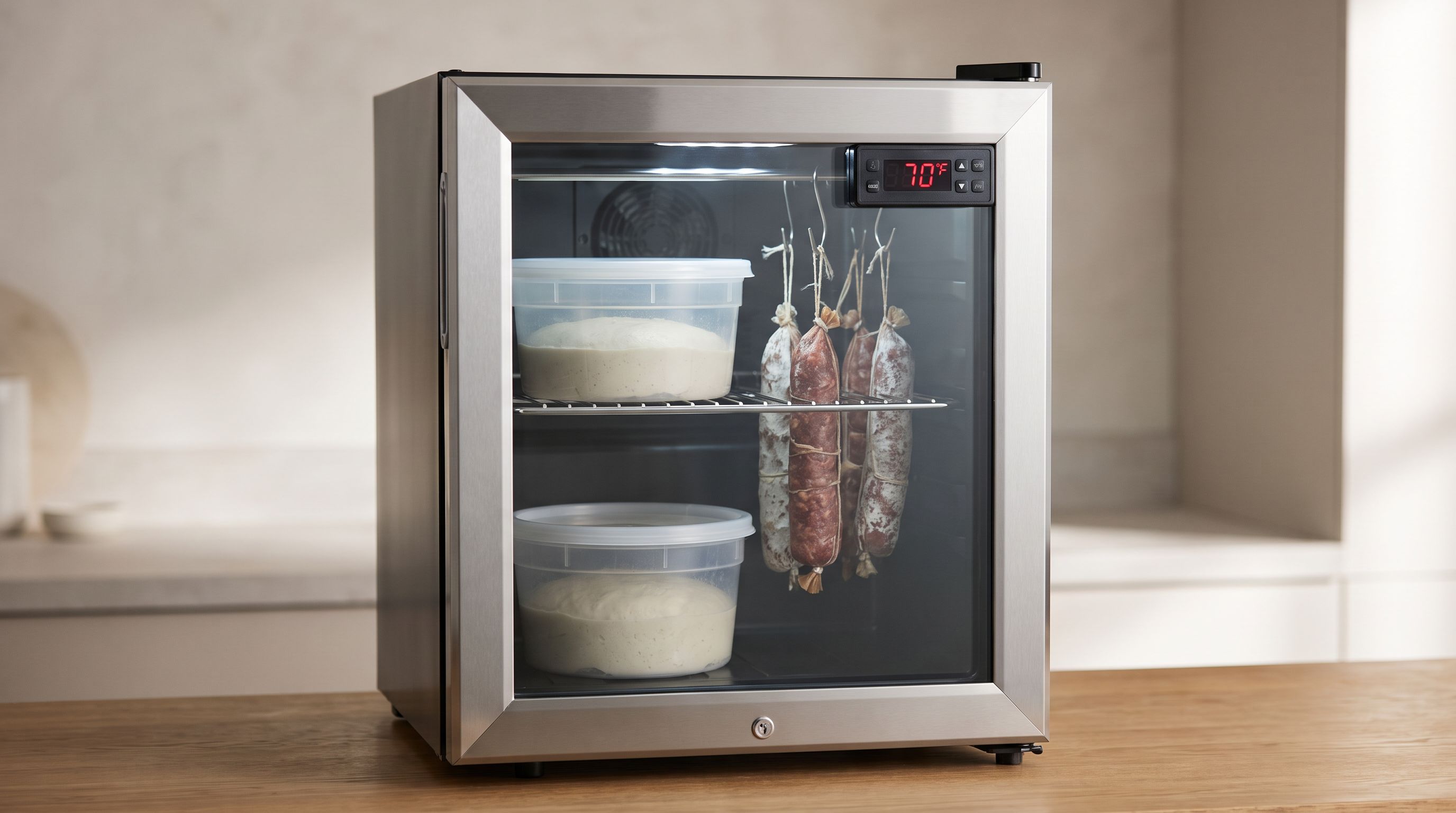
A fermentation chamber fridge is not a special appliance — it's an ordinary compact fridge, beverage cooler, or chest freezer with an external temperature controller plugged in between it and the wall. The controller overrides the factory thermostat, so a cabinet designed to sit at 38°F can instead hold 55°F for charcuterie, 50°F for a cold-retard bulk, or 65°F for an ale ferment.
That means the shopping decision has almost nothing to do with the fridge's own temperature settings and almost everything to do with three physical facts: how tall the usable interior space is, how cold the compressor can actually pull, and whether the unit is thermoelectric or compressor-driven. Get those right and almost any cabinet works. Get them wrong and you own a very expensive box that won't fit a 6-quart Cambro with a lid on.
The three specs that actually decide this
1. Usable shelf height (not total interior height)
Manufacturer "capacity" numbers in cubic feet are useless here. What you need is the clear vertical gap between shelves once you remove what you can remove.
Rough targets:
- 8–10 in — sheet-pan-friendly for pizza dough boxes, proofing trays, round bannetons, quart deli containers.
- 12–14 in — 6 qt and 8 qt Cambro-style tubs with the lid on, half-size hotel pans, most sourdough bulk vessels.
- 18–24 in — hanging space for a single row of salami or a duck breast rack, and the minimum for a 5-gallon bucket fermenter.
- 26–30 in — a 6.5-gallon carboy with an airlock, or a two-tier charcuterie hang.
Wine cabinets are the trap. Their shelves are fixed-pitch and often welded or press-fit into the liner, leaving you 4–5 inches of clearance per bay. Before buying one, confirm that shelves are removable, not just "adjustable." Beverage coolers with wire shelves on ladder racks are nearly always easier to gut than wine racks with contoured wood slats.
2. The low-temp floor — and whether you need it
For dough retarding and charcuterie you never need brutal cold. A retard sits at 38–45°F; a curing chamber lives at 52–58°F with 70–80% RH. Any compressor fridge clears that easily.
The low-temp floor matters if you also want the chamber to serve as a kegerator, lager at 32–34°F, or cold-crash. Thermoelectric (Peltier) coolers typically only manage a fixed offset below ambient — often cited around 30°F below room temperature — so in a 78°F summer kitchen a thermoelectric unit may never see 50°F, let alone 38°F. If the chamber lives in a garage, attic, or un-air-conditioned kitchen, buy compressor-based, full stop.
3. Compressor cycling and controller compatibility
An external controller works by cutting power to the whole unit. That's fine for a compressor fridge as long as you set a compressor protection delay of 3–5 minutes on the controller so it can't short-cycle. Nearly every current Inkbird and Johnson Controls unit has that setting built in.
Two caveats worth knowing before you buy:
- Fridges with electronic touch controls sometimes boot to a default temperature or require a button press after a power cut. Mechanical dial thermostats are friendlier for conversion — set the dial to its coldest and let the external controller do the work.
- Auto-defrost models will periodically run a heater. In a curing chamber that causes humidity swings. Manual-defrost cabinets (most chest freezers, many beverage coolers) are more stable.
Our picks, and what each one is actually for
The Inkbird ITC-308 is the default starting point and the single most common component in home fermentation chambers. It's a plug-and-play dual-relay controller: one outlet for cooling, one for heating, with a probe you tape to the fermenter wall or dangle in air. Buy this first, then shape the cabinet around it. If your chamber is for charcuterie rather than dough or beer, the Inkbird IHC-200 Humidity Controller is the companion piece — it runs a small humidifier and a dehumidifier or fan off the same logic, which is what separates a working curing chamber from a box that grows the wrong mold.
For the cabinet itself, the NewAir 126-Can Beverage Refrigerator is the shape most home fermenters should start with: a narrow, tall, compressor-driven glass-door cooler with wire shelves on a ladder rack. Pull every shelf and you get a single full-height column deep enough to hang a short run of salami or stand a fermenter; leave two or three in and you have multi-tier dough storage. Glass doors cost you some insulation efficiency but let you spot mold bloom or a stalled levain without opening the door.
 Best cabinet for mixed use · NewAir 126-Can Beverage Refrigerator — Check price on Amazon →
If your priority is dough and you want shelves you'll keep, the Whynter BR-130SB Beverage Refrigerator is a stainless, compressor-based undercounter unit with removable wire racks and a reversible door — a good fit for slotting under a counter as a dedicated retarder for deli quarts and pizza dough boxes.
 Best dough retarder · Whynter BR-130SB Beverage Refrigerator — Check price on Amazon →
When the job is bulk volume and absolute temperature range, nothing beats the Midea MRC050S0AWW 5.0 Cu. Ft. Chest Freezer. Homebrew forums have converged on chest freezers for a reason: top-opening means cold air doesn't fall out every time you check, insulation is thicker than any beverage cooler, and the compressor can go well below freezing, so one cabinet handles a 65°F ale ferment, a 34°F lager, and a cold crash. The trade-off is ergonomics — you're lifting heavy tubs over a lip, and a collar build is often needed for tall fermenters. For a counter-height, upright alternative at similar capacity, a compact fridge like a 3.2 cu ft unit with a mechanical dial will serve dough and small-batch work fine, but you'll lose the sub-freezing range.
Comparison
| Cabinet type | Typical usable shelf height | Realistic low-temp floor | Best for | Watch out for |
|---|---|---|---|---|
| Beverage cooler, glass door (NewAir 126-Can) | ~26–30 in with all shelves out; ~8–9 in per bay | Low-to-mid 30s°F (compressor) | Charcuterie hang, mixed dough + ferment | Glass door loses heat; condensation in humid rooms |
| Undercounter beverage fridge (Whynter BR-130SB) | ~8–10 in per bay | Upper 30s°F | Dough retarding, deli quarts, pizza boxes | Not tall enough for hanging or carboys |
| Chest freezer (Midea 5.0 cu ft) | ~20–24 in interior depth | Well below 0°F | Lagering, cold crash, bulk fermenters | Lifting ergonomics; needs a collar for tall vessels |
| Wine cabinet (dual-zone) | ~4–5 in per bay | Mid-40s°F typical | Nothing, unless shelves fully remove | Fixed racks; many won't go low enough |
| Thermoelectric mini fridge | Varies | ~30°F below ambient only | Cool rooms only | Fails in warm kitchens and garages |
Mistakes worth avoiding
- Buying by cubic feet. Measure the tallest vessel you own, add 2 inches for an airlock or lid handle, and shop to that number.
- Skipping the compressor delay. Rapid on-off cycling is the fastest way to kill a converted fridge.
- Assuming a dual-zone wine cabinet gives you two chambers. Most share one compressor and one airflow path; the "zones" are a temperature gradient, not independent control.
- Running a curing chamber without humidity control. Below about 65% RH you get case hardening; above about 85% you get the wrong surface growth. A hygrometer is not optional.
- Putting the probe in the air for beer. Tape it to the fermenter wall under a square of insulation so you're controlling the wort, not the headspace.
FAQ
Will an external controller void the fridge warranty? It can. You're not opening the unit, but the manufacturer may treat operation outside its control logic as misuse. Many people accept this on a budget cabinet; if the warranty matters to you, check terms before buying.
Can one chamber do both dough and charcuterie? Not at the same time. Curing humidity is far too high for dough storage, and cured meat will pick up yeasty aromas. Pick one job per cabinet.
Do I need a heater as well as cooling? If the chamber lives somewhere that drops below your target — a garage in winter, a basement — yes. A small ceramic heat source or a seedling mat on the ITC-308's heating outlet keeps a 65°F ale ferment from stalling.
Is a chest freezer really better than a fridge? For temperature stability and energy use, generally yes, and homebrewers overwhelmingly say so. For daily access to dough tubs at waist height, an upright is far more pleasant to live with.
How long before the chamber is stable after setup? Give it 24 hours empty with the controller running, then another 12 hours loaded, before trusting the readings. Thermal mass — full water jugs in empty space — dramatically smooths cycling.
Our picks

Inkbird WiFi ITC-308 Digital Temperature Controller Thermostat
Dual-relay plug-in controller with compressor delay — the component that turns any fridge into a fermentation chamber.
NewAir 126 Can Beverage Refrigerator | Freestanding Small Mini Fridge for Bedroom with Glass Door | Drink Cooler with Adjustable Shelves, Quiet Cooling & Locking Door | Black
Compressor-driven glass-door cooler whose wire shelves pull out for a full-height hanging or fermenter column.
Midea MRC050S0AWW 5.0 Cu. Ft. Chest Freezer
Thick insulation and sub-freezing range handle ale ferments, lagering, and cold crashing in one cabinet.
Whynter Beverage Fridge, 127 Can, Glass Door, BR-130SB
Undercounter stainless unit with removable wire racks sized for deli quarts and pizza dough boxes.
Inkbird IHC-200 Humidity Controller
Adds the humidify/dehumidify control a curing chamber needs to hold 70–80% RH alongside temperature.
Get the best kitchen gear deals in your inbox
Join the PrepDeck newsletter for hand-picked kitchen gear deals and new buying guides. No spam, unsubscribe anytime.
Related reads
Wine Fridge Buying Guide 2026: Picks by Bottle Count
A practical wine fridge buying guide for 2026: usable bottle capacity, compressor vs thermoelectric cooling, clearance rules, and picks from 18 to 166 bottles.
Stand Mixer Attachments in 2026: Which Ones Earn Storage
The best stand mixer attachments 2026: we compare KitchenAid hub fit, metal vs plastic gearing, and years of owner reports on gear wear and real-world use.
Induction Ranges in 2026: 5 Picks That Fit Your Cutout
The best induction range 2026 picks sorted by 30-inch cutout fit, bridge zones, oven capacity, and whether your kitchen has a 40A or 50A circuit.