Copper Core vs 5-Ply Cookware in 2026: What the Core Buys You
Copper core vs 5 ply cookware in 2026: what each core layer actually does for heat response and evenness, and which tier is worth it on gas, electric or induction.
Reader-supported: we may earn a commission from links on this page, at no extra cost to you. It never affects our picks. Learn more.
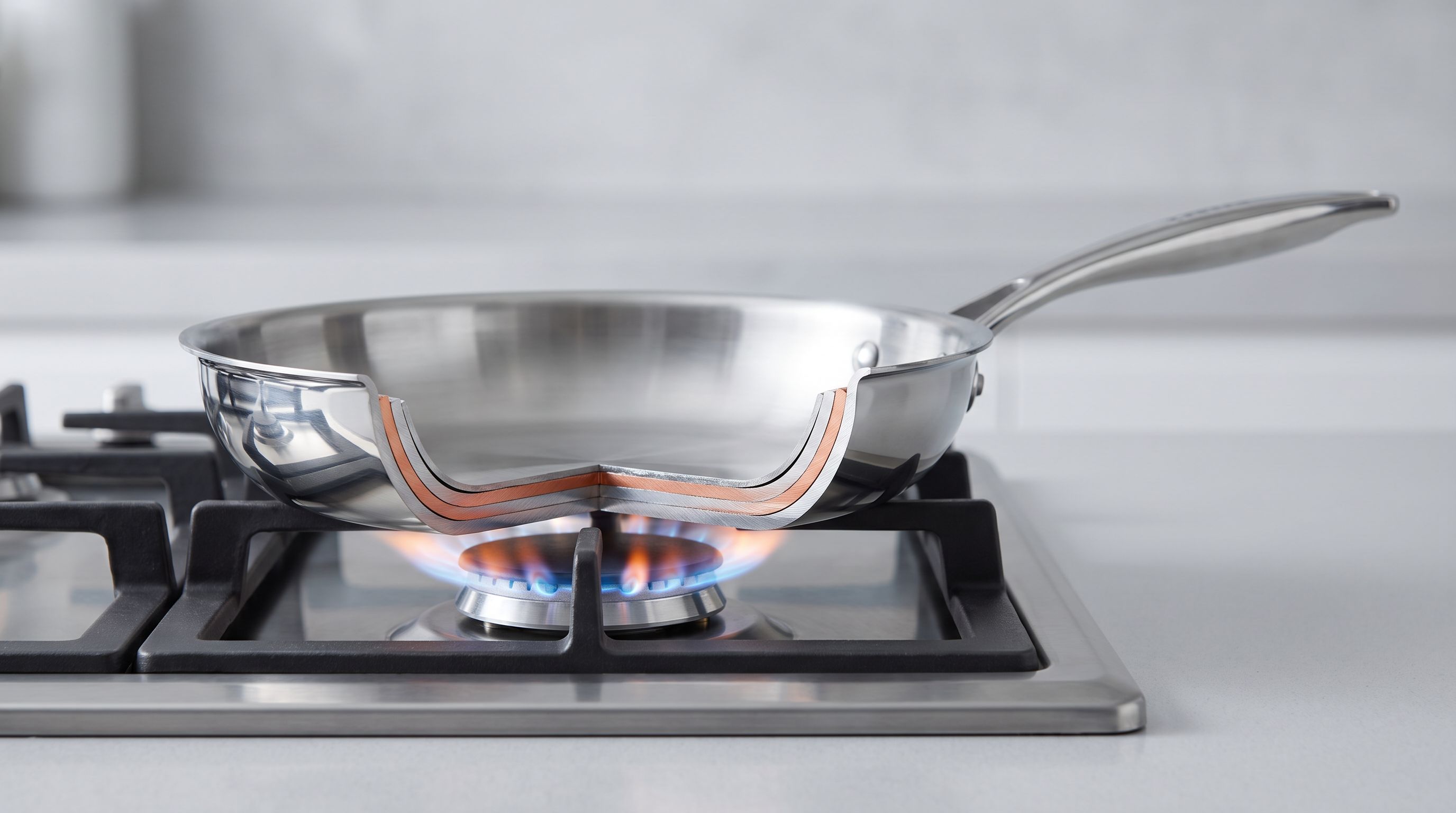
Stainless cookware is sold on cross-sections. Brands show you an exploded diagram of layers, put a copper band around the rim, and let you assume more layers equals better food. That's not how it works. What actually matters is how much conductive metal is in the pan, where it sits, and how thick the whole thing is.
Here's what the core layer does, what it doesn't do, and which tier is worth paying for depending on what's under your pans.
What the core layer is actually doing
Stainless steel is a terrible conductor of heat — roughly 1/20th as conductive as copper. On its own it produces hot rings over the burner and cold edges. So clad cookware sandwiches a conductive metal between stainless skins: the inside layer for food safety and easy cleaning, the outside layer so it's durable and (if magnetic) induction-compatible.
Two things come out of that core:
Heat spreading (evenness). The core moves energy sideways from the burner flame or element toward the rim. More conductive metal, more spreading. A thick aluminum core does this very well; copper does it better per millimeter.
Thermal mass (stability). Thicker metal holds more energy, so the pan's temperature drops less when you drop in cold chicken thighs. Aluminum is lighter per unit of heat capacity than steel; copper is heavy and holds a lot.
Here's the part marketing skips: copper's advantage is per-millimeter, and the copper layers in "copper core" pans are thin. In a typical 5-ply copper core pan, the copper sits in the middle of a stack that also includes aluminum. You're not buying a copper pan. You're buying a clad aluminum pan with a conductive booster in the middle, which is why these pans respond fast but don't behave like a 2.5mm French copper saucier.
Copper core vs 5-ply aluminum: the real-world difference
All-Clad's own lineup is the cleanest comparison because the two products are built in the same factory to the same standards. Copper Core is 5-ply with copper in the middle. D5 is 5-ply with aluminum layers separated by an extra stainless layer. Reviewers and owners who've used both converge on the same conclusion: Copper Core heats and cools faster; D5 heats slightly more evenly and is more forgiving.
That's it. That's the whole difference, and it's smaller than the price gap suggests.
Independent test write-ups make the tradeoff concrete: Copper Core pans heat so quickly that cooks making caramel have to swirl more aggressively to avoid scorching. That's a feature if you're reducing a pan sauce, holding a hollandaise, or pulling sugar — you get near-instant response when you turn the burner down. It's a liability if you tend to walk away, or if you cook a lot of low-and-slow braises where you'd rather the pan ignore small burner changes.
The honest framing: copper core buys responsiveness, not better food. If your technique is reactive — you adjust the flame constantly, you cook by sound and sight — you'll feel it. If you set a dial and cook, you won't.
Where 3-ply still wins
Most home cooks over-buy here. A good tri-ply pan like All-Clad D3 has a single thick aluminum core between two stainless layers. It's lighter than either 5-ply line, heats faster than D5 (less steel to warm up), and costs meaningfully less. For searing, sautéing, pan sauces, and boiling, a quality 3-ply pan does 90% of what 5-ply does.
5-ply's real argument is sidewall heating on larger pieces — tall stockpots and rondeaus where you want the walls, not just the base, to participate — and a bit more stability under a heavy load of cold food. In a 10-inch skillet, that argument is weak. In a 6-quart sauté pan or a Dutch oven, it's stronger.
Cooktop matters more than core
This is the part most guides bury.
Gas. The flame heats a ring, not the whole base. Spreading matters most here, so a conductive core earns its keep. Copper core's responsiveness pairs well with gas's instant flame adjustment — turn the knob down and the pan actually follows.
Electric coil and radiant/ceramic. These elements are slow and cycle on and off. A responsive pan can't outrun a slow burner. Thermal mass helps here: you want a pan that rides through the element's on/off cycling. 5-ply aluminum or a thick-based 3-ply is the smarter buy; copper core's speed is largely wasted.
Induction. The magnetic outer layer is heated directly across most of the base, so evenness is already good before the core does anything. Induction is also fast and precise on its own. What you want is a thick, flat base with no warping — which is why Demeyere Atlantis, with its very heavy induction-optimized base, outperforms thinner clad pans on induction even though it isn't marketed as copper core. Check that any pan you buy is explicitly induction-compatible; some all-copper and some aluminum-exterior pans are not.
Comparison
| 3-ply (D3-style) | 5-ply aluminum (D5-style) | 5-ply copper core | |
|---|---|---|---|
| Core | One thick aluminum layer | Two aluminum layers + stainless divider | Copper between aluminum layers |
| Heat-up speed | Fast | Slowest of the three | Fastest |
| Response to burner changes | Good | Damped, forgiving | Immediate — can overshoot |
| Evenness | Very good | Best | Very good |
| Weight | Lightest | Heavy | Heavy |
| Best cooktop | Any | Electric, radiant | Gas, induction |
| Oven limit | Typically 600°F | Typically 600°F | Typically 600°F |
| Typical use case | Everything | Braises, big pots, hands-off cooks | Sauces, sugar work, reactive cooks |
| Value | Highest | Moderate | Lowest per dollar |
What to buy in 2026
If you cook on gas and chase precision: All-Clad Copper Core 5-Ply 12-Inch Fry Pan is the clearest expression of the format — fast, oven-safe to 600°F, induction-compatible, and the signature copper band makes it easy to spot in a cabinet. Buy it as a single piece, not a set. The responsiveness matters in a skillet and a saucier; it's irrelevant in a stockpot.
 Best overall copper core · All-Clad Copper Core 5-Ply 12-Inch Fry Pan — Check price on Amazon →
If you want one set to cover everything: All-Clad D5 Stainless 5-Ply 10-Piece Cookware Set is the forgiving choice, especially on electric or radiant ranges where its thermal mass smooths out element cycling.
If you want the best ratio of performance to money: All-Clad D3 Stainless 3-Ply 10-Piece Cookware Set. Genuinely hard to argue against. Lighter to handle, easier to afford, and the performance delta against 5-ply is smaller than the price delta.
 Best value tri-ply · All-Clad D3 Stainless 3-Ply 10-Piece Cookware Set — Check price on Amazon →
If you want 5-ply without the premium name: Made In Stainless Clad 5-Ply 12-Inch Frying Pan delivers the same layer architecture with a long stay-cool handle, at a lower price point.
If you're on induction and want the last word: Demeyere Atlantis 5-Ply 11-Inch Proline Skillet. Thick, flat, heavy, and built for exactly that heat source. Its Silvinox-treated exterior resists the dull gray haze stainless picks up over years of dishwashing.
 Premium induction pick · Demeyere Atlantis 5-Ply 11-Inch Proline Skillet — Check price on Amazon →
The honest verdict
Copper core is real engineering, not a gimmick — but it's a refinement, not a transformation. The jump from a thin, cheap stainless pan to any decent clad pan is enormous. The jump from 3-ply to 5-ply is modest. The jump from 5-ply aluminum to 5-ply copper core is a change in character, not a change in quality.
Spend the difference on a bigger pan, a carbon steel skillet, or an instant-read thermometer. Those will improve your cooking more than two millimeters of copper.
FAQ
Is copper core cookware worth the extra money over D5? Only if you cook reactively on gas or induction — sauces, reductions, caramel, delicate proteins — where instant response is useful. For general cooking, most people won't notice the difference in daily use.
Does more plies mean better cookware? No. Total core thickness and the conductivity of that core matter more than layer count. A thick 3-ply pan can outperform a thin 5-ply one. Layer count is a marketing-friendly number, not a performance spec.
Is copper core cookware induction-compatible? Yes, when the outermost layer is magnetic stainless — which is the case for All-Clad Copper Core and most modern 5-ply lines. Pure copper pans and copper-exterior pans generally are not. Always check the listing.
Can I put these pans in the dishwasher? Many copper core lines are not dishwasher-recommended, because detergent dulls and can pit the exposed copper band. Hand wash those. Fully stainless-clad pans tolerate the dishwasher better but will still lose some shine.
What's the oven temperature limit? Bonded stainless lines commonly rate to around 600°F (315°C). Lids, especially glass ones, are often rated lower — check them separately.
Will the copper band tarnish? Yes, and it's cosmetic. A quick pass with a copper polish or a salt-and-vinegar paste brings it back. It has no effect on performance.
Our picks
All-Clad Copper Core Stainless Steel 12" Fry Pan, Made in the USA
The reference copper core pan: fastest response of the clad pans, oven-safe to 600°F, induction-ready.

All-Clad D5® Stainless Steel 10-Piece Cooking Set, Made in the USA
Five alternating layers trade a little speed for steadier, more forgiving heat across the pan.
All-Clad D3® Stainless Steel Cookware Set, 10-Piece, Made in the USA
The honest baseline: lighter, faster-reacting and cheaper than either 5-ply line for most cooking.
Made In Stainless Clad 5-Ply 12-Inch Frying Pan
Five-layer bonded construction with a long stay-cool handle at a friendlier price than All-Clad.
Demeyere Proline 7, 11 Inch Fry Pan, Helper Handle, 7 Ply Made in Belgium
Very thick base engineered for induction, with silvinox-treated steel that stays bright over years.
Get the best kitchen gear deals in your inbox
Join the PrepDeck newsletter for hand-picked kitchen gear deals and new buying guides. No spam, unsubscribe anytime.
Related reads
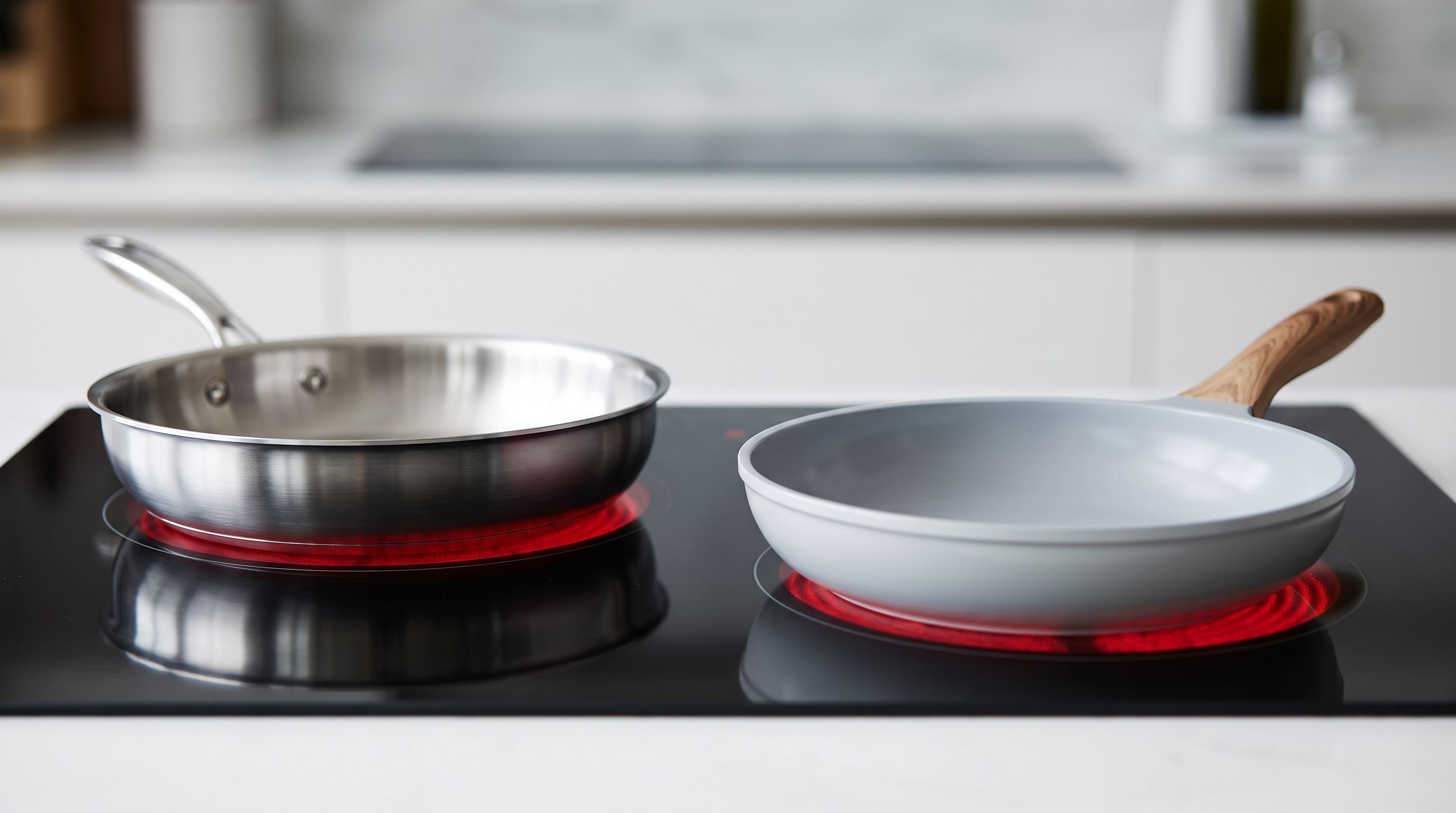
Glass Top Stove Cookware in 2026: 5 Picks That Won't Scratch
The best cookware for a glass top stove in 2026, ranked by base flatness, weight, and scratch risk — plus which pans to keep off a smooth-top range entirely.
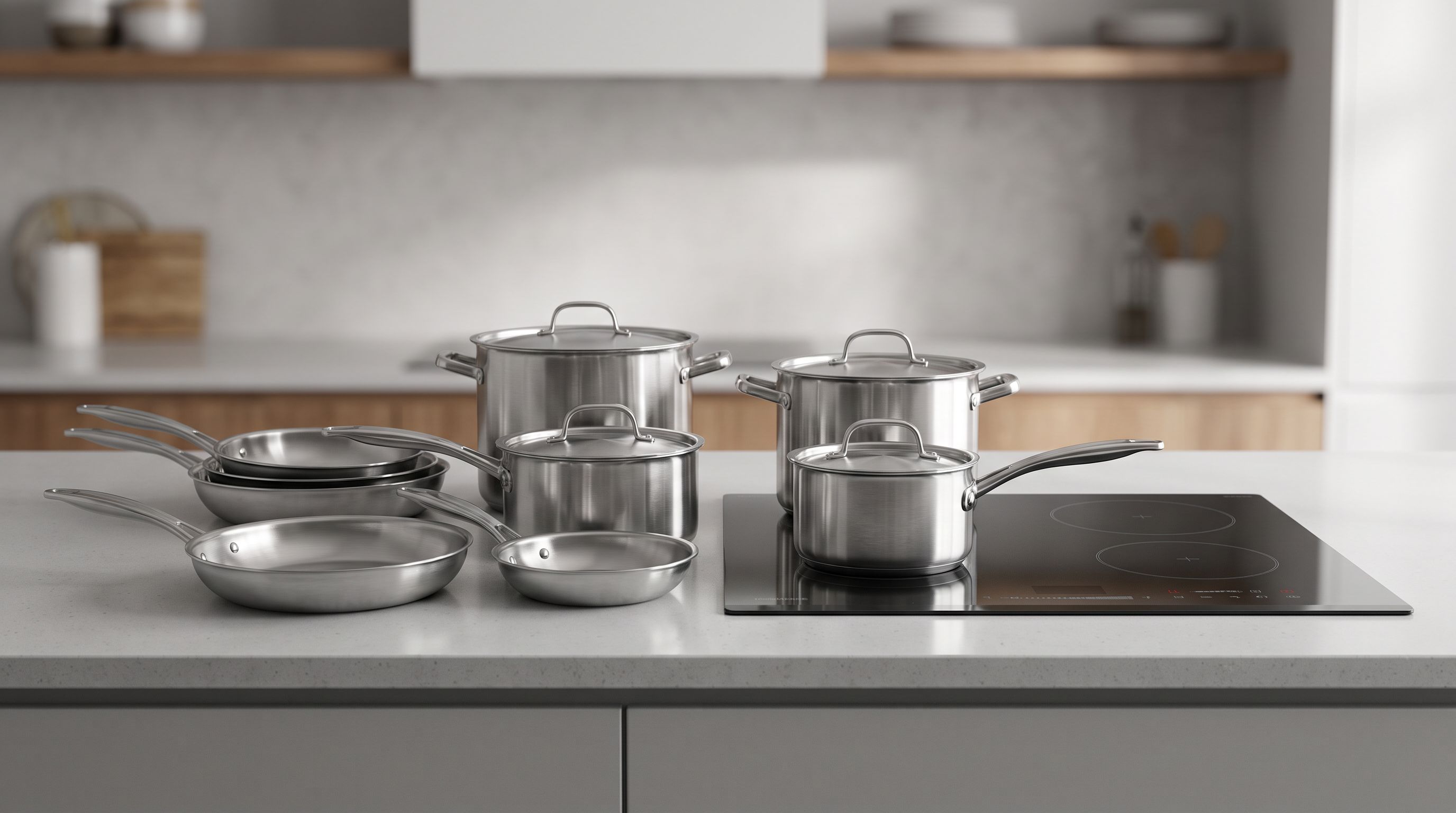
Stainless Cookware Sets 2026: Stop Paying for Lids
The best stainless steel cookware set 2026 picks compared on real usable piece count, handle comfort, oven limits and induction compatibility — not lid math.
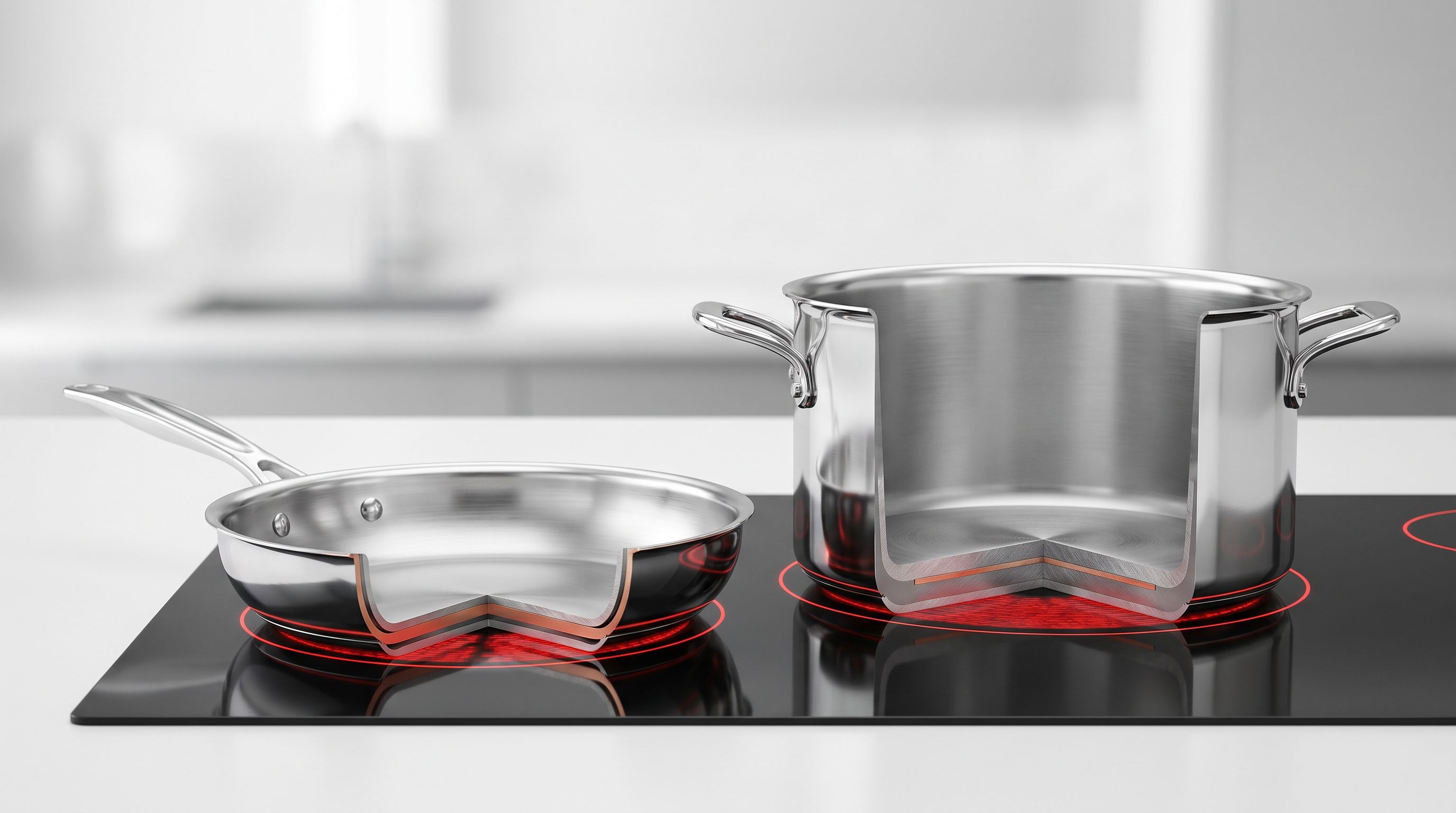
Tri-Ply vs Disc Bottom Cookware: Which Survives a Decade?
Tri-ply vs disc bottom cookware, explained: how clad and impact-bonded bases differ on warping, induction response, and 10-year durability — plus 2026 picks.