Bread Proofing Boxes in 2026: 4 Picks by Counter Space
The best bread proofing box for home bakers in 2026, plus bannetons, bench scrapers and couches — sorted by batch size, counter footprint and real baking use.
Reader-supported: we may earn a commission from links on this page, at no extra cost to you. It never affects our picks. Learn more.
Dough doesn't care how much you spent. It cares about temperature, humidity, and whether you can get it out of the bowl without deflating it. That's the whole case for proofing gear: a box that holds 78°F instead of "somewhere between 65 and 84, depending on the weather," a basket that wicks moisture off the skin so the loaf doesn't glue itself in, and a scraper that does in one pass what your hands do badly in four.
We compared the proofing boxes, bannetons, scrapers and couches home bakers are actually buying in 2026 — using manufacturer specs, independent reviews, and owner feedback over long ownership windows — and sorted them by the two constraints that matter most in a home kitchen: how much dough you make at once, and how much counter you're willing to give up.
Do you actually need a proofing box?
Honest answer: no, if you bake one loaf a week in a warm apartment and don't mind variable timing. An oven with the light on, a cooler with a mug of hot water, or the top of the fridge will all get dough to rise.
A proofer earns its keep when you want repeatability. Fermentation rate roughly doubles for every 15–17°F increase, which is why the same recipe takes four hours in August and seven in January. Holding a stable 78–82°F means your bulk ferment lands at the same time every bake, and your sourdough starter stops going dormant in a cold kitchen. If you bake weekly, keep a starter alive year-round, or make yogurt and tempeh too, that consistency is the product.
Skip it if: you bake rarely, you have zero spare storage, or you already retard everything overnight in the fridge and don't care about daytime timing.
Picking by counter footprint
Small kitchens, 1–2 loaves
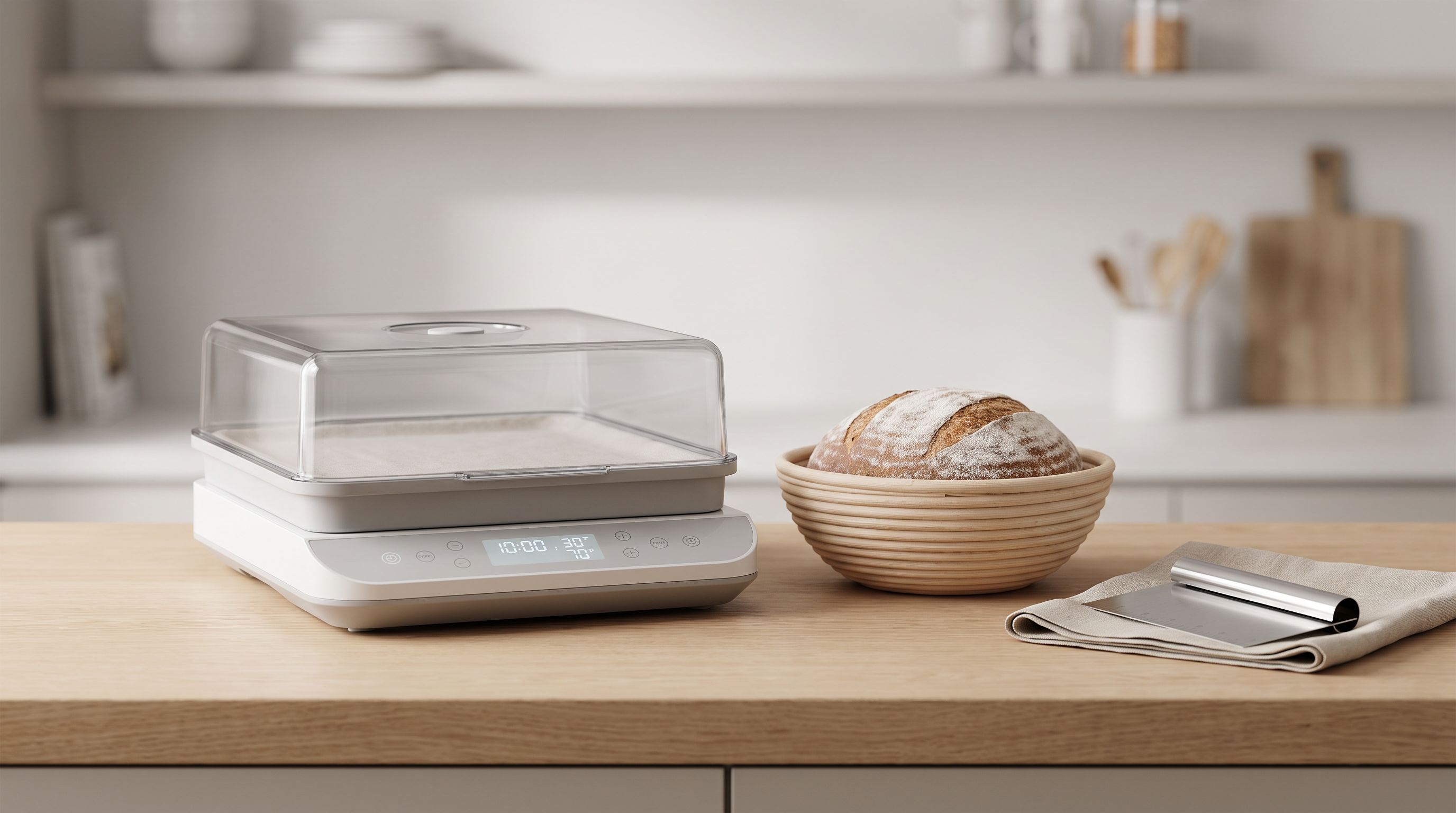
The Brod & Taylor Folding Proofer & Slow Cooker remains the default recommendation for a reason that has nothing to do with brand loyalty: it collapses. Folded, it's slim enough to slide behind a stand mixer or into a cabinet, and it unfolds into a chamber big enough for two standard loaf pans or a large dough bucket. It runs on a water tray for humidity, holds a wide low-temperature range, and in reviews and owner reports it's consistently praised for tight temperature stability — the key reason bakers trust it for yogurt and chocolate tempering as well as dough.
 Best overall · Brod & Taylor Folding Proofer & Slow Cooker — Check price on Amazon →
It's also the only proofer in common home use that genuinely doubles as a slow cooker with the included rack and pot accessory, which matters if counter space is the binding constraint.
Medium batches, 2–4 loaves
If you bulk-ferment in a 6-quart Cambro and shape three or four loaves at a time, you want internal height more than you want folding. Rigid, zip-panel proofing boxes — the foldable fabric-and-frame kits that proliferated in 2025–2026 with multi-level temperature settings and silicone mats — give you more usable volume per dollar. The tradeoff is real: most use simple stepped heat levels rather than thermostatic control to a set temperature, so they drift more. Several owners end up parking a cheap probe thermometer inside and treating the settings as approximations. That's fine for bread, less fine for yogurt.
Big-batch and holiday baking
Beyond four loaves, you're better off building a proofer than buying one: a 48-quart cooler with a seedling heat mat and an inkbird-style temperature controller gives you enormous capacity for less than a mid-tier box, and it stores nested in the garage. It's ugly. It works.
Bannetons: rattan, pulp, or lined?
A banneton's job is to support a shaped loaf while it does its final proof and to pull a little surface moisture out so the crust sets and scoring goes clean.
- Rattan (cane) is the classic. The coiled spiral leaves those signature rings, breathes well, and seasons over time into a near-nonstick surface. It needs dry storage or it mildews.
- Wood pulp bannetons absorb more aggressively and are easier to clean, but give a plain surface and can feel damp-smelling if stored wet.
- Linen liners go in either one. Use the liner for high-hydration or enriched doughs that stick; bake bare rattan when you want the rings.
A Banneton Bread Proofing Basket Set that pairs a 9-inch round with a 10-inch oval covers nearly every home loaf size — roughly 1.5 to 2 lb of dough each. Buy the pair rather than two rounds; batards fit baking stones and Dutch ovens differently, and having both shapes stops you from forcing dough into the wrong form.
Care, briefly: never wash with soap. Knock out flour with a stiff brush, air-dry completely, and store uncovered. If dough sticks, you under-floured — try a 50/50 rice flour and bread flour dust.
Scrapers: buy both kinds
This is the cheapest upgrade in bread baking and the one new bakers skip.
A bench scraper (stiff, steel, straight-edged) divides dough, lifts sticky masses off the counter, does the slap-and-fold turns, and cleans your work surface in one swipe. The OXO Good Grips Stainless Steel Multi-Purpose Scraper & Chopper is the workhorse version — rigid blade, cushioned handle, and etched measurement markings that are genuinely useful when you're splitting dough into even pieces.
A bowl scraper (flexible, curved, plastic) is a different tool entirely. The Ateco 14793 Plastic Bowl Scraper conforms to a round mixing bowl and gets every bit of wet dough out without tearing the gluten network. It costs about as much as a coffee. There is no reason not to own one.
Couches: only if you bake baguettes
A baker's couche is a heavy, untreated flax linen cloth. You pleat it between shaped baguettes, ciabatta or rolls so they hold their form during final proof instead of spreading sideways. The San Francisco Baking Institute Bakers Couche is the reference item — thick enough that the pleats actually stand up, untreated so it absorbs flour and seasons.
Rules: flour it generously, never wash it, brush it out and hang it to dry. A seasoned couche is a good couche. If you only bake boules, you don't need one.
Comparison
| Gear | Best for | Typical capacity | Footprint when stored | Main tradeoff |
|---|---|---|---|---|
| Brod & Taylor Folding Proofer & Slow Cooker | Year-round consistency, 1–2 loaves | 2 loaf pans or a large dough tub | Folds flat, slides into a cabinet | Highest cost; small chamber for big batches |
| Foldable multi-level proofing box kit | 2–4 loaves, budget-conscious | Taller interior, fits a 6 qt tub | Collapses to a fabric panel | Stepped heat levels drift; verify with a thermometer |
| Banneton set, 9" round + 10" oval | Final proof, shaping structure | ~1.5–2 lb dough each | Nests on a shelf | Rattan needs dry storage; no soap |
| OXO Good Grips Scraper & Chopper | Dividing, turning, counter cleanup | n/a | Drawer | Too stiff for bowl work |
| Ateco 14793 Bowl Scraper | Clearing wet dough from bowls | n/a | Drawer | Too flexible for cutting |
| SFBI Bakers Couche | Baguettes, ciabatta, rolls | 3–5 baguettes | Rolls up | Single-purpose; never wash it |
What's not worth the counter space
Heated proofing mats alone. Without an enclosure and a controller, they heat the bottom of a bowl and little else. Pair one with a cooler or skip it.
Proofing baskets with built-in plastic lids. They trap moisture against the skin, which is the opposite of what a banneton should do.
Oversized wooden proofing cabinets sold as furniture. The two-tier wooden boxes circulating in 2026 reviews look handsome and hold a lot, but most lack real thermostatic control and they permanently occupy counter real estate. If you want that capacity, the cooler build is cheaper and stores away.
FAQ
What temperature should I proof bread at? 78–82°F is the standard target for bulk fermentation with commercial yeast or an active sourdough starter. Lower (65–72°F) stretches timing and builds more flavor; above about 86°F you risk over-proofing and off flavors.
Can I use a proofing box for sourdough starter? Yes, and it's one of the best arguments for owning one. A steady 78–80°F keeps a starter predictable and peaking on schedule, which makes timing your bake far easier in winter.
Do I need to season a new banneton? Lightly. Mist the inside, dust heavily with rice flour or a rice-flour blend, and let it dry before the first use. After a few bakes the cane builds a flour patina and releases cleanly.
Rice flour or regular flour for dusting? Rice flour doesn't absorb water and gelatinize the way wheat flour does, so it stays powdery and releases better. A 50/50 blend with bread flour is a good default.
Is a proofing box useful for anything besides bread? The Brod & Taylor unit is regularly used for yogurt, cultured butter, tempeh, koji and chocolate tempering because of its low-temperature precision. Simpler fabric boxes are bread-and-pizza tools, essentially.
How do I proof without any of this gear? Oven off with the light on and a pan of hot water on the bottom rack gets most kitchens into the mid-70s to low-80s. Put a thermometer in there once to learn what your oven actually does — they vary a lot.
Our picks
Brod & Taylor Folding Proofer & Slow Cooker (Proofer w/Accessory Shelf), White
Precise low-temp control, folds to roughly the thickness of a cutting board when stored.

Banneton Bread Proofing Basket Set with Liners,9 Inch Round & 10 Inch Oval Sourdough Baking Kit for Professional & Home Use
Rattan coils give sharp spiral rings; the round and oval pair covers boules and batards.

OXO Good Grips Multi-Purpose Scraper & Chopper
Stiff stainless blade with a comfortable grip and etched measurement marks for portioning.
Ateco 14793 Plastic Bowl Scraper
Flexible curved plastic that hugs the bowl wall and clears wet dough in one sweep.
San Francisco Baking Institute Bakers Couche (Heavy Linen)
Heavy untreated flax linen that holds pleats for baguettes and ciabatta without sticking.
Get the best kitchen gear deals in your inbox
Join the PrepDeck newsletter for hand-picked kitchen gear deals and new buying guides. No spam, unsubscribe anytime.
Related reads
Why 1g Kitchen Scales Fall Short for Bread, Explained
Resolution isn't accuracy. Here's why 1g kitchen scales struggle with salt, yeast and starter in bread baking — and what specs actually matter in 2026.
Half Sheet Pans in 2026: Why Gauge Beats Brand Name
The best half sheet pan comes down to aluminum gauge, rolled rims and oven fit. We compare Nordic Ware, USA Pan, All-Clad and Vollrath for 2026 kitchens.